A groundbreaking fabrication technique developed by a research team at Penn State University has paved the way for the creation of highly adaptable, multifunctional "smart synthetic skin." This innovative material, led by Assistant Professor Hongtao Sun of Industrial and Manufacturing Engineering (IME), can be programmed to perform a diverse array of tasks, ranging from dynamically hiding and revealing information to facilitating adaptive camouflage and supporting the development of sophisticated soft robotic systems. This advancement marks a significant departure from conventional synthetic materials, which are typically engineered for a singular, narrow range of functions.
The core of this breakthrough lies in a novel approach that allows for the creation of a programmable smart skin from hydrogel, a soft and water-rich material. Unlike its traditional counterparts, which possess fixed behaviors, this smart skin is designed for tunable responsiveness. Its visual appearance, mechanical properties, surface texture, and even its capacity for shape alteration can be precisely adjusted when exposed to external stimuli such as variations in temperature, the presence of specific solvents, or mechanical stress. The findings detailing this pioneering research were recently published in the esteemed journal Nature Communications, where the study was also recognized with an Editors’ Highlights designation, underscoring its significance within the scientific community.
Inspiration from the Natural World: Cephalopods as a Blueprint
The conceptual genesis of this advanced synthetic material can be traced back to the remarkable biological adaptations observed in cephalopods, most notably octopuses. These marine invertebrates are renowned for their extraordinary ability to rapidly and dramatically alter both the appearance and texture of their skin. This biological chameleonism serves crucial evolutionary purposes, enabling them to seamlessly blend into their surroundings for predator avoidance or communication with conspecifics.
Hongtao Sun, the principal investigator of the project, articulated the profound influence of these natural systems on the research. "Cephalopods utilize a complex interplay of muscles and nerves to achieve dynamic control over the appearance and texture of their skin," Sun explained. "Drawing inspiration from these remarkably adaptable soft organisms, we set out to develop a 4D-printing system capable of replicating that inherent dynamism within a synthetic, soft material."
Sun, who also holds distinguished affiliations with Penn State’s departments of Biomedical Engineering, Materials Science and Engineering, and the Materials Research Institute, further elaborated on the significance of the "4D printing" designation. This terminology reflects the fact that the printed objects are not static entities. Instead, they are engineered to exhibit active changes and transformations in response to their environmental conditions, a characteristic that distinguishes them from conventional 3D-printed materials.
Halftone-Encoded Printing: Embedding Digital Instructions
The key to achieving this unprecedented level of adaptability lies in a sophisticated fabrication method known as halftone-encoded printing. This technique involves the conversion of digital image or texture data into binary code – a series of ones and zeros. This binary information is then directly embedded within the hydrogel material during the printing process. The underlying principle is analogous to how dot patterns are employed in traditional newspapers and photographic reproductions to construct visual images.
By meticulously encoding these digital patterns into the hydrogel matrix, the researchers gain the ability to precisely program the smart skin’s reaction to various external stimuli. The specific printed patterns dictate how different regions of the material will respond. For instance, certain areas might be programmed to swell or shrink to a greater extent than others, or to soften more readily, when subjected to changes in temperature, immersion in liquids, or the application of mechanical forces. Through the careful and deliberate design of these halftone patterns, the research team can exert fine-grained control over the material’s collective behavior.
"In essence, we are printing instructions directly into the material," Sun clarified. "These embedded instructions serve as a guide, dictating how the skin will react and transform when its surrounding environment changes."
Dynamic Information Display: Hiding and Revealing Images on Demand
One of the most compelling demonstrations of the smart skin’s capabilities is its ability to dynamically conceal and reveal visual information. Haoqing Yang, a doctoral candidate in IME and the lead author of the published paper, highlighted the profound implications of this feature. "This inherent capability underscores the immense potential of the smart skin for a wide range of applications," Yang stated.
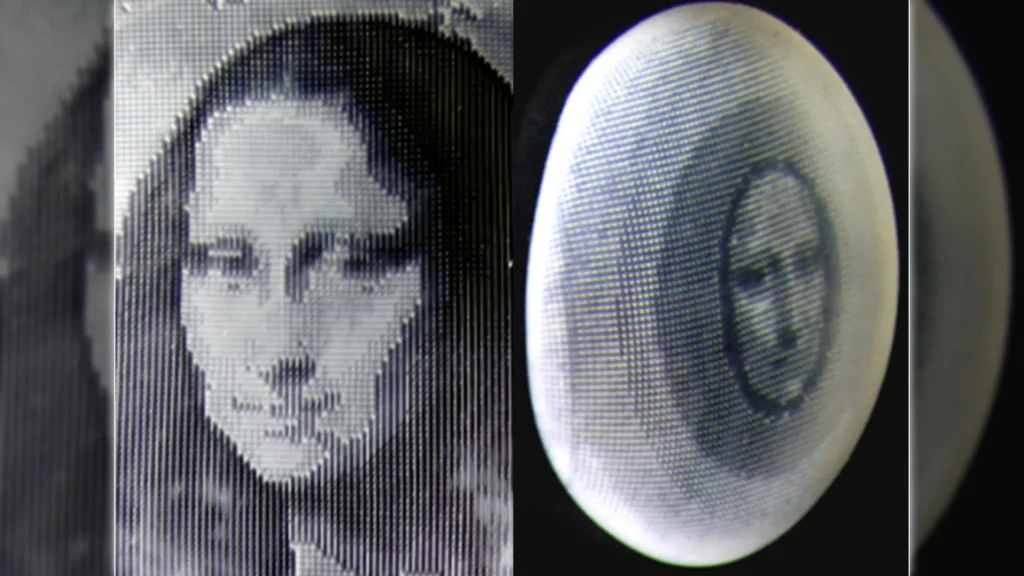
To illustrate this functionality, the research team ingeniously encoded an image of Leonardo da Vinci’s iconic Mona Lisa into a thin film of the smart hydrogel. Initially, when the material was treated with ethanol, it became transparent, rendering the embedded image completely invisible. However, upon subsequent exposure to ice water or gradual warming, the hidden Mona Lisa image gradually reappeared, becoming clearly discernible.
Yang emphasized that the choice of the Mona Lisa was purely illustrative. The flexibility of the printing technique allows for virtually any image to be encoded within the hydrogel, opening up vast possibilities for creative and functional applications.
"This dynamic visual behavior has significant potential for applications in camouflage, where a surface could effectively blend into its surroundings by altering its appearance," Yang explained. "Furthermore, it holds promise for information encryption, enabling messages or sensitive data to be hidden and then selectively revealed only under specific, controlled conditions."
Beyond purely visual revelation, the researchers also demonstrated that concealed patterns could be detected through mechanical interaction. By gently stretching the smart skin and employing digital image correlation analysis to meticulously track its deformation, they were able to reveal the presence of the hidden patterns. This discovery introduces an additional layer of security and interaction, suggesting that information can be accessed not only visually but also through physical manipulation of the material.
Seamless Shape-Shifting Without Multi-Layer Construction
The smart skin exhibits remarkable versatility not only in its visual and informational capabilities but also in its capacity for shape-shifting. According to Sun, the material can readily transform from a simple flat sheet into intricate, bio-inspired three-dimensional shapes, complete with detailed surface textures. A significant advantage of this technology is that, unlike many other shape-changing materials that rely on complex multi-layered structures or the integration of disparate substances, this transformation is achieved within a single, monolithic sheet.
The control over these changes in shape and texture is entirely governed by the digitally printed halftone patterns embedded within the hydrogel. This internal programming allows the material to replicate sophisticated effects reminiscent of those observed in the skin of cephalopods.
Building upon this foundational capability, the team further showcased the material’s potential by demonstrating the simultaneous integration of multiple functionalities. Through the meticulous design of the halftone patterns, they were able to encode the Mona Lisa image into flat films that subsequently transformed into complex three-dimensional forms. As these films gradually curved to adopt dome-like structures, the hidden image subtly emerged. This coordinated transformation elegantly illustrates that changes in shape and visual appearance can be seamlessly orchestrated within a single, unified material.
"Much like how cephalopods masterfully coordinate their body shape and skin patterning, our synthetic smart skin can simultaneously control its visual presentation and its physical deformation, all within a single, flexible material," Sun remarked, underscoring the biomimetic achievement.
Expanding the Horizons of 4D-Printed Hydrogels
This latest research represents a significant expansion upon the team’s earlier work with 4D-printed smart hydrogels, which was also published in Nature Communications. The previous study focused on integrating mechanical properties with programmable transitions from flat to three-dimensional forms. In the current research, the researchers have significantly advanced the approach by leveraging halftone-encoded 4D printing to imbue a single hydrogel film with an even greater array of integrated functions.
Looking towards the future, the researchers’ ambitious goal is to develop a scalable and versatile platform that facilitates the precise digital encoding of multiple, diverse functions within a single, adaptive material. This vision promises to unlock new frontiers in material science and engineering.
"This interdisciplinary research, situated at the confluence of advanced manufacturing, intelligent materials, and mechanics, opens up exciting new avenues with broad implications," Sun projected. "These implications span a wide spectrum, including stimulus-responsive systems, biomimetic engineering, advanced encryption technologies, sophisticated biomedical devices, and beyond."
The collaborative effort behind this significant scientific advancement included several key contributors from Penn State. Co-authors Haotian Li and Juchen Zhang, both doctoral candidates in IME, and Tengxiao Liu, a lecturer in Biomedical Engineering, played integral roles in the project. Furthermore, H. Jerry Qi, a professor of Mechanical Engineering at the Georgia Institute of Technology, also contributed his expertise as a collaborator. This multidisciplinary approach was crucial in bringing this complex and innovative technology to fruition.
Broader Impact and Future Trajectories
The implications of this breakthrough are far-reaching and extend across numerous scientific and industrial sectors. The ability to program materials with dynamic, multi-functional capabilities has long been a pursuit in materials science. By drawing inspiration from nature’s elegant solutions, the Penn State team has not only achieved this goal but has also introduced a method that is potentially scalable and adaptable.
In the realm of defense and security, adaptive camouflage could be revolutionized. Imagine military vehicles or personnel whose surfaces can instantaneously alter their color and texture to match the surrounding environment, rendering them virtually invisible to detection. Similarly, in the field of secure communication, information could be embedded within everyday objects, accessible only to authorized individuals or under specific environmental conditions, thereby creating an entirely new paradigm for data encryption.
The potential for soft robotics is equally compelling. Current soft robots often rely on complex pneumatic or hydraulic systems to achieve movement and shape change. This smart skin, however, offers a pathway to creating more integrated, autonomous soft robotic systems where the material itself is inherently responsive and capable of complex deformations. This could lead to the development of more dexterous and adaptable robotic hands, more lifelike prosthetics, or even novel forms of medical devices capable of navigating intricate biological pathways.
The biomedical field stands to benefit significantly as well. Smart materials that can change shape or release therapeutic agents in response to specific biological cues hold immense promise for targeted drug delivery, minimally invasive surgery, and the development of advanced tissue engineering scaffolds. The biocompatibility of hydrogels further enhances their potential for these sensitive applications.
However, the path from laboratory breakthrough to widespread adoption often involves significant challenges. Scaling up the halftone-encoded printing process to industrial levels while maintaining precision and cost-effectiveness will be a critical next step. Furthermore, understanding the long-term stability and durability of these smart hydrogels under various operational conditions will be essential for their practical implementation.
Despite these challenges, the research from Penn State represents a significant leap forward. It demonstrates a powerful new paradigm for material design, one that moves beyond static functionality towards dynamic, programmable, and intelligent materials. As Sun and his team continue to refine their techniques and explore new applications, the future of synthetic materials appears to be one of unprecedented adaptability and intelligence, mirroring the complexity and ingenuity of the natural world.