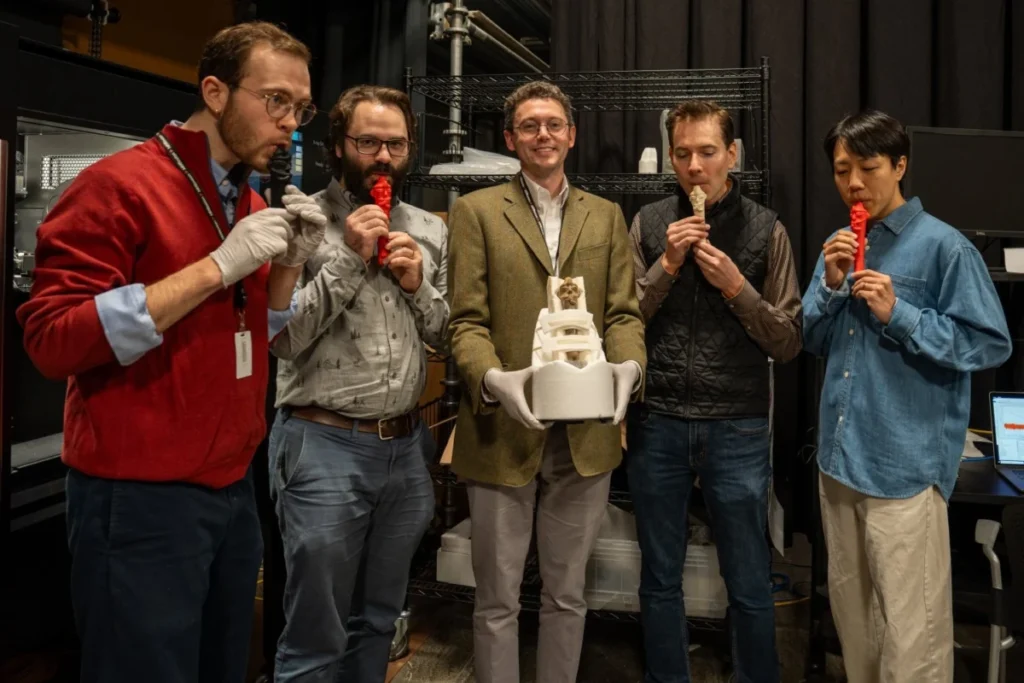
What if the silent echoes of ancient melodies could once again resonate through our modern world? What if the intricate craftsmanship and sonic soul of long-lost instruments could be not only accurately studied but also experienced firsthand? This ambitious vision is rapidly becoming a reality through a groundbreaking collaborative research project at the Massachusetts Institute of Technology (MIT), partnering with the esteemed Museum of Fine Arts, Boston (MFA). This initiative endeavors to breathe new life into historical musical instruments by creating playable, accurate replicas, bridging the gap between past and present through cutting-edge technology and interdisciplinary expertise.
The Genesis of a Sonic Renaissance
The spark for this ambitious undertaking ignited in late 2024 when Benjamin Sabatini, a senior postdoctoral researcher at MIT, reached out to Professor Eran Egozy. Sabatini’s inquiry was direct: could a method be developed to produce accurate, playable, and audible replicas of ancient and historical musical instruments? This question initiated a cross-departmental collaboration between MIT’s Center for Materials Research in Archeology and Ethnology (CMRAE) and the School of Humanities, Arts, and Social Sciences (SHASS). The project’s core objective: to leverage advanced imaging and characterization techniques to meticulously study instruments housed at the Museum of Fine Arts, Boston (MFA), and subsequently, to construct faithful reproductions.
Soon after, Sabatini found himself collaborating with Mark Rau, a newly appointed MIT professor specializing in music technology and electrical engineering. Their shared passion for the intersection of sound, technology, and history quickly materialized into a concrete proposal. The duo reached out to Jared Katz, the Pappalardo Curator of Musical Instruments at the MFA. Katz, whose own research centers on ancient musical practices, possessed a technique for 3D scanning and printing playable replicas, a dream he had long nurtured. His primary aspiration was to gain access to CT scanning technology, which would allow for a deeper understanding of the internal construction of ancient instruments. The MFA, with its rich and extensive collection, proved to be an ideal partner. Established in 1917, the MFA’s musical instrument collection boasts over 1,450 instruments from six continents, with some dating back as far as approximately 1550 BCE. Katz articulated a common sentiment among museum curators and enthusiasts alike: "my biggest qualm is often there are no accompanying audio examples. I want to hear these instruments; I want to play these instruments." This desire to move beyond passive observation and engage with the sonic dimension of these artifacts became a driving force for the project.
A Multidisciplinary Approach to Preservation and Experience
The initiative secured funding from the MIT Human Insight Collaborative (MITHIC), a testament to its innovative potential and the collaborative spirit it fostered. The core team, a dynamic ensemble of five, now meets regularly at the MFA. This group includes Nate Steele, a program associate in the MFA’s Department of Musical Instruments, and Jin Woo Lee, an MIT postdoc. Their work involves a comprehensive process of scanning and acoustically measuring the instruments, employing state-of-the-art technology to unlock their secrets.
Central to their methodology is a high-resolution CT scanner provided by Lumafield, a company founded by MIT alumni. This advanced equipment allows the team to capture both the external dimensions and the intricate internal structures of the instruments with unparalleled detail. These precise measurements, when combined with non-destructive vibration analysis, acoustic testing, and sophisticated numerical simulations, form the basis for digitally recreating the instruments’ original sound. Professor Rau elaborated on the meticulous process: "For example, if we’re trying to recreate a violin, we can use an impact hammer – a very small hammer with a transducer in it – so we’re imparting a known force signal into the instrument, and then measure the resulting [surface] vibrations with a laser Doppler vibrometer." This method allows for a detailed understanding of how each instrument responded to excitation, providing crucial data for acoustic replication.
From Digital Reconstruction to Physical Embodiment
The digital models generated from the CT scans and acoustic analyses serve as blueprints for physical replicas. The team utilizes 3D printing technology to create copies of the instruments, which are then employed to generate plaster mold negatives. These molds are subsequently used to cast the replicas, often employing materials like slip for ceramic instruments. A prime example of this process was demonstrated with a Paracas whistle, a ceramic artifact from Peru dating between 600 and 175 BCE. This whistle, showcasing intricate facial details and internal geometry, was successfully replicated and presented at the MITHIC Annual Event in November, where its playable nature was showcased. For wooden instruments, the team plans to collaborate with local luthiers, utilizing old-growth wood to ensure authenticity in both material and sound.
Benjamin Sabatini, a key figure from CMRAE, highlights the profound humanistic implications of this project. From a materials and archaeological perspective, the research aims to delve into the cultures that produced these instruments. "From our perspective, we want to understand the people who made these instruments through both the materials that they’re made of, but also the sound that they have," Sabatini explained. This approach emphasizes that an instrument is not merely an object but a conduit to understanding the societal, technological, and artistic context of its creation.
Under Sabatini’s guidance, a dedicated team of Undergraduate Research Opportunities Program (UROP) students, including Irene Dong and Mouhammad Seck, have been instrumental in reproducing several ancient and historical clay instruments within the CMRAE archaeology lab. The Paracas whistle, a centerpiece of their efforts, garnered significant attention at the MITHIC event. To date, the team has meticulously scanned approximately 30 instruments from the MFA’s extensive collection. Their ambitious goal is to document at least 100 instruments over the project’s duration, creating a comprehensive digital archive that will support future scholarly research. These scans are not merely static records; they are dynamic datasets used to reconstruct the instruments, both in physical form and within sophisticated software environments, ensuring that their sonic characteristics are as faithfully rendered as their visual appearance.
Preserving the Past, Amplifying its Voice
Jared Katz emphasizes the dual nature of these historical artifacts: "They’re both visually beautiful and striking objects, but they are meant to be heard." His vision for the project extends beyond academic curiosity, aiming to provide a practical solution for preserving these invaluable cultural treasures. "My hope for this research is to provide us with a way to protect the original instrument while still allowing them to be heard and experienced in the way they were intended to be experienced," Katz stated. This dual objective of preservation and accessibility is central to the project’s long-term impact.
The potential for community engagement and broader outreach through these playable replicas is also a significant aspect of the project, as outlined in its proposal. Katz further elaborated on the transformative power of interdisciplinary collaboration: "[It] shows how powerful it can be when art and science come together to create new understandings and to help us reactivate these instruments in exciting ways." This sentiment underscores the project’s capacity to foster a deeper appreciation for history and culture among the public.
Inspiring the Next Generation of Innovators
The project has also proven to be a powerful catalyst for engaging undergraduate students in cutting-edge research. Victoria Pham, a second-year undergraduate in materials science and engineering, is working with Sabatini as a UROP student. Her fascination with history drew her to the project: "I love history. I love wandering through the halls of the MFA and immersing myself in the descriptions of paintings and artifacts. I find learning about ancient peoples to be fascinating, especially in how their legacy affects us today." Pham’s current work involves using finite element modeling to non-destructively investigate the acoustics of a Veracruz poly-glabular flute, an artifact dating from 500-900 CE. She finds the work deeply rewarding, noting, "My work is fulfilling because I was able to learn new software and problem-solve to improve my model, which was very satisfying." Pham believes that contributing to the emerging field of music technology is intellectually stimulating and hopes her involvement will inspire others to explore archaeology, material science, or music technology.
Alexander Mazurenko, a second-year undergraduate pursuing a double major in music and mathematics, has also made significant contributions to the project. Having begun last summer and continuing through the Independent Activities Period, Mazurenko sees his involvement as a crucial step in his interdisciplinary education at MIT. "The opportunity to participate in this UROP with Professor Rau was the perfect chance to begin to work in the intersection of my passions," he commented. Both Mazurenko’s and Pham’s research findings are slated for presentation at upcoming academic conferences, with the expectation of leading to the publication of scholarly papers under the guidance of Sabatini and Rau.
Broader Implications and Future Horizons
The success of this initiative promises to have far-reaching implications beyond the academic realm. By meticulously documenting and recreating historical instruments, the project contributes significantly to the field of organology – the study of musical instruments. It offers a new paradigm for how museums can engage with their collections, moving beyond static displays to interactive and experiential encounters. The data generated will be invaluable for ethnomusicologists, historians, archaeologists, and instrument makers alike.
The technological advancements developed within this project, particularly in non-destructive imaging and acoustic modeling, have the potential to be applied to the preservation and study of other historical artifacts, including ceramics, architecture, and even biological specimens. The collaborative model itself, bringing together expertise from materials science, engineering, humanities, and the arts, serves as a blueprint for addressing complex challenges in other interdisciplinary fields.
As the project progresses, the team aims to expand its scope, potentially collaborating with other institutions and collections worldwide. The ultimate goal is to create a publicly accessible digital archive of these sonic reconstructions, allowing anyone, anywhere, to explore the rich auditory heritage of humanity. This endeavor is not merely about recreating old sounds; it is about forging new connections to our past, fostering a deeper understanding of human ingenuity, and ensuring that the voices of history continue to resonate for generations to come. The fusion of scientific rigor with artistic passion is creating a unique symphony of innovation, proving that the echoes of ancient instruments can indeed find their voice in the 21st century.