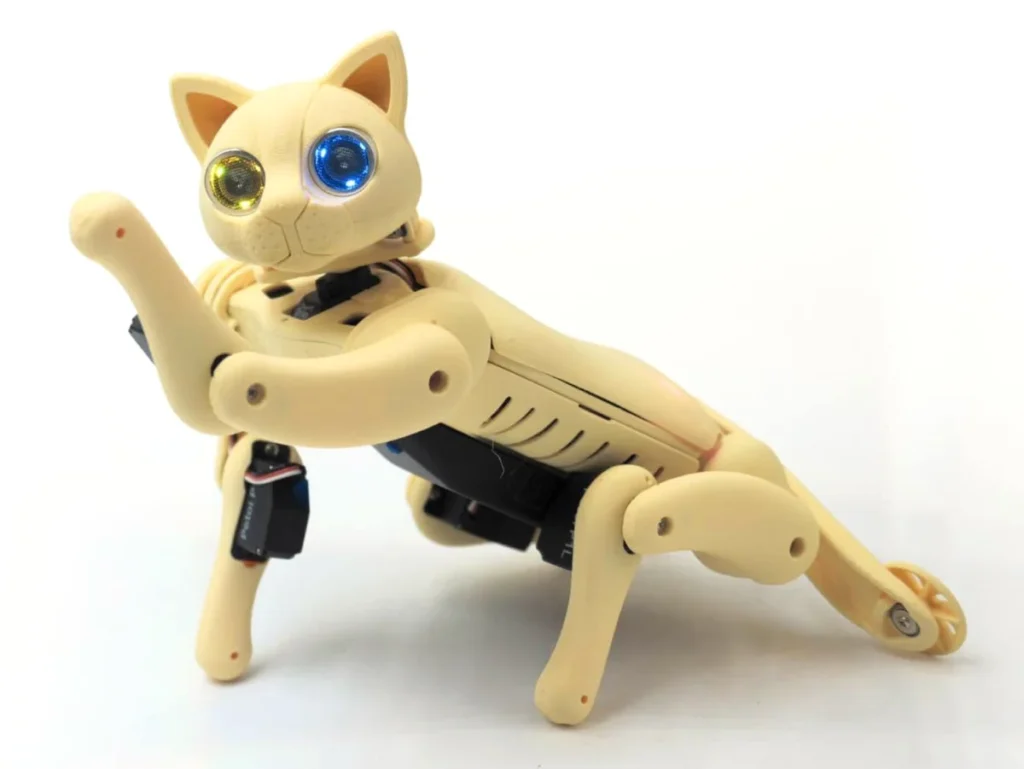
Petoi, a prominent innovator in the field of educational and hobbyist robotics, has once again captured the attention of enthusiasts and educators with its latest offerings: the Nybble Q robotic cat and the Bittle X V2 robotic dog. These advanced quadruped robots are designed not merely as impressive toys but as comprehensive platforms for deep exploration into programming, engineering, and artificial intelligence. Priced at $435 for the Nybble Q and $469 for the Bittle X V2 with its optional arm, these units represent a significant investment in personal and classroom-based STEM education, offering a blend of sophisticated mechanics, versatile programmability, and a robust support ecosystem. The review, originally featured in Make: Vol 94, highlights the compelling features and educational potential of these highly customizable robot pets, positioning them as ideal starting points for anyone eager to delve into the complex world of robotics.
The Evolving Landscape of Educational Robotics
The global push for STEM (Science, Technology, Engineering, and Mathematics) education has dramatically increased the demand for engaging and effective learning tools. Robotics, in particular, offers a unique interdisciplinary approach, combining aspects of mechanical design, electronics, computer science, and even artificial intelligence. This surge has fueled the growth of the educational robotics market, projected to reach billions of dollars in the coming years, driven by both institutional adoption and individual hobbyist interest. Companies like Petoi are at the forefront of this movement, aiming to democratize access to advanced robotic concepts that were once exclusive to university labs or industrial settings.
Petoi’s journey began with a vision to create open-source, programmable quadruped robots that are both powerful and accessible. Their initial models, Nybble and Bittle, gained significant traction through crowdfunding campaigns, demonstrating a strong community appetite for miniature, agile robots that could be customized and programmed. These early iterations laid the groundwork for the more refined and feature-rich Nybble Q and Bittle X V2, which incorporate lessons learned from user feedback and technological advancements. The design philosophy centers on providing a solid hardware foundation, while leaving ample room for users to experiment with software and additional modules, fostering a true maker spirit. By offering kits that allow users to assemble their robots (though pre-assembled units are also available), Petoi encourages a deeper understanding of the internal workings, moving beyond mere consumer product interaction to genuine engineering engagement.

Nybble Q: A Graceful and Intelligent Feline Companion
The Petoi Nybble Q, styled as a sleek robotic cat, stands out as a sophisticated marvel of miniature engineering. Its palm-sized form factor belies a complex internal architecture packed with servos, sensors, and an upgraded control board. For many, the Nybble Q serves as an immediate conversation starter and an impressive demonstration piece, capable of executing a range of pre-programmed movements and responding to voice commands straight out of the box. The initial experience of discovering these built-in behaviors is described as highly engaging, quickly captivating observers, including seasoned educators looking for innovative classroom tools.
Beyond its immediate appeal as a dynamic display, the Nybble Q offers profound educational depth. It supports multiple programming paradigms, catering to a wide spectrum of users from beginners to advanced coders. Mobile and desktop applications provide intuitive interfaces for block-based coding, such as Mind+, which is excellent for introducing foundational programming concepts without the complexities of syntax. For those ready to delve deeper, support for Arduino and Python opens up avenues for more sophisticated control, custom algorithms, and integration with external systems. This multi-level programming accessibility ensures that users can grow with the robot, continually expanding their skills.
The hardware enhancements in the Nybble Q significantly improve upon its wooden predecessor. The new 3D-printed body not only gives it a more polished and durable aesthetic but also provides a more robust chassis for its internal components. The upgraded BiBoard V1.0, the robot’s central nervous system, coupled with superior servos, translates into smoother, more precise movements and greater responsiveness. A key addition is the voice control capability, allowing for natural language interaction, which, despite occasional humorous misinterpretations ("coffee table" becoming "be table"), proves remarkably accurate for command execution, often negating the need for the micro:bit-powered remote.
Sensor integration further elevates Nybble Q’s capabilities. It features distance sensors, crucial for autonomous navigation and obstacle avoidance, allowing the robot to interact with its environment in a more intelligent manner. The color-changing eyes serve as intuitive indicators, signaling different states or responses, adding a layer of personality and feedback. The onboard Inertial Measurement Unit (IMU) is a critical component for dynamic stability, enabling the Nybble Q to detect its orientation and attempt to self-right after a fall. While the self-righting mechanism performs admirably, especially on uneven surfaces, it can take a few seconds to find balance on smoother terrains, a minor but realistic detail reflecting the challenges of quadruped robotics.

One of the most powerful features introduced is servo feedback control, which allows users to manually manipulate the robot’s limbs to design custom actions and gaits. This hands-on approach to motion design is invaluable for understanding biomechanics and robotic kinematics. Furthermore, the Nybble Q is designed for expandability, notably through integration with a Raspberry Pi. By sharing the cognitive load between the BiBoard V1.0 and a more powerful single-board computer like the Raspberry Pi, users can implement advanced artificial intelligence and computer vision tasks, pushing the boundaries of what the robot can achieve. This modularity transforms the Nybble Q from a programmable pet into a versatile research and development platform.
Petoi also provides a comprehensive curriculum, guiding users through various projects and concepts. This structured learning pathway is complemented by an active and supportive online community. This community acts as an invaluable resource, offering troubleshooting advice, sharing innovative projects, and filling in gaps in hardware documentation, thereby fostering collaborative learning and problem-solving.
Bittle X V2: A Robust and Adaptable Canine Platform
The Petoi Bittle X V2 robotic dog offers a distinct set of features and capabilities, building upon the basic Bittle model with significant upgrades. Like the Nybble Q, the Bittle X V2 incorporates built-in voice control and an upgraded ESP32-based board, providing enhanced processing power and connectivity. While it foregoes the ultrasonic eyes found on the Nybble Q, the Bittle X V2 emphasizes modularity and expandability through its mouth-based sensor slots. Users can easily add light, motion, and gesture sensors, allowing the robot to detect environmental changes, movements, or specific human gestures, opening up diverse interactive possibilities. The option to integrate an AI camera module further enhances its capabilities, enabling tasks like object recognition, facial detection, and more complex computer vision applications, transforming it into a truly "smart" pet.
The most distinctive and priciest configuration of the Bittle X V2 includes a robot arm that replaces the traditional head. This arm, while altering the robot’s aesthetic, introduces a new dimension of interaction: manipulation. With unlockable macros, the Bittle X V2 can be programmed to pick up and toss small toys, demonstrating surprising strength for its size. This feature is particularly appealing for those interested in tasks requiring physical interaction with objects, such as miniature automation or complex play scenarios. However, the review notes a preference for the "nimbleness and expandability of Bittle with a head," suggesting that while the arm is powerful, it might trade off some of the versatility offered by the head-mounted sensors and the traditional canine appearance.

Both the Nybble Q and Bittle X V2 embody Petoi’s philosophy of providing "intermediate projects" rather than consumer-grade, foolproof toys. They are designed for individuals who enjoy hands-on learning and are comfortable with a certain degree of tinkering. This means that while circuit boards are pre-assembled, users are not locked out of modifying or extending the hardware. For instance, adding a Grove sensor might require disassembling certain parts. The review mentions a situation where a servo connector on the Nybble Q needed repositioning, a task that was fast and tool-free but exposed a delicate ribbon cable. This transparency in design encourages users to understand the internal mechanics and electronics, fostering a deeper connection with the technology.
For those who prefer a more traditional robotic dog experience without the manipulation arm, a Bittle X V2 kit is available without the arm, still offering a solid platform for exploration. The choice between Nybble Q and Bittle X V2 ultimately depends on specific interests: Nybble Q’s eyes provide a sleek solution for distance sensing and autonomous roaming, while Bittle X V2 offers greater durability and the unique option of a robotic arm for interaction. Regardless of the choice, either Petoi quadruped serves as an excellent entry point into the advanced world of robotics, providing a rich blend of pre-built functionality and extensive customization potential.
Educational Impact and Future Implications
The Petoi Nybble Q and Bittle X V2 are more than just advanced robotic kits; they are catalysts for STEM education and innovation. By providing sophisticated quadruped robotics in an accessible package, Petoi is democratizing access to technologies that are typically found in high-level research. These robots empower students, hobbyists, and educators to engage with complex topics like kinematics, control systems, artificial intelligence, and embedded programming in a tangible and exciting way. The hands-on nature of these platforms fosters critical thinking, problem-solving skills, and creativity, preparing individuals for future careers in technology and engineering.
The open-source nature of Petoi’s platforms is a significant advantage. It allows for continuous development and innovation driven by a global community of users. This collaborative environment ensures that the robots remain relevant and adaptable, with new projects, code examples, and hardware integrations constantly emerging. This model contrasts sharply with closed-source consumer products, where functionality is limited to the manufacturer’s offerings. The ability to add compute power with Raspberry Pi further extends their lifespan and potential, allowing them to evolve with advancements in AI and computing.

In a broader context, the rise of accessible, programmable robots like those from Petoi reflects a growing trend towards personalized learning and maker culture. These tools enable individuals to move beyond passive consumption of technology to active creation and modification. They bridge the gap between theoretical knowledge and practical application, making abstract concepts concrete and engaging. As robotics continues to integrate into various aspects of daily life, platforms like Petoi’s will play a crucial role in cultivating a generation of innovators who are not just users of technology, but its designers and architects.
The commitment to providing comprehensive curriculum and fostering an active online community underscores Petoi’s dedication to genuine educational outcomes. These resources mitigate the potential frustration that can arise from complex technical projects, ensuring that users, regardless of their prior experience, have the support needed to succeed and grow. Ultimately, the Petoi Nybble Q and Bittle X V2 represent a significant step forward in making advanced robotics approachable, engaging, and profoundly educational, shaping the future of STEM learning one programmable pet at a time.