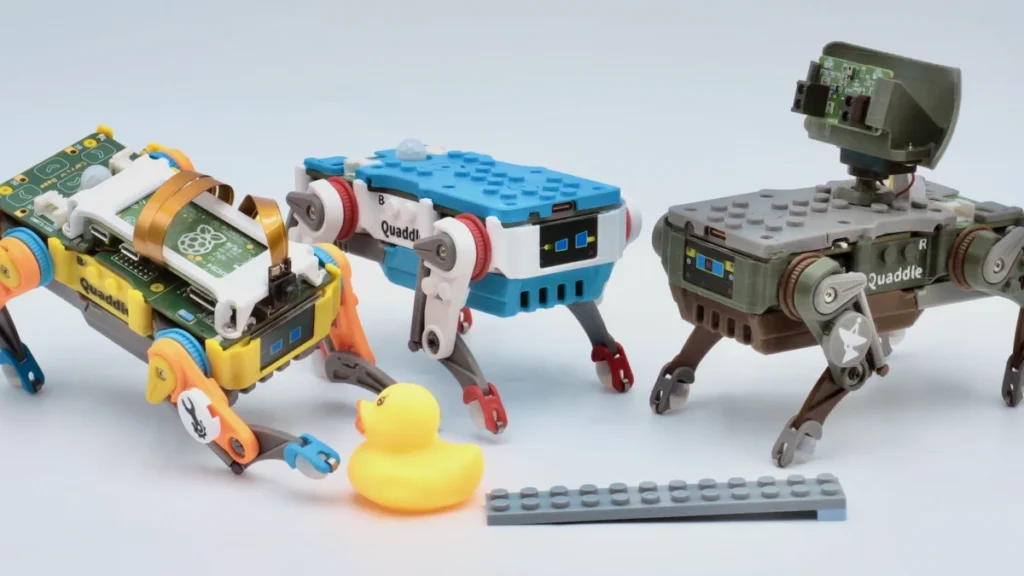
The landscape of consumer robotics is witnessing a significant shift toward accessibility and sophisticated mechanical design with the introduction of Quaddle, the latest innovation from Petoi. Known for bridging the gap between high-end industrial robotics and the hobbyist maker community, Petoi has officially unveiled its newest quadrupedal robot, designed to be both more affordable and more technologically integrated than its predecessors. This launch represents a pivotal moment for the company, which first gained international attention with the plywood-framed Nybble cat and later the palm-sized Bittle dog. Quaddle arrives as a refined successor, aiming to democratize the field of walking robotics through a combination of simplified hardware and enhanced software capabilities.
The Genesis and Evolution of Petoi Robotics
To understand the significance of Quaddle, one must look at the trajectory of Petoi since its inception. Founded by Dr. Rongzhong Li, a former physics professor with a passion for biomimetic robotics, Petoi began as an open-source project named OpenCat. The project’s first commercial success, Nybble, was a laser-cut wooden robot that proved quadrupedal movement could be achieved without the multi-thousand-dollar price tags associated with industrial units like Boston Dynamics’ Spot.
Following Nybble, Petoi introduced Bittle, a plastic-injection-molded robot dog that offered greater durability and a more polished aesthetic. While these models were highly praised for their educational value, they required a certain level of technical proficiency to assemble and calibrate. Quaddle has been developed specifically to lower these barriers to entry. By refining the mechanical complexity and integrating sensors directly into the unit’s structure, Petoi is positioning Quaddle as an entry-level gateway for students, educators, and technology enthusiasts who may have previously found the field of robotics too daunting or expensive.
Engineering Innovation: The Single-Servo Leg Mechanism
The most striking technical advancement in Quaddle is its approach to locomotion. Traditional quadrupedal robots typically utilize at least two servos per leg—one for the shoulder (hip) movement and one for the knee—to achieve a natural gait. However, servos are often the most expensive and fragile components of a small-scale robot. In a bold engineering move, Dr. Rongzhong Li and his team spent two years redesigning the leg architecture to function with only one servo per limb.

This reduction in component count was not merely a cost-saving measure; it was a challenge in mechanical engineering. To compensate for the loss of a second active motor, Petoi developed a sophisticated leg mechanism that utilizes a combination of springs and clever linkage geometry. This "clever mechanics" approach allows Quaddle to perform complex maneuvers, including walking, turning, and even executing backflips, while maintaining a lower center of gravity and reducing the overall weight of the robot.
The development process for these components was uniquely intensive. Dr. Li reportedly lived at the servo manufacturing facility for two years to oversee the co-development of the robot’s frame and its motors. This close collaboration ensured that the servos were optimized for the specific stresses of the new leg design, resulting in a machine that is more durable and resilient to the impacts of jumping and falling.
Product Versions and Design Enhancements
Quaddle is being launched in three distinct versions to cater to different user needs:
- The Builder: Aimed at the DIY community, this version comes as a kit, allowing users to understand the mechanical assembly and electronic wiring from the ground up.
- The Buddy: A pre-assembled version designed for those who want to focus on programming and interaction immediately out of the box.
- The Scout: A more advanced configuration equipped with additional sensors and capabilities for autonomous navigation and complex environmental interaction.
One of the most visible changes from previous models is the replacement of the stylized plastic "face" with an integrated OLED screen. This screen serves a dual purpose: it provides a digital "face" capable of displaying a wide range of nuanced expressions, giving the robot a more interactive and "alive" personality, and it acts as a diagnostic interface. The OLED can display real-time data such as battery levels, sensor readings, and system status, allowing users to troubleshoot issues without needing to connect the robot to a computer.
Furthermore, the sensor suite has undergone a major overhaul. In previous iterations, sensors like ultrasonic distance modules were often mounted on external, bone-shaped circuit boards. In Quaddle, these sensors are integrated directly into the body of the robot. This streamlined design reduces the risk of wire snags and improves the robot’s aesthetic profile, making it look less like a prototype and more like a finished consumer product.

The OpenCat Ecosystem and Software Versatility
Despite the hardware changes, Quaddle remains firmly rooted in the OpenCat ecosystem. It is powered by the same open-source framework that drives Nybble and Bittle, ensuring compatibility with a vast library of community-created behaviors and codes. The robot is built on a programmable platform—typically utilizing ESP32 or Arduino-compatible microcontrollers—which allows users to code in C++, Python, or through block-based programming interfaces.
New features introduced with Quaddle include the ability to record motions and calibrate servos directly on the device. Historically, calibrating a robot’s gait required a tethered connection to a PC and manual adjustment of software parameters. Quaddle simplifies this process, allowing for on-the-fly adjustments that make the robot more adaptable to different surfaces and environments. Additionally, the robot features built-in object-tracking behaviors and a new "sliding" trick, showcasing the versatility of its single-servo leg design.
For those who wish to experiment with the robot before purchasing, Petoi has launched an online simulator. This virtual environment allows users to test the physics and programming logic of Quaddle in a digital space, further lowering the barrier to entry for prospective roboticists.
STEM Education and the Broader Impact
The release of Quaddle is expected to have a significant impact on the STEM (Science, Technology, Engineering, and Mathematics) education market. Quadrupedal robotics is often considered the "gold standard" for teaching advanced concepts like kinematics, center of mass, and control loops. However, the high cost of entry has often limited these lessons to university-level laboratories.
By bringing the price point down and simplifying the assembly process, Petoi is making it possible for middle and high schools to incorporate walking robots into their curricula. The open-source nature of the project encourages students to go beyond mere assembly, inviting them to modify the code, 3D print new attachments, and contribute to a global community of makers.

Industry analysts suggest that the move toward single-servo-per-leg designs could signal a new trend in the toy and hobbyist robot sectors. As components become more integrated and mechanical designs more efficient, the line between "high-tech" and "affordable" continues to blur. Quaddle represents a shift toward "smart minimalism," where sophisticated software compensates for simplified hardware to create a product that is greater than the sum of its parts.
Market Response and Availability
The launch of Quaddle is being facilitated through a Kickstarter campaign, a strategy Petoi has successfully used for its previous models to gauge market interest and secure initial production funding. The campaign has already garnered significant attention from the global maker community, reflecting a continued appetite for programmable, biomimetic robots.
In addition to its digital launch, Petoi is showcasing Quaddle at major industry events. The robot will be a featured attraction at Maker Faire Bay Area, providing the public with the first opportunity to see the units in action. Following the Bay Area event, Quaddle will also be presented at Maker Faire Shenzhen, underscoring Petoi’s international reach and its roots in the heart of the world’s hardware manufacturing hub.
Conclusion and Future Outlook
Petoi Quaddle stands as a testament to the power of iterative design and community-driven development. By addressing the pain points of previous models—namely cost, complexity, and fragility—Dr. Rongzhong Li and his team have created a platform that is as educational as it is entertaining.
As the field of robotics continues to evolve, the lessons learned from Quaddle’s development—such as the importance of mechanical efficiency and the value of integrated diagnostics—will likely influence future generations of consumer electronics. For now, Quaddle offers a unique opportunity for anyone, regardless of their technical background, to own, program, and explore the future of walking robotics. Whether used as a classroom tool or a high-tech desk companion, Quaddle is poised to become a staple of the modern maker movement, proving that advanced robotics can indeed be for everyone.