Unveiling the Universe’s Infancy: The Quark-Gluon Plasma
Before the emergence of stars, planets, atoms, or any of the familiar forms of matter we observe today, the Universe existed in an extraordinarily hot and dense state. This epoch, lasting for merely the first millionth of a second after the Big Bang, was dominated by a exotic substance known as quark-gluon plasma (QGP). In this extreme environment, the fundamental building blocks of matter – quarks and gluons – moved freely, unbound by the forces that would later confine them into protons and neutrons. Understanding this primordial soup is crucial for piecing together the cosmic evolutionary narrative, from its genesis to the formation of complex structures.
For decades, physicists have endeavored to replicate these extreme conditions in laboratories, with the ultimate goal of observing and characterizing QGP. The European Organization for Nuclear Research (CERN) in Switzerland stands at the forefront of this quest, utilizing its colossal particle accelerators, such as the Large Hadron Collider (LHC), to smash atomic nuclei together at nearly the speed of light. These high-energy collisions generate fleeting droplets of QGP, allowing researchers to study its properties before it rapidly expands and cools, transitioning into ordinary matter. The international ALICE (A Large Ion Collider Experiment) collaboration, a global consortium of scientists, has been central to these investigations.
A Microscopic "Little Big Bang" Achieved with Lighter Nuclei
A significant milestone in this endeavor has now been achieved by researchers from the Niels Bohr Institute at the University of Copenhagen, working within the ALICE collaboration. Traditionally, the scientific consensus held that the production of quark-gluon plasma necessitated collisions between very heavy atomic nuclei, such as lead. The immense energy required to create and sustain QGP was thought to be only achievable by slamming together these massive particles. However, the new experiments have dramatically revised this understanding.
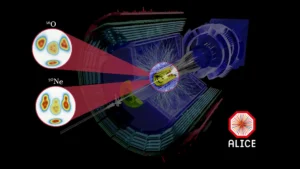
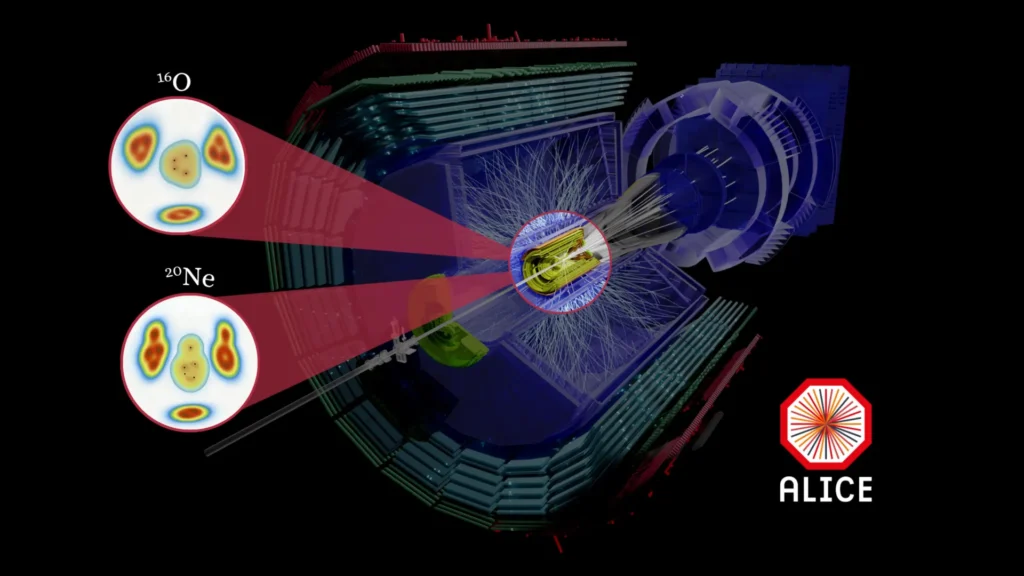
In a series of meticulously conducted trials, the team successfully generated quark-gluon plasma by colliding much smaller nuclei: oxygen-16 and neon-20. This revelation challenges long-held assumptions about the minimum energy and particle size required for QGP formation. "We have pushed the boundary for how small the atomic nuclei can be while still recreating this primordial matter – what you could call a Little Big Bang," stated Associate Professor You Zhou, who spearheaded the experiment during his tenure at the Niels Bohr Institute. "We now know more about the fundamental conditions required for matter to transition into this extreme state."
This breakthrough, published in the esteemed journal Physical Review Letters, signifies a crucial advancement in our ability to probe the early Universe. Zhou emphasized the broader implications: "Hopefully, this will help us better understand how the plasma behaved during the first moments of the Universe – and how it later evolved into the forms of matter that everything around us is made of." The ability to create QGP with lighter nuclei opens up new avenues for experimentation, potentially allowing for more precise and varied studies of this elusive state of matter.
The Genesis of Matter: A Brief Chronology
To appreciate the significance of recreating quark-gluon plasma, it is essential to recall the Universe’s initial timeline:
- Big Bang (t=0): The Universe begins from an infinitely dense and hot state.
- Planck Epoch (t < 10^-43 seconds): All four fundamental forces (gravity, electromagnetism, strong, weak) are unified. Current physics theories break down.
- Grand Unification Epoch (10^-43 to 10^-36 seconds): Gravity separates; the strong, weak, and electromagnetic forces remain unified.
- Electroweak Epoch (10^-36 to 10^-12 seconds): The strong force separates. The Universe is a hot, dense plasma of fundamental particles including quarks, leptons, and their antiparticles.
- Quark Epoch (10^-12 to 10^-6 seconds): The electroweak force separates, forming distinct electromagnetic and weak forces. The Universe is filled with quark-gluon plasma – a "soup" of free quarks and gluons. This is the state recreated at CERN.
- Hadron Epoch (10^-6 to 1 second): As the Universe cools, quarks and gluons combine to form hadrons, primarily protons and neutrons.
- Lepton Epoch (1 second to 3 minutes): Hadrons and anti-hadrons annihilate, leaving a small surplus of hadrons. Leptons (electrons, neutrinos) and anti-leptons dominate the mass of the Universe.
- Nucleosynthesis (3 to 20 minutes): Protons and neutrons fuse to form the first light atomic nuclei: hydrogen, helium, and trace amounts of lithium.
- Recombination (380,000 years): The Universe cools sufficiently for electrons to combine with atomic nuclei, forming neutral atoms. This makes the Universe transparent, releasing the Cosmic Microwave Background (CMB).
- Dark Ages (380,000 to ~150 million years): The Universe is filled with neutral hydrogen and helium, no stars yet.
- Reionization (~150 million to 1 billion years): The first stars and quasars form, emitting ultraviolet radiation that reionizes the neutral gas.
- Formation of Galaxies and Stars (billions of years): Gravity amplifies density fluctuations, leading to the formation of galaxies, stars, and planets.
The recreation of QGP with smaller nuclei allows physicists to examine the critical transition from the Quark Epoch to the Hadron Epoch with unprecedented detail, offering a window into the conditions that governed the formation of all baryonic matter.
A "Bowling Pin Signature" for Nuclear Geometry
One of the most intriguing aspects of this research lies in the method of observing the unobservable. Quark-gluon plasma itself exists for an infinitesimally brief period – a mere fraction of a second – before expanding and converting into other particles. Scientists cannot directly witness the plasma. Instead, they meticulously measure the trajectories and properties of the particles that emerge immediately after the QGP’s demise, inferring the plasma’s characteristics from these post-collision remnants.
The new results reveal that these emergent particle patterns are not random but preserve crucial information about the original geometric shape of the colliding nuclei. This phenomenon provides a novel spectroscopic tool for nuclear physics. For instance, collisions between two oxygen nuclei, which are relatively spherical, generate a distinct, more rounded pattern of emergent particles. In contrast, collisions involving neon nuclei, which possess a more elongated, almost "bowling-pin-like" shape, produce a recognizably different, elongated pattern.
"The particles from the primordial matter are directly governed by the geometric shape of the atomic nucleus. If the two nuclei we smash together are spherical, we get one pattern. If they are shaped like bowling pins, we get another," explained Postdoctoral Researcher Emil Gorm Dahlbæk Nielsen from the Niels Bohr Institute, a co-author of the study. He further elaborated on this indirect observation technique: "By studying how the particles move after the collision, we can gain insights into atomic nuclei that are otherwise difficult for physicists to obtain. It is a bit like shining light on an object and seeing its shadow. You cannot see the object directly, but its shadow reveals its shape. In the same way, the movement of the particles reveals the geometric shape of the atomic nuclei that was present at the beginning of the collision."
The Enduring Quest for Nuclear Structure and the Strong Force
The ability to infer nuclear shapes from high-energy collisions represents a significant leap in nuclear physics. The study of atomic nuclear structure has a rich history, particularly at the Niels Bohr Institute. Aage Bohr, son of the renowned physicist Niels Bohr, was awarded the Nobel Prize in Physics in 1975, alongside Ben Mottelson and James Rainwater, for their pioneering work on the collective model of the atomic nucleus, which describes nuclei as having dynamic shapes and rotational-vibrational modes. For over 70 years, physicists have strived to understand the intricate arrangements of protons and neutrons within the nucleus, as this internal architecture dictates a nucleus’s stability, decay modes, and interactions.
The shape of a nucleus is far more than a mere geometric curiosity; it provides critical clues about the fundamental forces at play within matter, particularly the strong nuclear force. This is one of nature’s four fundamental forces, responsible for binding quarks together to form protons and neutrons, and subsequently holding these protons and neutrons together within the atomic nucleus, overcoming the electromagnetic repulsion between positively charged protons. Despite its immense strength, the strong force remains the least understood of the fundamental forces, presenting a formidable challenge to theoretical physicists.
Traditionally, physicists have investigated nuclear structure using relatively low-energy experiments. These methods typically involve gently probing nuclei, observing their rotational and vibrational spectra, or scattering other particles off them to infer their internal configurations. The new approach from the ALICE collaboration completely reverses this strategy. Instead of gentle probing, researchers subject nuclei to the most extreme conditions imaginable – colliding them at the highest energies achievable – and then meticulously reconstruct their shapes from the patterns imprinted on the emergent particles.
"A precise understanding of nuclear structure helps us understand the strong force. But instead of carefully investigating nuclei at low energies, we smash them together at the highest energies we can create and can now read their shape from the imprint they leave behind," You Zhou remarked. The researchers believe this technique holds the potential to instigate a "paradigm shift" in nuclear structure studies. If further refined and developed, this method could provide an entirely new and powerful means to investigate atomic nuclei whose internal structures are currently poorly understood or inaccessible through conventional techniques.
Broader Impact and Future Directions
The implications of this research extend across both cosmology and fundamental physics. For cosmology, the ability to generate QGP with smaller nuclei offers a more versatile "mini-Universe" for studying the conditions and dynamics of the early cosmos. It allows for a deeper understanding of the crucial transition phase where free quarks and gluons condensed into protons and neutrons, ultimately forming the baryonic matter that constitutes everything around us. This insight is vital for validating and refining cosmological models of the Big Bang.
For nuclear physics, the new method of inferring nuclear shapes from high-energy collisions provides an unprecedented tool. It offers a complementary approach to traditional low-energy nuclear spectroscopy, potentially revealing new aspects of nuclear deformation, cluster structures, and the behavior of the strong force in different nuclear environments. The ability to characterize the strong force more precisely could lead to a more complete Standard Model of particle physics, or even hint at physics beyond it.
Looking ahead, the research team is eager to push the boundaries even further. A primary objective is to determine the exact minimum size of a collision system capable of producing quark-gluon plasma. To this end, they plan to conduct additional experiments using even lighter atomic nuclei, such as helium-4. Such studies will help delineate the fundamental conditions necessary for QGP formation, shedding light on the critical threshold at which ordinary matter transitions into this exotic primordial state.
"What is fascinating is that we can use the same experiment both to learn about the structure of atomic nuclei and to gain a better understanding of what happened during the birth of the Universe," You Zhou concluded. "These two things turn out to be much more closely connected than one might initially think." This profound interconnectedness between the microscopic realm of atomic nuclei and the macroscopic expanse of the cosmos underscores the transformative potential of this research, promising new discoveries at the very frontiers of human knowledge.