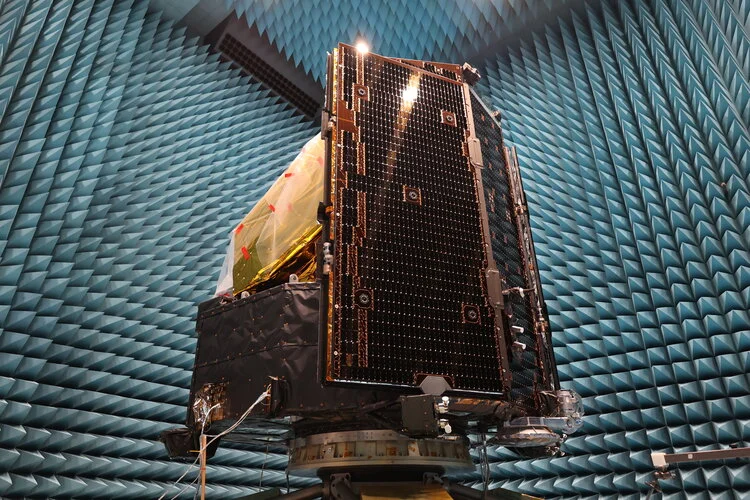
The European Space Agency’s (ESA) ambitious planet-hunting mission, Plato, has successfully completed a series of critical electromagnetic compatibility (EMC) tests within the specialized Maxwell Test Chamber at ESA’s ESTEC facility in the Netherlands. This significant milestone signifies that the spacecraft’s intricate electronic systems are now verified to operate harmoniously in the demanding environment of space, free from detrimental interference. The successful completion of these tests marks the final major hurdle for Plato before its scheduled launch.
The Maxwell Test Chamber, a marvel of engineering designed to replicate the conditions of space with unparalleled precision, provided the ideal setting for these rigorous evaluations. The chamber itself is a testament to the lengths ESA goes to ensure mission success. Its interior is a meticulously engineered Faraday cage, constructed with conducting metal walls, floor, and ceiling. This shielding is paramount, designed to completely block any external electromagnetic interference from penetrating the sensitive electronics of the spacecraft. Furthermore, the chamber’s 9-meter height is lined from floor to ceiling with thousands of specially designed foam spikes. These spikes are not merely decorative; they are acoustically engineered to absorb electrical signals and sound waves, effectively simulating the vacuum and acoustic silence of space, where there is no medium for sound to travel and electromagnetic radiation behaves differently.
During the testing phase, engineers remotely powered up and commanded Plato’s electronic equipment. The objective was to meticulously assess the intricate interplay between its numerous instruments and modules. The primary concern during such tests is to identify and eliminate any potential for "crosstalk"—unwanted electromagnetic interference between different components that could disrupt their functionality, corrupt data, or even lead to equipment failure. In the vacuum of space, where heat dissipation and signal propagation differ significantly from terrestrial conditions, electronic behavior can be unpredictable. Without thorough EMC testing, such unforeseen consequences could jeopardize the mission’s scientific objectives or, in the worst-case scenario, lead to catastrophic damage to the spacecraft itself. The successful outcome of these tests provides a strong assurance that Plato’s sophisticated systems are robust and reliable.
A String of Successful Trials Leading to Launch Readiness
The EMC testing is the culmination of a comprehensive series of environmental assessments that Plato has undergone. These trials are designed to progressively "graduate" the spacecraft, ensuring it is fully prepared for the rigors of launch and the harsh realities of its operational environment in deep space.
The initial phase of these critical examinations commenced in January of this year with a series of vibration and acoustic tests. These tests simulate the extreme forces and noise levels experienced during a rocket launch. Plato was subjected to intense shaking and sound waves to confirm that its structural integrity and the secure mounting of its components could withstand these violent conditions. Following these dynamic tests, Plato embarked on a month-long residency within the Large Space Simulator (LSS). The LSS is another key testing facility at ESTEC, capable of recreating the vacuum and temperature extremes of space. Here, Plato was exposed to simulated solar radiation and thermal cycles, demonstrating its ability to endure the challenging thermal environment and vacuum of its future orbit. The successful completion of these LSS tests further solidified confidence in Plato’s resilience.
Plato’s Mission: Unveiling the Secrets of Exoplanets
Plato, an acronym for PLAnetary Transits and Oscillations of stars, is ESA’s next-generation space observatory dedicated to the discovery and study of exoplanets. Its primary scientific goal is to find and characterize rocky, Earth-sized planets orbiting within the habitable zones of their host stars, particularly those around Sun-like stars. The mission aims to build a catalog of such planets, with a focus on understanding their diversity and the conditions that might lead to the formation and evolution of life. Plato will employ the transit method, observing the slight dimming of a star’s light as a planet passes in front of it, to detect these distant worlds. Its sophisticated instruments will then be used to measure the size, mass, and atmospheric properties of these exoplanets, providing crucial data for comparative planetology and the search for habitable environments beyond our solar system.
The mission’s scientific payload includes a suite of highly sensitive cameras designed to observe thousands of stars with unprecedented precision. By monitoring these stars over extended periods, Plato will be able to detect the subtle periodic dips in brightness indicative of transiting exoplanets. Furthermore, the mission will also perform asteroseismology, studying the internal structure and evolution of stars by analyzing their oscillations, which can provide vital context for understanding the exoplanets orbiting them.
Launch Preparations and Future Endeavors
With all major environmental and compatibility tests now successfully concluded, Plato is one step closer to its operational debut. The spacecraft is slated to launch on an Ariane 6 rocket, a powerful and versatile launch vehicle developed by the European Space Agency. The launch is currently scheduled for March 2027, with Arianespace, the designated launch service provider, overseeing the mission’s ascent into space.
The choice of Ariane 6 underscores Europe’s commitment to independent access to space for its scientific missions. This robust launch vehicle is designed to accommodate a wide range of payloads, ensuring that missions like Plato can reach their intended orbits efficiently and reliably. The anticipation for Plato’s launch is palpable within the scientific community, as it promises to revolutionize our understanding of planetary systems and the prevalence of potentially habitable worlds in our galactic neighborhood.
The Significance of Electromagnetic Compatibility
The successful completion of the electromagnetic compatibility tests in the Maxwell Test Chamber is a crucial, albeit often unseen, aspect of space mission readiness. Electromagnetic interference can manifest in numerous ways, from subtle data corruption to complete system failure. In the vacuum of space, where there is no atmosphere to absorb or scatter electromagnetic radiation, signals can travel vast distances unimpeded, making careful management of these emissions absolutely critical.
Each electronic component on a spacecraft generates its own electromagnetic field. When these components are placed in close proximity, particularly within the confined space of a spacecraft, their fields can interact. This interaction can lead to unintended consequences: one instrument’s signals might interfere with another’s, or the spacecraft’s communication antennas could be degraded by spurious emissions from internal systems. The goal of EMC testing is to ensure that the total electromagnetic emissions from all components remain below acceptable limits and that all components are sufficiently immune to external interference.
The Maxwell Test Chamber, with its precise simulation of the space environment and its ability to isolate the spacecraft from all external electromagnetic noise, provides the perfect arena for this crucial validation. Engineers meticulously monitor every signal, every power fluctuation, and every communication handshake to ensure that Plato’s systems are not just functional individually, but that they operate as a cohesive, interference-free whole. This meticulous attention to detail is what underpins the reliability of complex space missions and allows them to achieve their ambitious scientific goals, often operating for years or even decades in the unforgiving environment of space.
A Collaborative Effort in Space Engineering
The successful completion of these tests is a testament to the dedication and expertise of the engineers and technicians at ESA’s ESTEC facility. ESTEC, the European Space Research and Technology Centre, serves as ESA’s technical heart, where spacecraft are designed, developed, and rigorously tested. The Maxwell Test Chamber is just one of many state-of-the-art facilities housed within ESTEC, all dedicated to pushing the boundaries of space exploration.
The collaborative nature of these testing campaigns is also noteworthy. Scientists, engineers, and project managers from various departments work in tandem to ensure that every aspect of the spacecraft’s design and functionality meets the stringent requirements of spaceflight. The successful EMC testing of Plato exemplifies this integrated approach, where the theoretical designs are translated into tangible, space-ready hardware through rigorous empirical validation.
As Plato progresses towards its launch in March 2027, the successful completion of its electromagnetic compatibility tests stands as a significant achievement. It signifies that this advanced planet hunter is now robustly equipped to navigate the challenges of space and commence its vital mission of unveiling the secrets of exoplanetary systems, bringing humanity closer to answering fundamental questions about our place in the universe. The journey from initial concept to launch readiness is a long and complex one, marked by numerous scientific and engineering milestones, and Plato’s recent success in the Maxwell Test Chamber represents a critical stride forward in this endeavor.