This groundbreaking discovery, if definitively confirmed, marks a significant step towards validating a nearly century-old prediction of quantum mechanics and opens an unprecedented window into the fundamental nature of the universe. The phenomenon, known as ‘vacuum birefringence,’ suggests that a perfect vacuum is not merely an absence of matter, but rather a dynamic realm teeming with fleeting ‘virtual particles’ that briefly manifest and vanish. These findings, published recently in the prestigious journal Nature, stem from the meticulous study of a magnetar, a rare and extraordinarily powerful type of neutron star.
The Quantum Realm: A Theoretical Foundation
The concept of vacuum birefringence was first theorized almost 90 years ago by Werner Heisenberg, one of the foundational figures of quantum mechanics. In the 1930s, Heisenberg, along with Hans Euler, proposed that according to the burgeoning theory of quantum electrodynamics (QED), a vacuum is far from empty. Instead, it is hypothesized to be a frothing sea of virtual particle-antiparticle pairs, such as electron-positron pairs, that spontaneously appear from nothingness and immediately annihilate back into energy, all within the constraints of Heisenberg’s uncertainty principle. These virtual particles are not directly observable in the same way as real particles, but their transient existence can have measurable effects under extreme conditions.
In classical physics, a vacuum is simply nothingness, and light travels through it unimpeded, its properties remaining unchanged. However, QED predicts that an exceptionally strong magnetic field can influence this ephemeral quantum foam. The theory posits that the immense energy of such a field can polarize or align these virtual particles, effectively transforming the vacuum into a medium that interacts with light. This interaction would cause light to refract differently depending on its polarization relative to the magnetic field, a phenomenon analogous to how certain crystals (like calcite) split unpolarized light into two polarized beams – hence the term "birefringence." The challenge, however, has always been the sheer scale of the magnetic field required to induce such an effect to an observable degree. Earth’s magnetic field, for instance, is far too weak, as are even the most powerful magnetic fields created in terrestrial laboratories, which max out around 100 Tesla.
Magnetars: Cosmic Laboratories for Extreme Physics
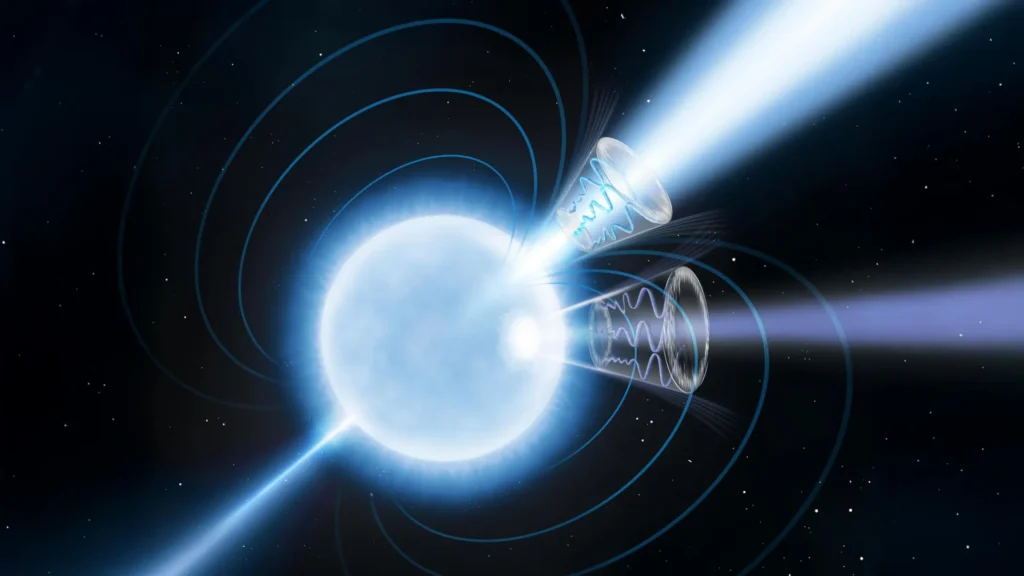
The universe, however, provides natural laboratories capable of generating fields far exceeding anything achievable on Earth: magnetars. These celestial objects are a rare subclass of neutron stars, which themselves are the collapsed cores of massive stars that have undergone supernova explosions. Neutron stars are incredibly dense, packing the mass of our Sun into a sphere only about 20 kilometers in diameter. Magnetars take this extreme density a step further, possessing magnetic fields that are the strongest known in the cosmos, typically ranging from 10^14 to 10^15 Gauss (10^10 to 10^11 Tesla). To put this into perspective, Earth’s magnetic field is roughly 0.3-0.6 Gauss, and a powerful refrigerator magnet is about 100 Gauss. A magnetar’s field is millions of billions of times stronger than Earth’s, powerful enough to distort atoms and tear flesh from bone from a distance of 1,000 kilometers.
These extraordinary magnetic fields are believed to be generated by a dynamo effect involving convection of ultra-dense matter and rapid rotation in the early life of the neutron star. Magnetars are also characterized by their emission of powerful bursts of X-rays and gamma rays, often associated with "starquakes" as their crusts crack under immense magnetic stress. It is precisely this unparalleled magnetic strength that makes magnetars the ideal, perhaps the only, environments in which the subtle quantum effects of vacuum birefringence might become detectable.
The Observational Campaign: Tools and Techniques
The recent observations, led by an international research team including Dr. Marcus Lower from Swinburne University of Technology, focused on a specific magnetar designated 1E 1547.0-5408, or 1E1547 for brevity. This particular magnetar presented an unusually favorable viewing geometry for the study, a critical factor for isolating such a subtle effect.
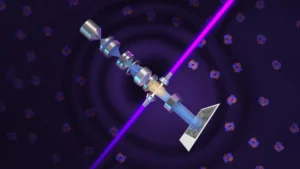
The investigation leveraged a sophisticated array of space-based and ground-based telescopes. The primary instrument for detecting the tell-tale X-ray polarization was NASA’s Imaging X-ray Polarimetry Explorer (IXPE). Launched in December 2021, IXPE is a groundbreaking mission designed specifically to measure the polarization of X-rays emitted from cosmic sources. It employs three identical telescopes, each with a mirror assembly and a detector unit, to precisely measure the direction and degree of X-ray polarization. This capability is crucial because vacuum birefringence is predicted to affect the polarization state of light passing through the magnetized vacuum. IXPE’s data provided the most direct evidence of the quantum effect.
Complementing IXPE’s observations were data from the Neutron Star Interior Composition Explorer (NICER), an X-ray telescope mounted aboard the International Space Space Station (ISS). NICER’s role was to provide precise timing and spectroscopic information on the magnetar’s X-ray emissions, helping to characterize its overall behavior and ensure the observed polarization was consistent with the magnetar’s known properties.
Crucially, radio observations also played a vital role in this multi-wavelength study. Dr. Lower utilized Murriyang, CSIRO’s Parkes radio telescope, a renowned 64-meter dish located in New South Wales, Australia. Parkes is one of the world’s premier radio astronomy facilities, celebrated for its discoveries, including the first detection of a fast radio burst (FRB). For this study, Murriyang tracked the changing polarization state of radio waves emanating from 1E1547 as the magnetar rotated. This allowed researchers to precisely map the orientation of the magnetar’s magnetic field relative to its rotation. The subsequent analysis of these complex datasets, especially the radio observations, was performed on Swinburne’s Ngarrgu Tindebeek supercomputer, highlighting the immense computational power required to process and interpret such intricate astrophysical data.
Unraveling the Clues: Polarization and Alignment
The research team focused on two critical sets of clues to identify the signature of vacuum birefringence. Firstly, IXPE detected exceptionally high levels of polarization in the X-rays emitted by 1E1547. Light polarization refers to the orientation of the oscillations of the electromagnetic waves. For instance, light can be unpolarized (oscillating in all directions), linearly polarized (oscillating in a single plane), or circularly polarized. The high degree of linear polarization observed in the magnetar’s X-ray emissions was a significant indicator.
Secondly, and perhaps even more tellingly, the direction of this X-ray polarization remained consistently tied to the magnetic field of 1E1547, mirroring the patterns observed in the radio data. This precise alignment was crucial. As Dr. Lower explained, "Because of the magnetic field’s strength, Heisenberg’s virtual particles become aligned with the direction the field is pointing." This alignment is precisely what QED predicts would cause the vacuum to become birefringent, affecting the polarization of light.
A key factor in the success of these observations was the "ideal viewing geometry" of 1E1547. The radio observations, meticulously analyzed by Dr. Lower, revealed that the magnetar’s magnetic and rotational axes are nearly aligned. Furthermore, 1E1547 is observed from a nearly pole-on perspective relative to Earth. These characteristics combined to provide an unusually favorable vantage point for detecting vacuum birefringence. When light travels through a birefringent medium, the effect is strongest when the light’s path is perpendicular to the alignment of the medium. In the case of 1E1547, the pole-on view and aligned axes meant that the X-rays and radio waves traversed the magnetar’s powerful magnetic field in an orientation that maximized the observable effects of the virtual particle alignment, making the predicted quantum behavior potentially detectable.
The ability to track the oscillation direction of both radio waves and X-rays as the magnetar rotated provided robust evidence. "By carefully tracking the direction the radio waves and X-rays oscillate as the magnetar rotates, the team found that the alignment of 1E1547’s magnetic and rotational poles were ideal for detecting vacuum birefringence," Dr. Lower stated, underscoring the fortuitous cosmic alignment that facilitated this potential breakthrough.
Closing in on a 90-Year Mystery: Implications for Fundamental Physics
If this interpretation of the observations is confirmed, it will represent a monumental achievement in fundamental physics. The detection of vacuum birefringence would provide the first direct observational evidence for a phenomenon predicted by quantum electrodynamics nearly a century ago. QED is arguably the most precisely tested theory in all of physics, renowned for its incredible accuracy in describing the interactions between light and matter. However, many of its predictions, particularly those related to the behavior of quantum fields in extreme conditions, have remained beyond the reach of experimental verification. This potential discovery would fill one of those long-standing gaps, validating QED’s predictions under some of the most extreme physical conditions found anywhere in the universe.
The confirmation of vacuum birefringence would provide scientists with an entirely new method to investigate the quantum universe. It would allow physicists to test the boundaries of established quantum theories, pushing them into regimes of magnetic field strength and energy density that are inaccessible in terrestrial laboratories. This could lead to a deeper understanding of the fundamental structure of space-time itself, revealing that what we perceive as empty space is, in fact, a complex and active quantum medium.
Beyond validating existing theories, such a discovery could also pave the way for new theoretical developments. Understanding how quantum fields behave in these extreme environments could offer insights into other exotic phenomena, such as the physics of black holes, the very early universe, or even speculative theories beyond the Standard Model of particle physics. It highlights the profound connection between the microscopic world governed by quantum mechanics and the macroscopic, cosmic phenomena studied in astrophysics, demonstrating how observations of distant stars can illuminate the most fundamental aspects of reality.
The Path Forward: Future Research and Validation
Despite the compelling evidence, the scientific community maintains a cautious optimism, emphasizing the need for further confirmation. The complex environment of a magnetar involves numerous physical processes that could potentially influence light polarization, making it crucial to distinguish the unique quantum signature of vacuum birefringence from other astrophysical effects.
Dr. Lower acknowledged this need for rigorous validation. He indicated that "additional observations and more advanced computer simulations could help establish whether the signal truly comes from vacuum birefringence." Future research will likely involve observing other magnetars with similar favorable geometries, as well as conducting longer and more detailed observations of 1E1547 with IXPE and other advanced telescopes. These expanded datasets will provide more statistical power and allow researchers to refine their models.
Furthermore, the development of increasingly sophisticated computer simulations is paramount. These simulations must accurately account for all known astrophysical processes occurring around magnetars, such as plasma effects, scattering, and synchrotron emission, to precisely isolate the predicted quantum signature. As these improvements are made, researchers anticipate being able to definitively confirm the presence of vacuum birefringence.
"With these future data on hand and our updated simulations, we may finally be able to complete the quest started by Heisenberg nearly 90 years ago," Dr. Lower concluded, reflecting the historical significance and the enduring scientific curiosity driving this research. The potential to finally observe this fundamental quantum phenomenon, after decades of theoretical prediction, underscores the remarkable progress in observational astronomy and computational physics, pushing the boundaries of human understanding of the universe’s deepest secrets. This ongoing quest promises to reshape our understanding of the vacuum, transforming it from an empty void into a vibrant arena of quantum activity.