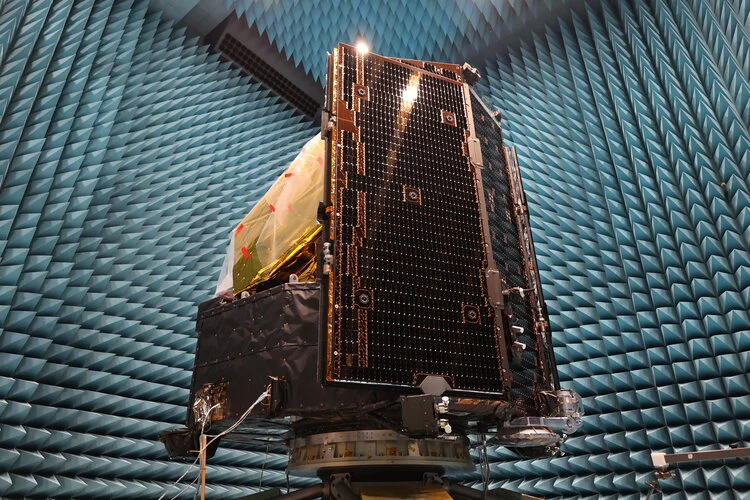
The European Space Agency’s (ESA) ambitious terrestrial planet hunter, Plato, has successfully navigated a critical phase of its pre-launch preparations, demonstrating its readiness for the rigors of space. The spacecraft recently underwent a series of rigorous electromagnetic compatibility (EMC) tests within the specialized Maxwell Test Chamber at ESA’s ESTEC facility in the Netherlands. This milestone signifies that Plato’s intricate electronic systems are robust and will function harmoniously in the demanding space environment, a crucial step before its planned March 2027 launch.
Inside the Maxwell Test Chamber: Simulating the Void of Space
The image accompanying this report captures Plato, a sophisticated observatory designed to discover and study exoplanets, standing serenely within the confines of the Maxwell Test Chamber. This state-of-the-art facility is engineered to replicate the unique electromagnetic conditions of outer space, a critical environment where the absence of atmospheric interference necessitates extreme precision in spacecraft design.
The chamber itself is a marvel of engineering, designed to create an isolated and controlled testing ground. Its interior is a Faraday cage, a shielded enclosure constructed with conducting metal walls, floor, and ceiling. This design effectively blocks all external electromagnetic interference, preventing any spurious signals from impacting the sensitive electronics of the spacecraft under test. Furthermore, the 9-meter high interior is meticulously lined, from floor to ceiling, with an array of specialized foam spikes. These spikes are not merely decorative; they are designed to absorb stray electrical signals and acoustic waves, effectively mimicking the near-perfect vacuum and silence of space. This comprehensive shielding is paramount for ensuring that the tests accurately reflect how Plato’s systems will perform once deployed beyond Earth’s protective atmosphere.
Verifying Inter-System Harmony: The Core of EMC Testing
Once the Maxwell Test Chamber was sealed, a team of engineers remotely activated and commanded Plato’s extensive array of electronic equipment. The objective was to meticulously observe and verify that the spacecraft’s numerous instruments and modules could operate concurrently without generating unwanted electromagnetic interference, commonly referred to as “crosstalk.” This phenomenon, where signals from one component unintentionally leak into and disrupt another, could have catastrophic consequences for a mission. In the unforgiving vacuum of space, where thermal management is critical and signal integrity is paramount, such interference can lead to instrument malfunctions, communication disruptions, or even permanent damage to vital hardware.
The tests involved a complex sequence of operations, simulating various mission phases and instrument usages. Engineers monitored telemetry data streams for any anomalies, listened for unexpected emissions, and analyzed the performance of each system under diverse operational loads. The goal was to confirm that Plato’s advanced payload, including its array of telescopes and sensitive detectors, would not interfere with its navigation, communication, or power systems, and vice versa. This meticulous verification process is a cornerstone of modern spacecraft development, ensuring reliability and mission success.
A Phased Approach to Space Readiness
The EMC tests in the Maxwell Chamber represent the final major hurdle in a comprehensive series of examinations Plato has undergone to achieve its launch readiness. This rigorous testing regime began earlier in the year, commencing in January with a series of demanding vibration and acoustic tests. These initial stages were designed to simulate the extreme forces Plato will experience during its launch ascent. The sheer power of an Ariane 6 rocket, the chosen launch vehicle, generates intense vibrations and acoustic pressures that could easily damage delicate components if they are not adequately hardened and secured.
Following the mechanical stress tests, Plato embarked on a month-long residency within the Large Space Simulator (LSS) at ESTEC. This facility, another cornerstone of ESA’s testing infrastructure, recreates the harsh thermal and vacuum conditions of space. Within the LSS, Plato endured simulated solar radiation, extreme temperature fluctuations, and the deep vacuum of orbit, proving its resilience and ability to maintain operational integrity under these challenging environmental factors. Its successful completion of these space-like tests further solidified its readiness for its cosmic journey.
Plato: A New Era in Exoplanet Discovery
Plato, an acronym for PLAnetary Transits and Oscillations of stars, is a flagship mission for ESA, poised to revolutionize our understanding of planetary systems beyond our own. Its primary objective is to search for and characterize Earth-like planets orbiting within the habitable zones of Sun-like stars. The mission’s innovative approach involves observing hundreds of thousands of stars, meticulously monitoring their brightness for the telltale dimming that indicates a planet passing in front of its star – a phenomenon known as a transit.
However, Plato’s scientific capabilities extend beyond simple transit detection. It will also employ the asteroseismology technique, studying the oscillations of stars to determine their mass and radius with unprecedented precision. This dual approach will allow Plato to identify potentially habitable exoplanets and accurately measure their sizes, providing crucial data for assessing their potential to host life. The mission’s focus on relatively bright and nearby stars will enable detailed follow-up studies by ground-based telescopes and future space observatories, potentially leading to the direct characterization of exoplanet atmospheres.
The data gathered by Plato is expected to significantly expand the catalog of known exoplanets, with a particular emphasis on those that resemble our own solar system. By studying the diversity of planetary systems, scientists aim to gain insights into the processes of planet formation and evolution, and to better understand our place in the cosmos. The mission’s findings will contribute to answering fundamental questions about the prevalence of habitable worlds and the potential for life beyond Earth.
The Road to Launch: A Collaborative Endeavor
The successful completion of these comprehensive tests is a testament to the dedication and expertise of the numerous engineers, scientists, and technicians involved in the Plato mission. The spacecraft itself is the culmination of years of design, development, and rigorous testing, a collaborative effort involving industrial partners across Europe.
Plato is scheduled to launch aboard an Ariane 6 rocket, a testament to the enduring partnership between ESA and Arianespace, the launch service provider. The launch is currently slated for March 2027, marking the beginning of Plato’s multi-year scientific mission. The choice of Ariane 6, ESA’s new-generation heavy-lift launch vehicle, underscores the agency’s commitment to maintaining independent European access to space for its ambitious scientific endeavors.
Broader Implications and Future Prospects
The successful electromagnetic compatibility testing of Plato is not merely a procedural milestone; it signifies a crucial step forward in humanity’s quest to explore the universe and understand our cosmic origins. By ensuring the reliability and robustness of its sophisticated instrumentation, ESA is paving the way for groundbreaking scientific discoveries.
The implications of Plato’s mission are far-reaching. The identification and characterization of Earth-like exoplanets could fundamentally alter our perception of life in the universe. It could provide the first concrete evidence that we are not alone, a discovery that would undoubtedly have profound philosophical and societal impacts. Furthermore, the data from Plato will contribute to a deeper understanding of planetary formation processes, offering insights that could refine our models of how solar systems, including our own, came to be.
As Plato prepares for its journey to the stars, the scientific community eagerly anticipates the wealth of data it will return. The success of this mission, built upon a foundation of meticulous testing and cutting-edge engineering, underscores Europe’s continued leadership in space exploration and its unwavering commitment to unraveling the mysteries of the cosmos. The meticulous verification of its electronic systems in the specialized Maxwell Test Chamber represents a quiet but vital victory, ensuring that when Plato finally embarks on its celestial voyage, its sensitive instruments will perform flawlessly, transmitting invaluable knowledge back to Earth for generations to come.