The evolution of experimental physics has historically been driven by a cycle of invention and refinement. From the earliest cloud chambers to the massive, multi-ton detectors currently buried deep underground or situated within sprawling particle colliders, the goal has remained the same: to visualize the invisible. However, as the quest to understand the fundamental building blocks of the universe—such as neutrinos and dark matter—intensifies, the sheer scale and complexity of traditional detection hardware have begun to reach a point of diminishing returns. In a groundbreaking departure from established norms, researchers from ETH Zurich and EPFL (École Polytechnique Fédérale de Lausanne) have unveiled a radical new approach to particle tracking. By combining light field photography with quantum-level sensor technology, the team has demonstrated that it is possible to achieve high-resolution, three-dimensional particle imaging within a solid, unsegmented block of material, potentially rendering the need for millions of individual components obsolete.
The Complexity Bottleneck in Modern Particle Physics
To understand the significance of the PLATON (Plenoptic Light-field Analysis for Tracking in Unsegmented Detectors) project, one must first consider the monumental challenges inherent in modern detector design. Experiments such as the T2K (Tokai to Kamioka) neutrino-oscillation experiment in Japan or the LHCb at CERN require the precise reconstruction of particle trajectories in three dimensions. When subatomic particles move through a dense medium, they often interact with a "scintillator"—a material that emits brief flashes of light (photons) when struck by charged particles.
Traditionally, to determine exactly where these flashes occur, scientists have relied on extreme segmentation. This involves carving the detector material into millions of tiny, individual units, such as plastic cubes or thin optical fibers. In the T2K experiment, the detector utilizes approximately two tons of material divided into two million individual cubes, supported by 60,000 optical fibers that channel light to sensors. While this method provides high spatial resolution, it introduces a massive logistical and financial burden. The manufacturing, assembly, and electronic readout of millions of discrete parts create a "bottleneck" that limits the size and affordability of future experiments. As the scientific community looks toward even larger detectors to catch the elusive "ghost particles" known as neutrinos, the need for a more scalable solution has become urgent.
A Paradigm Shift: From Segmentation to Computational Imaging
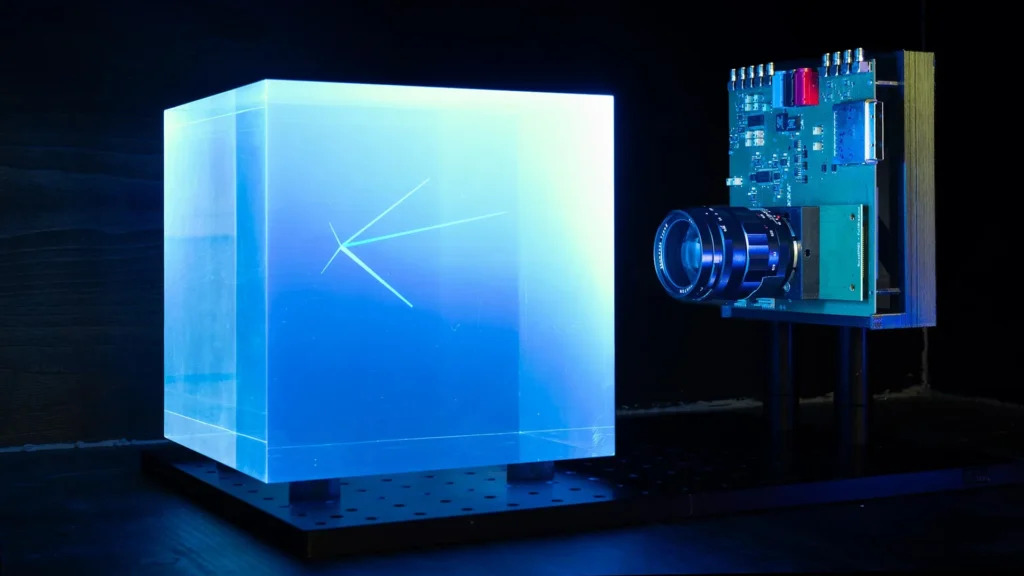
The collaboration between ETH Zurich and EPFL, led by Professor Davide Sgalaberna and Professor Edoardo Charbon, proposes a solution that moves the complexity from the hardware’s physical structure to its optical and computational systems. Instead of dividing the scintillator into millions of pieces, the researchers use a single, solid block of material. The "segmentation" is performed virtually through a sophisticated imaging system inspired by plenoptic, or light field, cameras.
Standard cameras record only the intensity and color of light hitting a two-dimensional sensor. In contrast, a plenoptic camera captures the "light field"—the total amount of light flowing in every direction through every point in space. This is achieved by placing a micro-lens array (MLA) between the main lens and the imaging sensor. Each microscopic lens captures the scene from a slightly different perspective, much like the compound eye of an insect. By processing this multi-angular data, the system can reconstruct the depth and three-dimensional structure of the light source, even if that source is a faint trail of photons inside a solid block of plastic.
The Technical Core: SwissSPAD2 and Micro-Lens Arrays
The prototype developed under the PLATON project represents a fusion of advanced optics and quantum sensing. At the heart of the device is the SwissSPAD2, a Single-Photon Avalanche Diode (SPAD) array sensor developed by the Advanced Quantum Architecture Lab at EPFL. Unlike conventional CMOS sensors found in smartphones, SPAD sensors are capable of detecting individual photons with incredibly high timing precision.
In the PLATON prototype, the MLA—designed by the German firm Raytrix GmbH—is mounted directly onto the SwissSPAD2 sensor. This setup allows the detector to not only see the flashes of light produced by particles but to determine the exact 3D coordinates of those flashes by analyzing the directionality of the incoming photons.
Furthermore, the SwissSPAD2 employs a "gating" mechanism. This allows the sensor to be active only during specific, nanosecond-scale windows. By synchronizing the sensor with the expected timing of particle interactions, the researchers can effectively filter out background noise and "dark counts" (random electronic signals), ensuring that even a handful of photons can be used to reconstruct a particle’s path.
Experimental Validation and Performance Data
The research team, including PhD student Till Dieminger and senior scientist Dr. Saúl Alonso-Monsalve, subjected the PLATON prototype to rigorous laboratory testing to determine its limits. One of the most striking findings was the system’s sensitivity; the researchers demonstrated that they could achieve spatial resolution even when the detector captured as few as five photons.
Using a strontium-90 source to produce electrons, the team observed the particles as they traveled through a block of plastic scintillator. The results of these physical tests were compared against extensive Monte Carlo simulations. The high degree of correlation between the experimental data and the simulations confirmed that the plenoptic approach is not just a theoretical curiosity but a viable tool for high-energy physics.
Key data points from the study include:
- Spatial Resolution: Simulations suggest that a 10x10x10 cm³ unsegmented detector can achieve spatial resolution of less than 1 millimeter.
- Sensitivity: Successful 3D reconstruction was achieved with light levels ranging from several hundred photons down to five.
- Scaling Potential: Initial modeling for a one-cubic-meter detector indicates that a spatial resolution of a few millimeters is possible, which is comparable to current state-of-the-art segmented detectors but at a fraction of the mechanical complexity.
AI and the Role of Transformer Architectures
A critical component of the PLATON system is its reliance on artificial intelligence to interpret the complex data produced by the light field sensor. The team implemented a neural network based on the "Transformer" architecture—the same underlying technology that powers large language models like GPT.
However, instead of processing sequences of words, this Transformer analyzes sequences and patterns of detected photons. It looks for spatial and temporal correlations between individual photon hits on the SPAD array. This allows the AI to "de-convolve" the overlapping images produced by the micro-lens array and accurately pinpoint the origin of the light within the scintillator. This AI-driven reconstruction is what enables the system to maintain high purity and efficiency, particularly when identifying neutrino interactions that produce low-momentum protons—a common but difficult-to-track occurrence in neutrino physics.
Future Developments: Sub-Nanosecond Timing
The current prototype is only the beginning. The researchers are already working on an upgraded version of PLATON that will feature a new generation of SPAD sensors. While the current system uses fixed time windows (gating), the next iteration will provide precise, individual time stamps for every detected photon with sub-nanosecond resolution.
This "4D" imaging—three spatial dimensions plus time—will allow for even more accurate track reconstruction. By knowing exactly when each photon arrived, the system can use the "time of flight" of the light to further refine the 3D position of the particle interaction. Additionally, the team is optimizing the optical design to widen the field of view, allowing a single camera system to monitor larger volumes of scintillator material.
Broader Implications: From Particle Physics to Medical Imaging
While the PLATON project was born out of the needs of the particle physics community, its potential applications extend far into the realm of medicine. The researchers have already filed three patents for the use of this technology in Positron Emission Tomography (PET) scanners.
PET scans are a cornerstone of modern oncology and neurology, used to detect cancer and map brain activity by tracking radioactive tracers. Current PET scanners rely on segmented crystals and photomultiplier tubes, much like traditional particle detectors. By replacing these expensive and bulky components with unsegmented scintillators and plenoptic SPAD cameras, medical manufacturers could potentially produce PET scanners that are higher in resolution, more compact, and significantly cheaper.
The transition of technology from high-energy physics to medicine has a storied history. The World Wide Web was famously invented at CERN to facilitate data sharing among scientists, and the field of proton therapy for cancer treatment emerged directly from advances in particle accelerators. PLATON appears poised to follow this trajectory, offering a new tool for both the exploration of the cosmos and the improvement of human health.
Analysis of Impact
The shift toward unsegmented detectors represents a fundamental change in how we approach large-scale scientific instrumentation. By leveraging the power of "computational optics"—where the heavy lifting is done by software and advanced sensors rather than mechanical architecture—the PLATON project addresses the two biggest hurdles in the field: cost and complexity.
If successful at the cubic-meter scale and beyond, this technology could democratize high-energy physics research, allowing smaller institutions to build sophisticated detectors that were previously only possible for massive international collaborations. Furthermore, the integration of Transformer-based AI models marks a significant step in the "AI for Science" movement, proving that deep learning is not just for language and images but is an essential tool for interpreting the quantum world.
As the ETH Zurich and EPFL teams move toward larger prototypes and refined sensors, the scientific community will be watching closely. The ability to see the "unseeable" in three dimensions, using a solid block of plastic and a clever arrangement of lenses, may soon become the new gold standard for particle detection across the globe.