On August 12, 2026, a remarkable celestial event unfolded across parts of Europe, as a total solar eclipse captivated millions. However, hours before the Moon’s shadow swept across the continent, a pioneering European Space Agency (ESA) mission, Proba-3, achieved an unprecedented feat: it created its own artificial eclipse, marking the 65th successful demonstration of this innovative technology. This achievement provided scientists with a unique opportunity to study the Sun’s corona under conditions mirroring a natural eclipse, but without the celestial body’s involvement.
Proba-3: A Coronagraphic Marvel in Orbit
The Proba-3 mission, comprising a pair of spacecraft operating in precise formation, is designed to revolutionize our understanding of the Sun’s elusive outer atmosphere, the corona. Orbiting approximately 60,000 kilometers above Earth, the two satellites maintain a delicate dance, positioning themselves 150 meters apart. One spacecraft, designated the "Occulter," meticulously positions itself to block the Sun’s blindingly bright disk, effectively acting as an artificial Moon. This maneuver creates a sustained period of darkness, allowing the second spacecraft, equipped with the Advanced Spaceborne Polarimetric Coronagraph (ASPIICS), to capture uninterrupted, high-resolution images of the Sun’s corona.
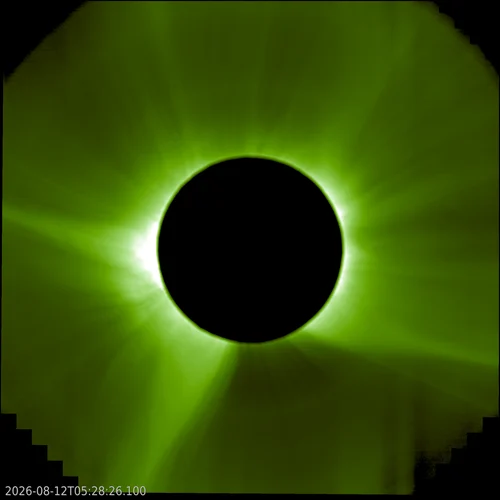
The image captured on the morning of August 12, 2026, by the ASPIICS coronagraph, showcases the Sun’s inner corona as a vibrant greenish hue. This visual representation closely mimics what ground-based observers would experience through a green filter during a total solar eclipse. The corona, a vast and dynamic region of plasma extending millions of kilometers into space, is typically obscured by the Sun’s overwhelming glare. Proba-3’s ingenious design circumvents this challenge, providing scientists with invaluable data on solar activity, including phenomena like solar flares and coronal mass ejections, which can significantly impact Earth and our technological infrastructure.
A Celestial Coincidence: The Double Eclipse
Adding a layer of cosmic serendipity to the mission’s artificial eclipse, the Moon itself made an appearance shortly after Proba-3’s coronagraph captured its image. As the natural solar eclipse approached its totality phase over Europe, the Moon’s orbit brought it into Proba-3’s field of view. This extraordinary alignment resulted in what ESA described as a "double eclipse," where the artificial eclipse created by Proba-3 was momentarily superseded by the natural eclipse caused by the Moon. This unique occurrence offered a comparative study, allowing scientists to analyze data from both artificial and natural eclipses within a short timeframe.
Predictive Power of Proba-3
Intriguingly, the Proba-3 mission had already provided a remarkably accurate preview of the August 12th eclipse conditions. Approximately two weeks prior, the mission observed the Sun from the opposite side of its orbit. Given that the Sun completes half a rotation on its axis in about two weeks, the coronagraphy images captured during that earlier observation served as a highly accurate prediction of what the solar corona would look like on August 12th. This predictive capability not only benefited the Proba-3 mission itself but also provided valuable insights for ground-based observers preparing for the natural eclipse. Scientists could anticipate specific coronal structures and their potential evolution, enhancing their observational strategies.
The Natural Eclipse: A Continent-Wide Spectacle
The natural solar eclipse of August 12, 2026, was a highly anticipated event, with millions across Europe preparing to witness the awe-inspiring spectacle. The path of totality, where the Sun is completely obscured by the Moon, stretched across a significant portion of the continent, offering a breathtaking display of the Sun’s corona. This rare celestial alignment drew significant public attention, with numerous events, viewing parties, and educational programs organized to mark the occasion. Beyond the public fascination, the eclipse also presented a valuable scientific opportunity for various ground-based observatories and space missions monitoring solar activity.
Historical Context and Scientific Significance
The study of solar eclipses, both natural and artificial, has a long and rich history in astronomy. For centuries, astronomers have relied on total solar eclipses to observe the Sun’s corona, a region invisible during normal conditions. Early observations during eclipses led to fundamental discoveries about the Sun’s composition and structure. However, the rarity of total solar eclipses at specific locations and the limited duration of totality have always posed challenges for continuous, in-depth study.
The Proba-3 mission represents a significant leap forward in overcoming these limitations. By creating artificial eclipses on demand, Proba-3 offers scientists the ability to conduct prolonged observations of the corona, gather more comprehensive data, and study dynamic solar phenomena in unprecedented detail. This sustained observation capability is crucial for advancing our understanding of space weather, the dynamic conditions in space that can affect satellites, communication systems, power grids, and even astronauts.
Supporting Data and Mission Objectives
The Proba-3 mission is a testament to ESA’s commitment to cutting-edge space science and technology. Launched in 2023, the mission’s primary objectives include:
- Observing the Sun’s corona: Capturing detailed images of the inner corona, allowing for the study of its structure, temperature, and dynamics.
- Investigating solar wind and coronal mass ejections (CMEs): Analyzing the origins and propagation of these energetic solar events, which can have significant impacts on Earth.
- Understanding solar activity cycles: Contributing to long-term monitoring of solar activity and its variations.
- Testing formation flying technology: Demonstrating the precise control and coordination of multiple spacecraft in orbit.
The ASPIICS coronagraph on Proba-3 is equipped with advanced instrumentation capable of measuring the polarization of light from the corona. This information provides crucial insights into the magnetic field structure of the corona, a key factor in understanding solar activity.
Broader Implications and Future Prospects
The success of Proba-3’s artificial eclipse capability has far-reaching implications for solar physics and space weather forecasting. By enabling continuous observation of the corona, the mission contributes to:
- Improved space weather prediction: More accurate forecasting of solar flares and CMEs can help protect critical infrastructure and ensure the safety of space missions.
- Enhanced understanding of solar-terrestrial relationships: A deeper understanding of how solar activity affects Earth’s magnetosphere and atmosphere.
- Advancements in space technology: The formation flying techniques demonstrated by Proba-3 have potential applications for future space telescopes and observatories.
The 65 successful artificial eclipses achieved by Proba-3 underscore the mission’s reliability and scientific value. As the mission continues its operations, it is poised to deliver a wealth of new data, furthering our knowledge of the Sun and its profound influence on our solar system. The coincidence of Proba-3’s artificial eclipse with the natural solar eclipse of August 12, 2026, serves as a powerful reminder of the interconnectedness of celestial phenomena and the ingenuity of human scientific endeavor.
The image captured by the ASPIICS coronagraph, showcasing the Sun’s inner corona against a black background with its characteristic greenish tendrils, is a visual representation of this ongoing scientific exploration. The bright green light emanating from behind the black disk, with brighter, almost white hues at the edge, illustrates the delicate and complex nature of the Sun’s outer atmosphere, now accessible to us for extended study thanks to missions like Proba-3. This mission not only mimics nature’s grandeur but also provides a controlled environment for scientific inquiry, pushing the boundaries of our cosmic understanding.