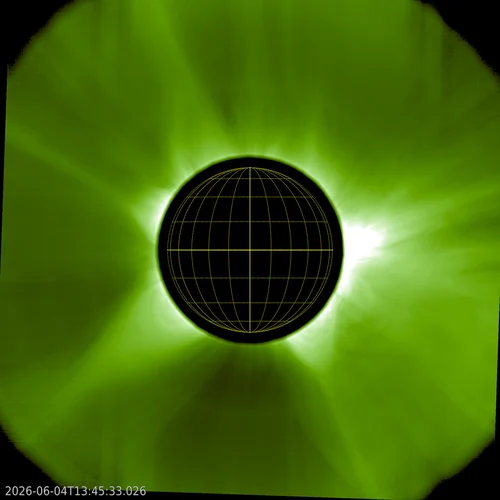
The Proba-3 mission’s Coronagraph spacecraft, along with its primary scientific instrument, ASPIICS (Association of Spacecraft for the Observation of the Sun’s Corona), are now confirmed to be in excellent health, signaling a triumphant return to routine formation flying operations and the resumption of its groundbreaking work in generating artificial solar eclipses. This marks a significant achievement for the European Space Agency (ESA) and its international partners, overcoming a critical anomaly that briefly jeopardized the mission’s ambitious scientific objectives.
A Period of Intense Effort and Successful Recovery
In February 2026, an unforeseen anomaly aboard the Coronagraph spacecraft led to a sudden and concerning loss of contact with ground control. This event initiated a period of intense dedication and around-the-clock effort from the mission team, comprising operators, engineers, and industry partners. Their collective focus was on diagnosing the issue, troubleshooting the complex systems, and ultimately restoring communication and control of the valuable spacecraft. The successful recovery is a testament to their expertise, resilience, and unwavering commitment to ESA’s scientific endeavors.
"When we received the first signal from the Coronagraph spacecraft after a month of silence, the relief across the entire team was palpable," stated Damien Galano, Proba-3 Mission Manager. "However, that moment of relief was quickly followed by the understanding that our work was far from over. We had to meticulously assess the impact of that prolonged period without power and determine if a full mission recovery was even feasible."
The process of bringing the spacecraft back online involved a systematic and rigorous checklist of procedures. Experienced operators diligently verified the status of each of the spacecraft’s subsystems. Crucially, they were able to successfully execute operations that had inadvertently triggered the anomaly in February. Following the identification and patching of the root cause within the spacecraft’s software, the team was confident that these critical operations could be safely performed without risk of recurrence.

"It has been truly inspiring and fascinating to witness the team’s energy and unwavering commitment in investigating the issue and diligently working towards the system’s recovery," Galano added. "For many of us, this has undoubtedly been one of the most intense and exhilarating periods of our professional lives, a true demonstration of human ingenuity and collaborative spirit under pressure."
Resumption of Scientific Operations and Promising Early Results
With the Coronagraph spacecraft fully recovered and its systems confirmed to be functioning optimally, the mission is now poised to resume its primary scientific objective: observing the Sun’s corona through artificial eclipses. The ASPIICS instrument, a sophisticated coronagraph designed to block the Sun’s bright disk, allows for unprecedented views of the faint outer atmosphere, revealing phenomena that are typically obscured.
"Last week, we successfully performed the first formation flight maneuvers since the anomaly occurred," confirmed Damien Galano. "We can now state with high confidence that all systems are functioning precisely as intended. With the Coronagraph spacecraft now securely back in its operational state, the mission can confidently return to its routine operational tempo."
Dr. Andrei Zhukov of the Royal Observatory of Belgium, the Principal Investigator for the ASPIICS instrument, expressed his satisfaction with the instrument’s performance. "Following very careful checks of the ASPIICS coronagraph instrument, I am extremely pleased to confirm that it is healthy and fully functional," Dr. Zhukov stated. "The formation flight conducted last week allowed us to capture new images of the solar corona, and they are as spectacular as the ones we obtained prior to the incident."
These recent observations are not only visually stunning but also scientifically significant. Preliminary analysis of data collected by Proba-3 has already yielded groundbreaking insights into the dynamics of the solar wind. Published findings suggest that structures within the inner corona can propagate at speeds three to four times faster than previously understood by the scientific community.

"Our initial results are exceptionally promising, and I am eagerly anticipating the future scientific discoveries that Proba-3 is set to deliver," Dr. Zhukov remarked, highlighting the mission’s potential to revolutionize our understanding of solar physics.
Background: The Proba-3 Mission and the Challenge of Artificial Eclipses
The Proba-3 mission is a unique endeavor by ESA designed to study the Sun’s corona, the outermost layer of its atmosphere, which extends millions of kilometers into space. The corona is the source of the solar wind, a stream of charged particles that flows outward and influences space weather throughout the solar system. Understanding the corona is crucial for predicting and mitigating the effects of solar storms, which can disrupt satellite operations, power grids, and communication systems on Earth.
Traditional coronagraphs often face limitations in observing the inner corona due to the intense brightness of the Sun’s disk. Proba-3 circumvents this challenge by employing a novel formation flying technique. The mission consists of two spacecraft flying in precise formation: the Coronagraph spacecraft, which houses the ASPIICS instrument, and an Occulter spacecraft. The Occulter spacecraft acts as a precise shield, creating a small, artificial eclipse of the Sun for the Coronagraph spacecraft. This allows ASPIICS to observe the faint light of the corona without being overwhelmed by the Sun’s direct glare.
The formation flying requires an extraordinary level of precision, with the two spacecraft maintaining a separation of approximately 150 meters. This delicate orbital dance necessitates continuous adjustments and precise maneuvering, making the loss of contact and subsequent recovery a significant technical hurdle. The anomaly in February, which led to the loss of contact, was an "extremely unlikely" event, as described by the mission team, underscoring the inherent risks and complexities of such advanced space missions.
Chronology of Events: From Anomaly to Recovery
- February 2026: An anomaly occurs on the Proba-3 Coronagraph spacecraft, resulting in a loss of contact with ground control. This marks the beginning of a mission-critical recovery effort.
- February – March 2026: The ESA mission team, engineers, and industry partners engage in intensive troubleshooting, analysis, and brainstorming to understand the anomaly and devise a recovery plan.
- March 2026: After approximately one month of silence, the first signal is successfully re-established with the Coronagraph spacecraft, bringing immense relief to the team.
- March – May 2026: A comprehensive diagnostic phase begins. Operators meticulously check the status of all spacecraft subsystems and perform critical operations to ensure stability and functionality. The root cause of the February anomaly is identified and addressed in the spacecraft’s software.
- Early June 2026: The Proba-3 mission successfully conducts its first formation flight maneuvers since the anomaly. This is a crucial validation of the spacecraft’s recovery and readiness for scientific operations.
- Mid-June 2026: Mission officials confirm that both the Coronagraph spacecraft and the ASPIICS instrument are fully healthy and ready to resume routine operations. New images of the solar corona are acquired, demonstrating the instrument’s continued high performance.
- Late June 2026: Initial scientific results from Proba-3 are published, providing new insights into the speed of solar wind structures in the inner corona.
Supporting Data and Scientific Implications
The Proba-3 mission is designed to achieve several key scientific objectives:

- Studying the Solar Corona: Providing high-resolution images of the solar corona to understand its structure, dynamics, and temperature distribution.
- Investigating the Origin of the Solar Wind: Analyzing data to determine how the solar wind is accelerated and where its components originate within the corona.
- Understanding Space Weather: Contributing to a more accurate prediction of space weather events by providing crucial data on solar activity.
The recent preliminary findings, indicating solar wind structures traveling three to four times faster than previously estimated, have significant implications for space weather forecasting. A more accurate understanding of solar wind acceleration and speed can lead to improved models for predicting the arrival and intensity of geomagnetic storms, allowing for better preparation and mitigation of their disruptive effects on Earth-based technologies and astronauts in space. The ability of ASPIICS to capture these detailed observations of the inner corona is instrumental in this endeavor.
Broader Impact and Future Prospects
The successful recovery of the Proba-3 Coronagraph spacecraft highlights ESA’s commitment to pushing the boundaries of space exploration and scientific discovery. It also underscores the importance of international collaboration and the dedication of highly skilled professionals in overcoming complex technical challenges.
The mission’s return to full operational status ensures that scientists will continue to receive invaluable data for years to come. Future observations from Proba-3 are expected to further refine our understanding of solar physics, contribute to the development of more robust space weather prediction models, and potentially uncover entirely new phenomena within the Sun’s enigmatic corona. The ability to consistently generate artificial eclipses with such precision opens up new avenues for observational astronomy, making Proba-3 a pioneering mission in its field. The resilience demonstrated by the mission team in the face of adversity serves as an inspiring example of human perseverance in the pursuit of knowledge.