In a landmark achievement for the field of condensed matter physics, an international team of researchers has provided the first experimental evidence that the seemingly empty "void" of a vacuum can be engineered to bolster the properties of superconducting materials. This discovery, detailed in a study published in the prestigious journal Nature, marks a fundamental shift in how scientists perceive the relationship between matter and the quantum vacuum. By utilizing a specialized electromagnetic environment to amplify quantum fluctuations, the team successfully increased the superconducting critical temperature of niobium diselenide (NbSe2), opening a transformative new pathway for the non-contact control of exotic states of matter.
The research was spearheaded by Professors Changgan Zeng and Guanghui Cheng from the University of Science and Technology of China (USTC) under the Chinese Academy of Sciences. The high-level collaboration also featured significant contributions from Professor Qingdong Jiang of Shanghai Jiao Tong University and Professor Frank Wilczek, a Nobel laureate from the Massachusetts Institute of Technology (MIT), alongside a diverse group of physicists dedicated to pushing the boundaries of quantum electrodynamics (QED).
The Quantum Nature of Nothingness
To understand the magnitude of this breakthrough, one must first discard the classical notion of a vacuum as a simple, empty container. In the realm of quantum physics, the vacuum is a roiling sea of activity. Governed by the Heisenberg Uncertainty Principle, the lowest energy state of the universe—the vacuum—is never truly at rest. Instead, it is characterized by "virtual particles" that spontaneously pop into and out of existence. These fleeting entities create an omnipresent background of quantum fluctuations.
While these fluctuations are invisible to the naked eye, their physical reality has been confirmed through several cornerstone experiments in 20th-century physics. The "Lamb shift," for instance, describes a small difference in energy between two energy levels of the hydrogen atom caused by the interaction between the electron and vacuum fluctuations. Similarly, the "Casimir effect" demonstrates a physical force that pulls two uncharged metallic plates together when they are placed extremely close to one another in a vacuum, a direct result of the vacuum’s electromagnetic zero-point energy.
For years, the scientific community has debated whether these microscopic fluctuations could be harnessed to influence macroscopic materials. The team led by Zeng and Cheng previously laid the groundwork for this inquiry by demonstrating that the Casimir force could be manipulated using magnetic fields, effectively switching the force between attraction and repulsion. This latest study takes that logic a step further, asking if the vacuum itself can be used as a "knob" to tune the fundamental phase transitions of matter, such as superconductivity.
Engineering the Vacuum: The Rise of Vacuumronics
The central challenge in using vacuum fluctuations to control matter lies in their inherent weakness. In free space, these fluctuations are too diffuse to exert a noticeable influence on the collective behavior of trillions of electrons in a solid-state system. To overcome this, the researchers turned to a concept they call "vacuumronics."
Vacuumronics involves the creation of engineered electromagnetic environments—specifically "dark cavities"—designed to confine and amplify vacuum fluctuations. In this study, the researchers employed a terahertz (THz) split-ring resonator. This device acts as a subwavelength cavity that reshapes the local vacuum field. Because the cavity is "dark"—meaning it is not being pumped by an external laser or light source—any effects observed within it are a result of the interaction between the material and the vacuum fluctuations themselves.
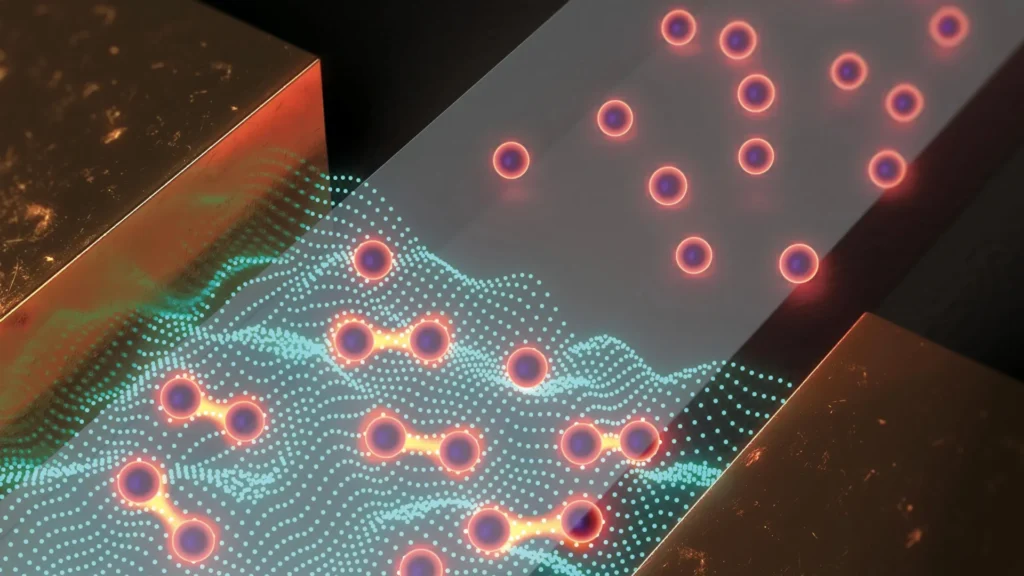
The researchers placed thin flakes of NbSe2, a well-known transition metal dichalcogenide that exhibits superconductivity at low temperatures, into this terahertz resonator. By coupling the superconducting electrons to the amplified vacuum modes of the cavity, they created a hybrid system where the vacuum and the matter became inextricably linked.
Experimental Results and Resonant Enhancement
The experimental phase of the study involved a rigorous comparison of NbSe2 samples located inside the resonator versus those in a standard environment. Superconductivity is defined by three critical parameters: the critical temperature ($T_c$), the critical current ($J_c$), and the critical magnetic field ($H_c$). Below these thresholds, a material loses all electrical resistance; above them, it returns to a "normal" metallic state.
The results were definitive. The researchers observed that for a six-layer NbSe2 device, the critical temperature increased by approximately 5.4%. Furthermore, the critical current and the critical magnetic field showed significant enhancement near the transition point. While a 5.4% increase may seem modest in absolute terms, in the context of superconductivity—where researchers often struggle to raise $T_c$ by fractions of a degree—this is a substantial and theoretically significant leap.
To ensure the validity of their findings, the team conducted an exhaustive series of control experiments. They systematically varied the geometry of the cavity, the thickness of the NbSe2 layers, and the types of dielectric materials used. This allowed them to rule out "boring" classical explanations. For example, they confirmed that the enhancement was not due to mechanical strain on the crystal lattice, material degradation, or the simple screening of electric fields by the metal in the resonator.
A pivotal piece of evidence came from the frequency dependence of the effect. The enhancement of superconductivity was not uniform across all cavity designs; rather, it showed a "resonance-like peak" when the characteristic frequency of the dark cavity matched the energy scales of the superconducting fluctuations. This resonance is a "smoking gun" for quantum coupling, proving that the vacuum photons were directly interacting with the electron pairs (Cooper pairs) responsible for superconductivity.
Theoretical Framework: Virtual Photons as Catalysts
The theoretical heavy lifting for the study was provided by Professor Jiang’s group and Professor Frank Wilczek. They utilized the Ginzburg-Landau framework—a mathematical description used to model phase transitions in superconductors—to explain how a "passive" vacuum could produce "active" changes in matter.
The model suggests that the superconducting state in the NbSe2 exchanges virtual photons with the dark cavity. These virtual photons are not "real" in the sense that they can be detected as light, but they carry energy. This exchange lowers the overall energy of the superconducting state, making it more energetically favorable than the normal state. In essence, the engineered vacuum acts as a catalyst that stabilizes the superconducting phase at temperatures and magnetic fields where it would normally collapse.
Professor Wilczek noted the philosophical and practical importance of this shift: "In most practical physics, the vacuum serves merely as the passive stage on which phenomena play out. This work shows that the background itself can become an actor—engineered to strengthen superconductivity and reshape the behavior of quantum matter."
A Timeline of Discovery
The path to this discovery was paved by a decade of advancing expertise in 2D materials and cavity quantum electrodynamics.
- 2010s: The rise of "van der Waals materials" like NbSe2 allowed researchers to study superconductivity in nearly two-dimensional planes, where quantum effects are more pronounced.
- 2019–2021: The USTC team began exploring the manipulation of the Casimir force, proving that vacuum-induced forces could be controlled via external stimuli like magnetic fields.
- 2022: Professor Jiang’s group published theoretical work proposing the concept of "vacuumronics," suggesting that cavities could be used to manipulate topological phases and superconducting states.
- 2023: The experimental setup was perfected, integrating terahertz split-ring resonators with ultra-thin NbSe2 flakes in a cryogenic environment.
- 2024: The team successfully measured the resonant enhancement of $T_c$, leading to the peer-reviewed publication in Nature.
Broader Implications and the Future of Quantum Materials
The implications of this research extend far beyond NbSe2. The ability to control matter without physical contact or external energy input (like high-pressure cells or intense laser pulses) represents a new frontier in material science.
One of the most exciting prospects is the application of vacuumronics to the quest for room-temperature superconductivity. While current high-temperature superconductors require massive pressure or extreme cold, engineering the vacuum environment around these materials might provide the extra stability needed to push $T_c$ into the range of everyday temperatures. This would revolutionize global energy grids, enable frictionless high-speed rail, and transform medical imaging technology.
Furthermore, the "vacuum-fluctuation-coupling" method is a general tool. It could potentially be used to control other "broken symmetry" states of matter, such as ferroelectricity, magnetism, or charge density waves. By tuning the "dark" electromagnetic environment, scientists may soon be able to create materials with properties that do not exist in nature.
As Professor Zeng concluded, the journey is only beginning. "With further optimization of cavity structures and material systems, vacuum-fluctuation coupling may enable more pronounced and widely applicable control of quantum states."
The study serves as a powerful reminder that in the quantum world, even "nothing" is a resource waiting to be harnessed. By turning the vacuum into a precision tool, the researchers have not only strengthened a superconductor; they have provided a new lens through which we can manipulate the very fabric of reality.