The humble material found in everyday pencil lead is revealing an extraordinary level of complexity at the microscopic scale, as researchers at the Massachusetts Institute of Technology (MIT) have identified that natural graphite can host a variety of unconventional superconducting states. In a landmark study published in the journal Nature, a team led by Long Ju, the Lawrence C. and Sarah W. Biedenharn Associate Professor of Physics at MIT, reported that specific microscopic configurations of carbon atoms, known as rhombohedral graphene, exhibit electronic properties that defy traditional understanding. This discovery marks a significant milestone in condensed matter physics, as it is exceedingly rare for a single material to demonstrate multiple distinct forms of superconductivity, particularly under conditions that would typically neutralize such a state.
Superconductivity is a quantum mechanical phenomenon where electrons form pairs and move through a conductor with zero electrical resistance, allowing for the transmission of energy without loss. While scientists have identified thousands of superconducting materials since the phenomenon was first discovered in 1911, most operate under very specific, fragile conditions. The discovery that rhombohedral graphene—a naturally occurring structure within graphite—not only supports multiple superconducting states but also sees these states strengthened by magnetic fields, challenges the established boundaries of material science.
The Microscopic Architecture of Rhombohedral Graphene
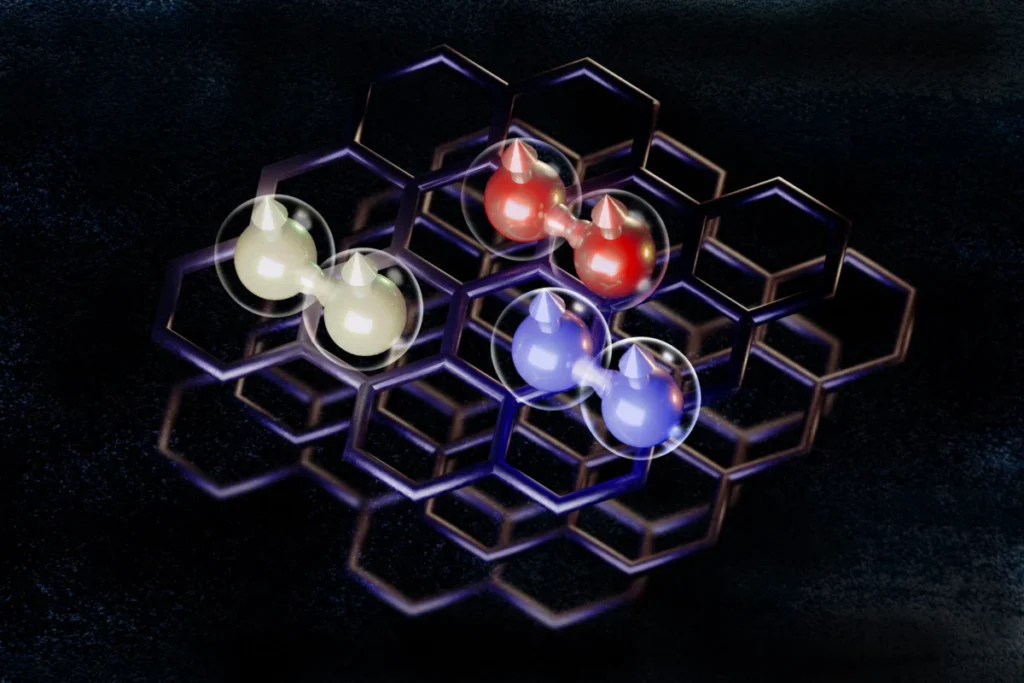
At the heart of this discovery is graphene, a single-atom-thick layer of carbon atoms arranged in a hexagonal honeycomb lattice. While graphene itself has been the subject of intense study since its isolation in 2004, the MIT team focused on a specific stacking arrangement known as rhombohedral graphene. In ordinary graphite, graphene layers are typically stacked in an alternating "AB" pattern. However, rhombohedral graphene consists of four or five layers stacked in a slightly offset, staircase-like "ABC" or "ABCAB" configuration.
This rhombohedral structure is found naturally within bulk graphite, but isolating it requires a meticulous process of exfoliation. Researchers use mechanical cleavage—often involving the use of adhesive tape—to peel away layers of graphite until they find the specific staircase-like flakes required for study. Unlike "magic-angle" twisted bilayer graphene, which requires researchers to manually stack and rotate two sheets of graphene at a precise 1.1-degree angle, rhombohedral graphene is a stable, crystalline form that exists in nature, albeit in small quantities within common graphite.
Long Ju’s research group has spent years investigating the electronic potential of these natural stacks. Their previous work revealed that rhombohedral graphene could host fractional electron charges and rare "chiral" forms of superconductivity. The current study, however, represents a deeper dive into how the density of electrons within the material dictates its ability to conduct electricity without friction.
Experimental Methodology and the "Tuning Knobs" of Physics
The MIT team, which included co-first authors Junseok Seo, Shenyong Ye, and Armel Cotten, employed a sophisticated experimental setup to probe the material’s limits. The researchers utilized "electrical doping" to manipulate the electron environment within the graphene samples. By applying an external voltage, they could either add electrons to the system or, as they did in this specific study, remove them. This process of removing electrons is known as "hole-doping," where the absence of an electron acts as a positively charged carrier.
As the team progressively lowered the electron density, they monitored the material’s electrical resistance. They were looking for the moment the voltage dropped to zero, signaling the onset of superconductivity. To further test the resilience of these states, the experiments were conducted at ultracold temperatures—near absolute zero—and in the presence of powerful magnetic fields.
This phase of the research involved a global collaboration. The team worked with Dominik Zumbühl’s group at the University of Basel in Switzerland, utilizing a specialized laboratory environment capable of maintaining high magnetic fields and millikelvin temperatures. Additional support and expertise were provided by researchers from Florida State University, the University of Florida at Gainesville, and the National Institute for Materials Science in Japan.
A Defiance of Magnetism: The Discovery of Four States
The results of the experiments were startling. The researchers identified four distinct superconducting states that emerged at specific electron densities. Most significantly, three of these states persisted even when subjected to intense magnetic fields.
In conventional superconductors, magnetic fields are considered the "enemy" of superconductivity. According to the standard BCS (Bardeen-Cooper-Schrieffer) theory, superconductivity arises when electrons with opposite spins pair up to form "Cooper pairs." A magnetic field exerts a force on these spins, attempting to align them in the same direction. If the field is strong enough, it breaks the Cooper pairs apart, thereby destroying the superconducting state.
However, in the rhombohedral graphene samples, the superconducting states survived a parallel magnetic field of up to 9 Tesla—roughly 180,000 times stronger than the Earth’s magnetic field. Even more surprising was the material’s reaction to a perpendicular magnetic field. Instead of the superconductivity fading as the field increased, the researchers observed that it actually strengthened.
"From a fundamental physics point of view, it’s very exotic that a magnetic field doesn’t kill superconductivity, and instead it boosts it," noted Long Ju. Specifically, the transition temperature—the point at which the material becomes superconducting—rose from 55 millikelvin to approximately 90 millikelvin under the influence of the field. Furthermore, the material was able to carry 50 to 60 percent more current before the superconducting state collapsed.
Theoretical Implications: Aligned Spins and New Pairing Mechanisms
While the exact microscopic mechanism remains a subject of investigation, the MIT researchers have proposed a compelling hypothesis. They suggest that the electrons in rhombohedral graphene may not be pairing up in the traditional "opposite spin" configuration. Instead, they might be forming pairs with "aligned spins."
If the electrons already have spins pointing in the same direction, a magnetic field would not pull them apart. Instead, the field would pull both spins in the same direction, preserving the bond and potentially stabilizing the pair. This would explain why the superconductivity is not only resilient to magnetism but is actually enhanced by it.
This hypothesis points toward "unconventional superconductivity," a category of materials where the pairing mechanism is driven by something other than the vibrations of the crystal lattice (phonons). Such materials are of high interest to the scientific community because they often remain superconducting at higher temperatures than conventional materials, offering a potential path toward room-temperature superconductivity.
A Timeline of Graphene Evolution
The discovery of multiple superconducting states in natural graphite is the latest chapter in a two-decade-long saga of carbon research:
- 2004: Andre Geim and Konstantin Novoselov at the University of Manchester isolate graphene for the first time using the "Scotch tape method," eventually winning the Nobel Prize.
- 2018: Researchers at MIT, led by Pablo Jarillo-Herrero, discover that stacking two layers of graphene at a "magic angle" of 1.1 degrees induces superconductivity, sparking the field of "twistronics."
- 2021-2023: Long Ju’s group begins focusing on rhombohedral graphene, discovering that it possesses unique electronic correlations without the need for artificial twisting.
- 2024: The current study reveals that hole-doped rhombohedral graphene hosts four distinct superconducting states and demonstrates magnetic field enhancement, a rare and "exotic" phenomenon.
Broader Impact and Future Applications
The implications of this research extend far beyond the laboratory. By demonstrating that a "simple" and abundant material like carbon can be tuned to exhibit complex quantum states, the MIT team has opened new doors for quantum computing and energy technology.
In the realm of quantum computing, unconventional superconductors are highly sought after for the creation of topological qubits. These qubits are theorized to be much more stable and less prone to decoherence than current iterations, which could lead to the development of more powerful and reliable quantum computers. The ability of rhombohedral graphene to maintain superconductivity in high magnetic fields makes it a prime candidate for these advanced architectures.
Furthermore, the discovery simplifies the manufacturing challenge. While "magic-angle" graphene requires incredibly precise mechanical alignment that is difficult to scale, rhombohedral graphene is a naturally occurring crystalline structure. If researchers can find ways to synthesize or isolate larger quantities of rhombohedral stacks, it could lead to the development of carbon-based superconducting electronics that are easier to produce than current ceramic or metal-alloy alternatives.
Lead author Junseok Seo emphasized the creative aspect of the work, stating, "We’re not only dealing with what nature gives us, but we’re applying additional controls to change it to something that nature does not give us, but that can exist in the same material."
Conclusion: Redefining "Boring" Materials
The MIT study serves as a reminder that even the most well-known materials can harbor secrets when viewed through the lens of modern physics. Graphite, a material used for centuries in pencils and lubricants, has proven to be a playground for exotic quantum phenomena.
As the scientific community digests the "nutrition" provided by these experimental results, the focus will shift toward developing a robust theoretical model for the aligned-spin pairing. For now, the discovery of a material that thrives under the very magnetic forces that usually destroy its most prized property marks a transformative moment in the study of 2D materials.
This work was supported in part by the U.S. Office of Naval Research, with device fabrication taking place at the MIT.nano facility. As researchers continue to turn the "knobs" of voltage and magnetism, the simple carbon atom remains at the forefront of the next technological revolution.