The pursuit of sustainable energy solutions has led a team of international scientists to a significant breakthrough in the field of artificial photosynthesis. Researchers from the Dalian Institute of Chemical Physics (DICP) of the Chinese Academy of Sciences (CAS), in collaboration with Inner Mongolia University, have successfully engineered a hollow CdS@polydopamine nanoreactor. This synthetic system replicates two critical structural and functional features of living cells, providing a sophisticated blueprint for the next generation of nanomaterials designed to facilitate complex chemical transformations.
The study, spearheaded by Professor LI Can of DICP and Professor Jian Liu of Inner Mongolia University, was recently published in the prestigious Journal of the American Chemical Society (JACS). By bridging the gap between biological efficiency and material science, the research team has demonstrated a novel method for synthesizing hydrogen peroxide (H2O2) using nothing more than water, oxygen, and visible light. This development marks a pivotal step in "nanocell engineering," a discipline that seeks to emulate the high-precision biochemical environments found in nature to solve modern industrial challenges.
The Genesis of Nanocell Engineering and the Biomimetic Challenge
For decades, the scientific community has looked toward the natural world to understand how energy is converted at the molecular level. Living cells are the ultimate chemical processors; they manage to perform myriad reactions simultaneously with near-perfect selectivity and efficiency. This is largely due to their compartmentalized nature—organelles like mitochondria and chloroplasts provide specialized environments where reactants are concentrated and intermediate products are channeled through specific pathways.
In the realm of artificial photosynthesis, the challenge has always been the synchronization of multiple reaction steps. To produce fuels or chemicals from sunlight, a material must capture photons, separate charge carriers (electrons and holes), and transport protons effectively. In most synthetic catalysts, these steps occur haphazardly, leading to energy loss and low yields. The DICP-led team sought to overcome these limitations by creating a "nanoreactor" that behaves like a simplified synthetic cell.
The choice of hydrogen peroxide as the target product is strategically significant. Traditionally produced through the energy-intensive anthraquinone process—which requires high pressure, organic solvents, and generates significant waste—H2O2 is a vital chemical used in water treatment, textile bleaching, and as a clean propellant. A direct, solar-driven synthesis route would transform H2O2 production into a carbon-neutral industry.
Architectural Sophistication: Two Pillars of the Design
The newly developed nanoreactor is defined by two primary biomimetic features that distinguish it from conventional photocatalysts.
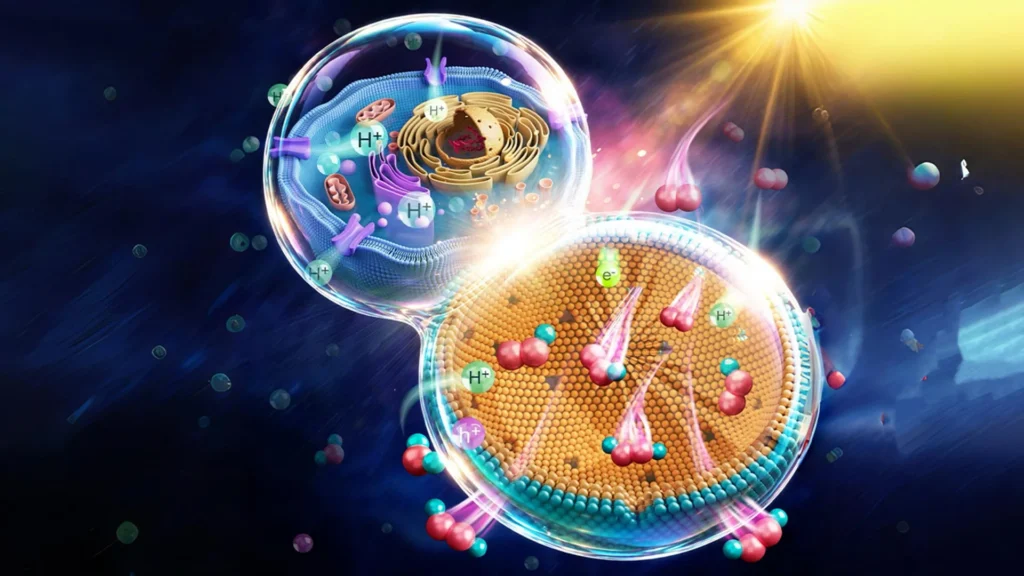
The first feature is the integration of a dynamic catechol/o-benzoquinone redox pair within a polydopamine (PDA) shell. In biological systems, proton pumps and relays are essential for moving hydrogen ions across membranes to maintain pH gradients or drive ATP synthesis. The researchers utilized the redox-active nature of polydopamine to act as a "proton relay." Instead of requiring external energy to pump protons, this chemical pair undergoes reversible transformations, accepting and releasing protons in a way that accelerates proton-coupled electron transfer (PCET). By streamlining the movement of protons alongside electrons, the nanoreactor prevents the "bottlenecks" that typically slow down the water oxidation and oxygen reduction reactions.
The second feature is the nanoreactor’s compartmentalized, hollow structure. The core of the system consists of a cadmium sulfide (CdS) semiconductor, which is encapsulated within the porous polydopamine shell. This architecture creates a confined nanoscale cavity. Much like a biological vacuole, this hollow space allows for the accumulation of reactants, increasing their local concentration and ensuring they stay in close proximity to the catalytic sites. Furthermore, the spherical, hollow geometry acts as a light-trap; photons entering the cavity are reflected internally, increasing the probability of absorption by the CdS core and enhancing the overall light-harvesting efficiency.
Breakthrough Performance and Data Analysis
The effectiveness of this biomimetic approach was validated through rigorous experimental testing. Under visible-light illumination in an aqueous environment, the CdS@polydopamine nanoreactors demonstrated an H2O2 photosynthesis rate of 3.24 mmol gcat.-1 h-1. More impressively, the system achieved a solar-to-chemical conversion (SCC) efficiency of 1.2%.
To put these numbers into perspective, many previous attempts at solar H2O2 production struggled to exceed 0.5% efficiency. The 1.2% benchmark is a significant leap toward the 5-10% efficiency levels generally considered necessary for commercial viability in solar-to-fuel technologies.
To understand the underlying mechanics, the researchers employed a suite of advanced analytical techniques. In situ spectroscopy allowed the team to observe the chemical changes in the polydopamine shell in real-time, confirming the role of the catechol/o-benzoquinone relay. Finite element simulations were used to model the concentration gradients within the hollow cavity, proving that the confined environment indeed boosted reaction kinetics. Theoretical calculations further clarified that the system operates via a Z-scheme heterojunction mechanism, a pathway that mimics the "Z-scheme" found in natural photosynthesis, where two different light-harvesting steps are linked to maximize the energetic potential of the electrons.
Chronology of Development and Collaborative Efforts
The development of the CdS@polydopamine nanoreactor is the result of a multi-year effort within the Chinese Academy of Sciences to refine artificial photosynthesis.
- 2018-2020: The DICP team focused on the synthesis of yolk-shell and hollow nanostructures, identifying polydopamine as a promising material due to its biocompatibility and tunable redox properties.
- 2021: Collaboration with Inner Mongolia University began, focusing on the theoretical modeling of proton-coupled electron transfer in confined spaces.
- 2022: Initial prototypes showed promise but struggled with stability. The team pivoted to a Z-scheme heterojunction design to better balance the two half-reactions (water oxidation and oxygen reduction).
- 2023: Successful integration of the nanoreactors into hydrogel matrices was achieved, allowing for the first outdoor tests under natural sunlight.
- 2024: Final data collection and publication in the Journal of the American Chemical Society.
Professor LI Can, a member of the Chinese Academy of Sciences and a leading figure in catalysis, emphasized that the collaboration was key. "By combining DICP’s expertise in solar energy conversion with the structural modeling capabilities of Professor Liu’s team, we were able to move beyond simple material synthesis into the realm of functional systems engineering," Li noted.
Practical Implementation: The Hydrogel Matrix
One of the most common criticisms of nanotechnology is the difficulty of recovering and reusing powder-based catalysts from liquid solutions. To address this, the researchers embedded the nanoreactors into a sodium alginate hydrogel. Sodium alginate, a natural polymer derived from seaweed, is environmentally benign and provides a stable, porous support structure.
The resulting solid photocatalyst "beads" or membranes can be easily retrieved from reaction tanks. In long-term stability tests, these hydrogel-embedded nanoreactors maintained consistent H2O2 production rates over multiple cycles. Most importantly, the researchers demonstrated that the system functions effectively under natural, unfiltered sunlight, rather than just calibrated laboratory lamps. This proves that the biomimetic design is robust enough to handle the fluctuations in light intensity and temperature found in real-world outdoor environments.
Broader Implications for Synthetic Chemistry and Energy
The implications of this research extend far beyond the production of hydrogen peroxide. The success of the CdS@polydopamine nanoreactor provides a template for "biomimetic catalysis" that could be applied to a variety of other high-value chemical reactions.
For instance, the same principles of compartmentalization and proton relays could be used to improve the reduction of carbon dioxide (CO2) into liquid fuels like methanol or ethanol. It could also play a role in nitrogen fixation, another process that, in nature, relies heavily on complex proton and electron management within specialized cellular structures.
From an industrial standpoint, the move toward "nanocell engineering" represents a shift from traditional batch chemistry to a more localized, efficient, and modular approach. Small-scale, solar-powered H2O2 generators could be deployed in remote areas for water purification, eliminating the need for hazardous transport of concentrated peroxide.
Conclusion and Future Outlook
The work by Professor LI Can, Professor Jian Liu, and their colleagues represents a sophisticated fusion of biology and chemistry. By successfully mimicking the proton-relay mechanisms and the compartmentalized architecture of living cells, they have created a nanoreactor that sets a new standard for solar-to-chemical conversion efficiency.
"Our study provides a new strategy for engineering biomimetic nanoreactors that increasingly replicate the sophisticated functions of living cells," Professor Li stated during a briefing at the Dalian Institute. "This opens new opportunities not only in artificial photosynthesis but also in energy catalysis and the broader field of synthetic chemistry."
As the world continues to seek alternatives to fossil-fuel-dependent chemical manufacturing, the lessons learned from the CdS@polydopamine nanoreactor will likely serve as a cornerstone for future innovations. The ability to harness sunlight to drive complex, multi-step reactions with cellular precision brings the dream of a truly circular, solar-powered chemical economy one step closer to reality. The next phase of research will likely focus on scaling these systems for industrial-level output and exploring the use of non-toxic, earth-abundant alternatives to cadmium to ensure the entire lifecycle of the technology remains as green as the photosynthesis it imitates.