A collaborative team of scientists from the CSIR-Central Salt and Marine Chemicals Research Institute (CSMCRI) in Bhavnagar, the Indian Institute of Technology Gandhinagar (IITGN), Nanyang Technological University (NTU) in Singapore, and the S N Bose National Centre for Basic Sciences has announced the development of a groundbreaking filtration technology that could redefine industrial separation processes. Published in the prestigious Journal of the American Chemical Society, the study introduces "POMbranes," a new class of crystalline membranes engineered at the molecular level to provide unprecedented precision in filtering liquids. This innovation arrives at a critical juncture for global manufacturing, offering a pathway to drastically reduce energy consumption and facilitate the large-scale reuse of industrial wastewater.
The Global Challenge of Industrial Separation
In the modern manufacturing landscape, the separation of chemical substances is a fundamental yet invisible pillar of production. From the purification of life-saving pharmaceuticals to the treatment of toxic dyes in the textile industry and the processing of food products, separation is essential. However, the methods currently used to achieve these results are often remnants of a previous industrial era. Traditional processes such as distillation and evaporation rely on heating liquids to separate components based on boiling points, a method that is inherently energy-intensive.
Current data suggests that these separation operations account for approximately 40% to 50% of the total energy consumed by global industrial sectors. In an era where carbon neutrality and energy efficiency are no longer optional, the reliance on thermal-based separation is a significant hurdle. While membrane-based filtration—essentially acting as a molecular sieve—has long been viewed as a cleaner alternative, existing technologies have faced persistent hurdles. Conventional polymer membranes often suffer from irregular pore sizes and structural instability. Over time, the plastic-like materials used in these filters can degrade, lose their shape, or become clogged, leading to a decline in performance and necessitating frequent, costly replacements.
Engineering the POMbrane: A Molecular Masterpiece
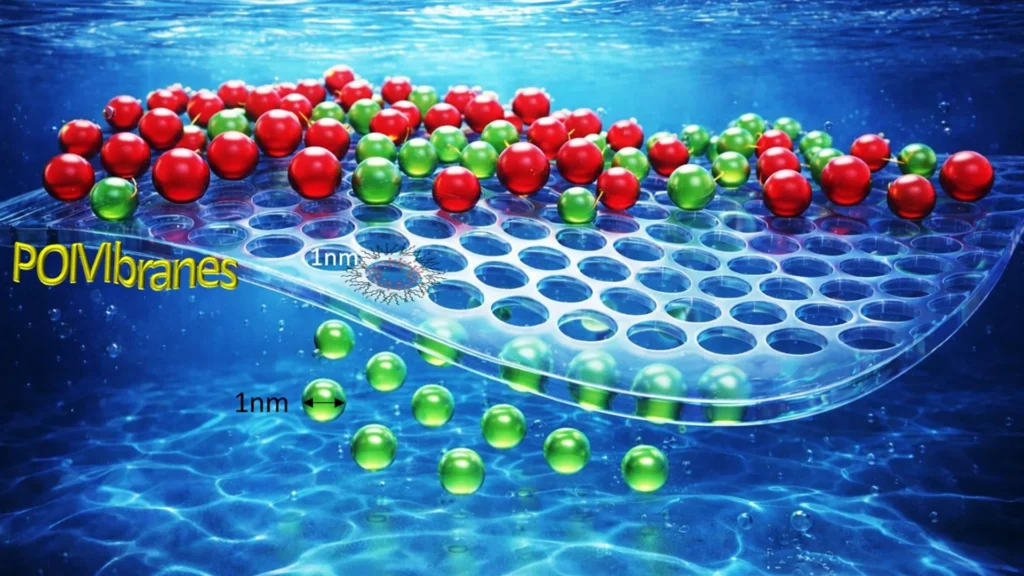
To overcome the limitations of traditional polymer filters, the research team looked to nature for inspiration, specifically the biological "aquaporins" that regulate water flow in living cells with absolute precision. The result is the "POMbrane," a name derived from the Polyoxometalate (POM) clusters used to build them. Unlike traditional membranes where pores are created through chemical etching or polymer stretching—resulting in uneven gaps—POMbranes are constructed from metal clusters that possess a naturally occurring, perfectly uniform opening.
Dr. Shilpi Kushwaha, Senior Scientist at CSMCRI, explained that these pores are approximately one nanometer wide—roughly 100,000 times thinner than a human hair. Because these holes are a fundamental part of the crystalline structure of the POM cluster, they are "permanently stable." Ms. Priyanka Dobariya, a research scholar at CSMCRI and co-first author of the study, described these clusters as tiny, crown-shaped metal structures. The central hole in these "crowns" serves as the filtration channel, ensuring that every single pore in the membrane is identical in size and shape, a feat previously thought nearly impossible to achieve at scale.
The Science of Self-Assembly and Scalability
The primary challenge in moving from a laboratory concept to an industrial tool lies in the assembly. A single POM cluster is far too small to be useful on its own; billions of them must be arranged into a continuous, defect-free sheet. The research team solved this by attaching flexible chemical chains to the POM clusters, allowing them to behave in a way that facilitates self-organization.
When these modified clusters are introduced to a water surface, they naturally spread out into an ultrathin film. By meticulously adjusting the length of the attached chemical chains, the researchers can control the density of the clusters. This process ensures that the only way for a molecule to pass through the film is by traveling through the one-nanometer holes in the center of the clusters. Dr. Raghavan Ranganathan, Associate Professor at IITGN’s Department of Materials Engineering, noted that this creates a "high-tech sieve" where the precision is dictated by the laws of chemistry rather than the mechanical limits of manufacturing.
To verify these results, Dr. Ranganathan and Mr. Vinay Thakur, a PhD scholar at IITGN, utilized advanced molecular-level simulations. These simulations provided a digital blueprint of how molecules interact with the POM clusters, confirming that the membrane could distinguish between molecules based on minute differences in their molecular weight—specifically between 100 and 200 Daltons.
Performance Metrics and Industrial Implications
The testing phase of the POMbranes revealed a performance leap that has the potential to disrupt the filtration market. The researchers reported that these membranes offer nearly ten times better separation performance than current state-of-the-art polymer technologies. Beyond precision, the POMbranes demonstrated remarkable resilience. They remained stable across a wide range of acidity levels (pH ranges), a crucial requirement for industrial environments where harsh chemicals are frequently used.
Dr. Ketan Patel, Principal Scientist at CSMCRI, emphasized that the flexibility and scalability of the POMbranes are what set them apart. "Our membranes are not just laboratory curiosities; they can be manufactured in large sheets and are flexible enough to be integrated into existing industrial systems," he stated. This combination of durability and high selectivity makes them an ideal candidate for "Zero Liquid Discharge" (ZLD) systems, which aim to eliminate wastewater by recycling every drop used in a factory.
Economic Impact on India’s Textile and Pharmaceutical Sectors
The timing of this discovery is particularly significant for India, where the textile and pharmaceutical industries are central to the national economy. The Indian textile and apparel sector currently contributes over 2.3% to the country’s GDP and accounts for 13% of industrial production. With the domestic market projected to grow from its current valuation of $160-225 billion to as much as $350 billion by 2030, the environmental footprint of this growth is a major concern.
Textile dyeing is notoriously water-intensive and produces large volumes of wastewater contaminated with complex dye molecules. Traditional treatment methods often fail to remove these dyes effectively or require massive amounts of energy to do so. POMbranes could allow textile mills to selectively filter out dye molecules while allowing clean water to pass through for immediate reuse. This would not only reduce the demand for freshwater—an increasingly scarce resource in many parts of India—but also lower the cost of waste management.
Similarly, in the pharmaceutical sector, the purification of drugs and the recovery of expensive solvents are critical to maintaining product quality and profitability. Mr. Vinay Thakur pointed out that the ability of POMbranes to operate at high precision while consuming low energy could significantly lower the overhead costs for pharmaceutical manufacturers while ensuring the stringent purity standards required for medical products.
A Chronology of Innovation and Future Outlook
The development of the POMbrane is the result of years of interdisciplinary collaboration. The project began with the fundamental chemical synthesis of POM clusters at CSMCRI and the S N Bose National Centre for Basic Sciences, followed by the materials engineering and simulation expertise provided by IITGN and NTU Singapore. This "platform technology" approach means that the POMbrane is not limited to a single application; its structure can be tuned for various tasks, from desalinating seawater to extracting lithium for batteries or capturing carbon emissions.
Industry analysts suggest that the adoption of molecularly engineered membranes like POMbranes could represent a shift toward "Next-Generation Manufacturing." As global regulations on industrial discharge tighten and the cost of energy continues to fluctuate, technologies that offer both environmental and economic benefits are likely to see rapid investment.
The success of the POMbrane study serves as a testament to the power of nature-inspired design. By replicating the efficiency of biological systems through the lens of advanced chemistry and materials science, the research team has provided a tangible solution to some of the most persistent challenges in industrial engineering. As the technology moves toward commercialization, it stands as a beacon for how sustainable innovation can drive the future of global industry, balancing the need for economic growth with the imperative of environmental stewardship.