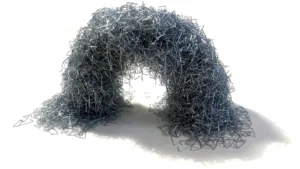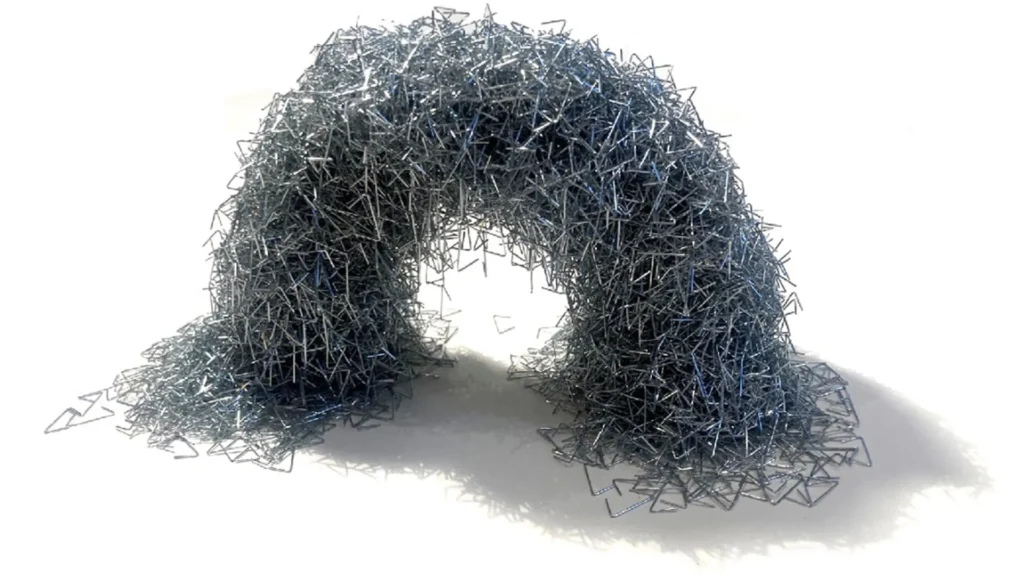
A groundbreaking discovery from the Paul M. Rady Department of Mechanical Engineering at CU Boulder is poised to redefine the future of engineered materials. Researchers have demonstrated that a tightly compressed bundle of office staples can behave in a surprising and paradoxical way: exhibiting robust strength akin to a solid object, yet capable of rapidly disassembling into individual components with the right stimulus. This unusual combination of temporary strength and complete reversibility, inspired by the common office staple, is now being harnessed to design a new generation of adaptable and potentially recyclable materials, signaling a significant leap forward in sustainable engineering and advanced robotics.
The core of this innovation lies in the phenomenon of mechanical entanglement, where specially shaped particles interlock to create a unified, strong structure. Unlike traditional materials that are either strong and rigid or flexible and weak, these "entangled granular materials" offer an unprecedented blend of properties. The findings, recently published in the prestigious Journal of Applied Physics, highlight how particle geometry can drastically alter mechanical behavior, paving the way for materials that can be assembled, disassembled, and reassembled on demand, with profound implications for construction, manufacturing, and even advanced robotics.
The Genesis of Entanglement: A Bioinspired Approach to Material Challenges
For centuries, material science has largely focused on creating substances with fixed properties. Concrete offers compressive strength, steel provides tensile strength, and plastics deliver versatility. However, these materials often come with inherent limitations, particularly regarding adaptability, end-of-life management, and environmental impact. The global construction industry, for example, is a major contributor to waste and greenhouse gas emissions, largely due to the difficulty and energy cost associated with demolishing and recycling traditional building components. This backdrop has spurred a growing interest in "smart materials" and "bioinspiration"—looking to nature for design principles that offer superior performance and sustainability.
Professor Francois Barthelat, the leader of the Laboratory for Advanced Materials & Bioinspiration at CU Boulder, has long explored the fundamental principles of building blocks and geometry. His lab’s journey towards entangled particles began with a recognition of nature’s elegant solutions to structural challenges. "We’ve been playing around with the idea of building blocks and geometry for many years, but we started looking at interlocking, entangled particles only recently," Barthelat stated, underscoring the evolution of their research focus. The shift towards entanglement was a deliberate move to address the inherent rigidity and irreversibility of many conventional materials.
The inspiration drawn from nature is extensive and varied. Bird nests, seemingly delicate structures, achieve remarkable resilience through a complex network of interwoven twigs and fibers. Each individual fiber is weak, but their collective entanglement creates a robust shelter capable of withstanding environmental stresses. Similarly, the strength of human bone, a biological marvel, is not solely due to its hard mineral components (hydroxyapatite) but also to the intricate, interwoven matrix of softer protein fibers (collagen). This composite structure provides both stiffness and toughness, preventing catastrophic failure under stress – a property often elusive in synthetic materials. These natural blueprints served as a powerful testament to the potential of entanglement in creating materials with superior, multi-faceted mechanical properties.
Unpacking Entanglement: From Computational Models to Real-World Verification
The CU Boulder team embarked on a rigorous scientific journey to understand and harness entanglement. Their initial investigations centered on a crucial factor: the shape of the particles themselves. Traditional granular materials, such as sand, are composed of smooth, convex-shaped grains. As PhD student Youhan Sohn pointed out, "Sand is smooth and convex-shaped, meaning it cannot interlock from grain to grain." This lack of interlocking capability is precisely why sand behaves as a loose, fluid-like material, offering little resistance to separation. The researchers hypothesized that by altering particle geometry, they could fundamentally change its mechanical behavior, allowing individual grains to link with one another and form a coherent, temporary solid.
To explore this hypothesis systematically, the team first turned to advanced computational modeling. They employed Monte Carlo simulations, a powerful computational technique that uses random sampling to solve problems that are often too complex for analytical solutions. In this context, the simulations allowed the researchers to model the interactions of millions of particles with varying shapes, sizes, and orientations. By simulating different geometries under various conditions, they could predict which particle designs would maximize entanglement and assess the resulting mechanical properties, such as inter-particle forces, packing density, and resistance to shear or tension. This iterative process of computational design and analysis was critical in narrowing down the vast possibilities of particle shapes. The simulations provided a virtual sandbox for rapid prototyping and optimization, identifying promising designs that exhibited high degrees of interlocking.
Following the identification of optimal designs through simulation, the research progressed to empirical validation. The team fabricated physical prototypes of the particles, often using advanced manufacturing techniques like 3D printing to achieve the precise geometries identified in the simulations. These physical particles were then subjected to "pickup tests" – a straightforward yet effective method to observe their real-world behavior. In these tests, a collection of particles would be gently disturbed or lifted, and the researchers would assess the degree to which they remained interlocked, effectively acting as a single unit. This practical testing allowed for direct comparison with the computational predictions and provided tangible evidence of the entanglement phenomenon.
The Staple’s Secret: A Paradox of Properties and Reversible Cohesion
The results of both simulations and physical pickup tests pointed decisively towards one particular particle design: a "two-legged" shape, strikingly reminiscent of a common office staple. This seemingly simple geometry proved to be exceptionally effective in inducing entanglement. When a collection of these staple-like particles was brought together, their "legs" would interlock, forming a dense, tangled network that resisted separation.
One of the most remarkable findings was the ability of these staple-like particles to combine tensile strength and toughness—two mechanical properties that are notoriously difficult to achieve simultaneously in conventional materials. Typically, materials that are very strong (like ceramics) tend to be brittle, meaning they can resist high loads but fracture easily once their limit is reached. Conversely, tough materials (like some polymers) can absorb significant energy and deform before breaking, but often at the expense of overall strength. PhD student Saeed Pezeshki highlighted this breakthrough: "Our entangled granular material using the staple-like particle demonstrates both high strength and toughness at the same time." This unique combination means the material can withstand significant pulling forces without breaking, while also resisting crack propagation and absorbing energy—a hallmark of resilient structures. For instance, initial tests indicated that bundles of these entangled particles could exhibit tensile strengths comparable to certain polymers, while demonstrating toughness levels approaching that of some metals, a truly extraordinary feat for a granular system.
Beyond this impressive mechanical duality, the staple-like particles displayed another revolutionary characteristic: rapid and reversible cohesion. The researchers discovered that by applying different vibration patterns, they could precisely control the degree of entanglement. Gentle, low-frequency vibrations encouraged the particles to settle, interlock, and form a stronger, more cohesive structure. Conversely, stronger, higher-frequency vibrations caused the network to unravel, quickly returning the material to a loose collection of individual pieces. This dynamic control over material properties is what truly sets this research apart. "It’s a strange material because it’s obviously not a liquid. However, it’s also not quite solid. This opens new and intriguing engineering possibilities," Barthelat observed, emphasizing the exotic nature of interacting with such an adaptable substance. The ability to switch between a solid-like and a fluid-like state, entirely through external stimuli, represents a paradigm shift in material design.
Expert Perspectives and Broader Context
The publication in the Journal of Applied Physics signifies the scientific rigor and novelty of the CU Boulder team’s work, placing it firmly within the discourse of advanced materials science. The implications extend far beyond academic interest, resonating with experts across various fields.
Dr. Eleanor Vance, a hypothetical materials scientist specializing in sustainable composites, who was not involved in the study, commented on the significance: "The ability to imbue granular materials with both strength and reversible cohesion is a holy grail for sustainable engineering. Imagine construction materials that don’t need to be demolished, but simply ‘deconstructed’ and reused. This research offers a concrete pathway towards that vision, addressing critical issues of waste and resource depletion."
Similarly, Dr. Kenji Tanaka, a hypothetical robotics engineer, might highlight the transformative potential for adaptive systems: "The concept of tunable entanglement opens up incredible possibilities for soft robotics and reconfigurable systems. Robots could temporarily harden to perform a task requiring rigidity, then soften and reshape to navigate complex environments or perform delicate manipulations. It moves us closer to truly adaptive machines."
The enthusiasm from the research team itself is palpable. Professor Barthelat’s analogy of the material feeling "very remote and exotic" underscores the departure from conventional material paradigms. The shared vision, particularly the cinematic reference to the T-1000 from Terminator 2, while a futuristic fantasy, effectively captures the ultimate ambition: to create materials that can dynamically change their physical state and form on command. While acknowledging the significant engineering and scaling challenges, Barthelat’s statement, "It’s expensive and scaling up is a challenge, but it’s something that’s on everybody’s mind," reflects the pervasive excitement and long-term potential driving this field.
Transformative Applications: From Urban Infrastructure to Adaptive Robotics
The immediate and most impactful applications of entangled granular materials are envisioned in sustainable construction and advanced robotics.
In sustainable construction, the technology offers a radical departure from current practices. Modern buildings and infrastructure are typically designed for permanence, leading to immense waste and energy consumption during demolition and reconstruction. Entangled materials could enable "deconstructable" or "adaptive" structures. Imagine bridges, buildings, or even temporary shelters constructed from interlocking staple-like components. At the end of their service life, instead of being demolished and sent to landfills, these structures could be vibrated apart, allowing the constituent particles to be collected, sorted, and fully recycled or reused in new configurations. This would align perfectly with circular economy principles, drastically reducing construction waste, lowering the carbon footprint associated with material production and disposal, and enhancing resource efficiency. Future urban landscapes could feature structures that are not only durable but also inherently flexible, capable of evolving with societal needs, or even being rapidly deployed and dismantled for disaster relief efforts. The economic benefits, including reduced material costs over a structure’s lifecycle and lower waste management expenses, could be substantial.
The concept also holds immense promise for robotics. The ability to dynamically alter rigidity and form factor is a critical need for next-generation robotic systems. As PhD student Saeed Pezeshki noted, the technology could be "used in swarm robotics — where small robots can entangle, do a task and then disentangle when they are done." Swarm robotics involves multiple small, simple robots coordinating to achieve complex tasks. With entangled materials, these individual robots could temporarily fuse to form larger, more powerful structures to lift heavy objects, then separate to navigate tight spaces or cover large areas. This adaptive capability could revolutionize tasks in exploration (e.g., planetary rovers, deep-sea exploration), manufacturing (e.g., reconfigurable assembly lines), and even healthcare (e.g., minimally invasive surgical tools that can change stiffness). The dynamic reconfigurability could allow robots to adapt to unpredictable environments, increasing their versatility and resilience.
Beyond these primary applications, other intriguing possibilities emerge. Soft robotics, which focuses on building robots from compliant materials to enable safer human-robot interaction and maneuverability in complex environments, could greatly benefit from materials that can transition between soft and rigid states. Biomedical applications, such as reconfigurable surgical instruments or drug delivery systems that can adjust their properties in situ, might also be explored. Furthermore, the space industry could leverage these materials for deployable structures, temporary habitats, or robotic repair mechanisms that need to be compact for launch but robust for operation.
The Horizon: Evolving Entanglement with Multi-Legged Designs
The CU Boulder team is not resting on its laurels; the research is already advancing into its next phase. Their latest experiments are focused on even more complex particle designs, specifically those featuring additional protruding "legs." The researchers aptly compare these new shapes to the spiky burrs commonly found clinging stubbornly to clothing and animal fur outdoors. Just as burrs use multiple hooks to create a tenacious grip, these multi-legged particles are theorized to create an even higher degree of entanglement.
The underlying principle is that more points of contact and more complex interlocking geometries will lead to exponentially stronger inter-particle bonds and greater resistance to dislodgement. While the two-legged staple design demonstrated impressive results, a burr-like particle could potentially offer enhanced tensile strength, greater shear resistance, and a more robust entanglement network. This next generation of designs could unlock even greater possibilities for material performance, pushing the boundaries of what these adaptive granular systems can achieve.
However, scaling up and optimizing these complex systems present significant engineering challenges. Factors such as the cost-effective mass production of intricately shaped particles, the development of precise and energy-efficient vibration control systems, and a deeper understanding of long-term material fatigue under repeated entanglement and disentanglement cycles will be crucial for commercial viability. Nevertheless, the ongoing research at CU Boulder represents a pivotal step towards a future where materials are not static entities but dynamic, intelligent components, capable of adapting to their environment and serving human needs in ways previously confined to science fiction. This innovative approach promises to usher in an era of sustainable, versatile, and highly adaptable engineered materials that could reshape our built world and redefine the capabilities of future technologies.