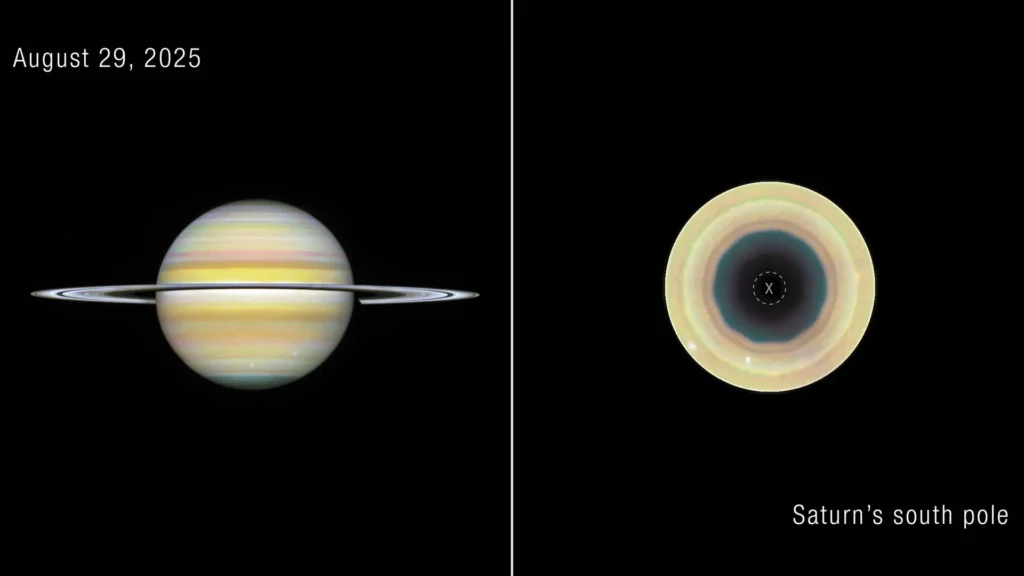
NASA’s Hubble Space Telescope has unveiled a remarkable and previously unobserved atmospheric phenomenon on Saturn: a colossal, ten-sided jet stream pattern encircling the planet’s south pole. This discovery marks the first time scientists have documented such a large, geometrically defined atmospheric feature in Saturn’s southern hemisphere. While bearing some superficial resemblance to the iconic and enduring hexagonal jet stream at Saturn’s north pole, crucial differences suggest that researchers are witnessing a distinct and dynamically evolving atmospheric process unfold in real-time. The groundbreaking findings were recently published in the prestigious scientific journal Science Advances, offering a tantalizing glimpse into the complex and ever-changing nature of giant planet atmospheres.
A New Geometrical Enigma Emerges on the Ringed Planet
The scientific community’s understanding of this nascent atmospheric structure was painstakingly pieced together through an analysis of several years of observations from the Hubble Space Telescope. These data, spanning from 2023 onwards, reveal a fascinating evolutionary trajectory. Earlier images, while less distinct, contained faint precursors to the feature, hinting at its eventual development into the sharply defined pattern observed more recently. This temporal mapping has allowed researchers to chart the genesis of this decagonal wave, providing an unprecedented opportunity to study a large-scale atmospheric pattern as it forms.
These crucial observations were facilitated by Hubble’s Outer Planet Atmospheres Legacy (OPAL) program, an initiative that has been diligently capturing annual images of the solar system’s outer planets for over a decade. This sustained observational commitment has proven invaluable in identifying and tracking transient and developing atmospheric phenomena.
"We’ve never seen anything quite like this in Saturn’s southern hemisphere," stated Amy Simon, a co-author of the study and the principal investigator for the OPAL program at NASA’s Goddard Space Flight Center in Greenbelt, Maryland. "The northern hexagon has been a consistent feature, present every time we’ve looked for more than 40 years. This southern feature is fundamentally different – it appears to be actively strengthening, offering us the exceptionally rare opportunity to witness a massive atmospheric pattern in the process of formation and evolution."
The changing seasons on Saturn played a pivotal role in enabling this discovery. As the gas giant transitioned through its seasonal cycle, its south pole gradually became more visible from Earth. Initial observations by astronomers utilizing ground-based observatories were the first to flag the unusual structure, prompting further investigation with more powerful instruments.
The Crucial Role of Citizen Scientists in Unveiling the Decagon
The identification and tracking of this nascent atmospheric feature owe a significant debt to the collaborative efforts of amateur astronomers worldwide. The study’s lead author, Agustín Sánchez-Lavega, a researcher at the University of the Basque Country in Spain, spearheads the Planetary Virtual Observatory Laboratory. This innovative platform aggregates ground-based images of solar system planets contributed by a global network of citizen scientists.
In images captured in 2024, Sánchez-Lavega, in collaboration with amateur astronomers Trevor Barry and Jean-Paul Oger, first noted a subtle, undulating band located near Saturn’s south pole. Subsequent ground-based observations collected in 2025 provided more robust evidence, strongly indicating that the feature had coalesced into a distinct decagon.
With these promising ground-based findings, researchers then turned their gaze to the Hubble Space Telescope for a more detailed and comprehensive view. The unique vantage point of space-based telescopes like Hubble allows for the acquisition of sharper, higher-resolution images that can capture complete rotations of Saturn without the distortion and blurring typically introduced by Earth’s atmosphere. This capability is essential for observing intricate atmospheric patterns.
"Given Saturn’s inherent symmetry in its north-south jet stream systems, we have been actively searching for a counterpart to the northern hexagon at the south pole in Hubble images since 1990," explained Sánchez-Lavega. "Intriguingly, even data from NASA’s Cassini spacecraft, which meticulously orbited Saturn between 2004 and 2017, revealed no indication of such a long-lived formation. The Hubble data has now definitively confirmed the feature’s presence, tracing it back to at least 2023."
A Deeply Rooted Atmospheric Structure
The newly identified wave is situated within one of Saturn’s powerful jet streams, regions of intense atmospheric flow. Importantly, observations indicate that this decagonal structure is not confined to the visible cloud tops; rather, it extends through multiple layers of the atmosphere. This suggests that it is a vertically integrated atmospheric phenomenon, rather than a superficial cloud pattern.
The apparent position of the decagon exhibits slight variations depending on the specific wavelength of light used by Hubble for observation. Different wavelengths penetrate Saturn’s atmosphere to varying depths, allowing astronomers to probe different altitudes. These altitudinal variations can subtly alter the perceived location of the decagon, providing clues about its three-dimensional structure.
"Perhaps the most intriguing aspect of this discovery for me is that this phenomenon appears to have formed quite recently," commented Simon. "The critical question that arises is: why has it suddenly materialized now, when we have no prior evidence of its existence?"
Scientists are currently grappling with fundamental questions regarding the trigger for the decagon’s formation and its potential long-term stability. The research team emphasizes that further dedicated observations from both the Hubble Space Telescope and the James Webb Space Telescope, coupled with sophisticated computer modeling, will be indispensable in unraveling the mysteries of its origin, its projected lifespan, and the extent to which it may ultimately resemble Saturn’s remarkably stable northern hexagon.
Decades of Hubble Observations Illuminate Planetary Evolution
The enduring operational history of the Hubble Space Telescope has afforded astronomers an unparalleled advantage: the ability to meticulously track changes in celestial bodies, including planetary atmospheres, over extended periods. This long-term perspective is critical for understanding dynamic processes that unfold over years or even decades.
The OPAL program, in particular, has proven to be an exceptionally valuable resource. It moves beyond providing isolated snapshots, instead offering a continuous stream of repeated observations. This sustained monitoring allows scientists to track seasonal shifts, follow the trajectory of transient storms, and identify atmospheric patterns that develop gradually over time.
"When we initiated the OPAL program, we anticipated encountering compelling surprises, though we couldn’t predict their specific nature," remarked Mike Wong, a co-author of the study from the University of California, Berkeley. "A significant portion of the discoveries emerging from OPAL are not based on single observations but are the result of accumulating data over many years. This consistent, long-term observational approach is enabling a wealth of new findings that would otherwise remain elusive."
The scientific community will continue to closely monitor Saturn, observing whether the southern decagon evolves into a stable, long-lived feature akin to its northern counterpart or if it proves to be a more transient phenomenon.
Broader Implications for Understanding Planetary Atmospheres
Future observations hold the promise of shedding light on the underlying mechanisms that power this newly discovered wave. Furthermore, the study of this decagonal structure could provide invaluable insights into atmospheric behavior across a range of giant planets within our solar system and beyond. Such findings might even offer broader perspectives on atmospheric dynamics that are fundamental to understanding processes occurring on Earth and other terrestrial planets. The intricate interplay of forces driving these massive atmospheric circulations on distant worlds may hold keys to deciphering complex weather patterns and climate dynamics closer to home. The ongoing investigation of Saturn’s southern decagon stands as a testament to the power of sustained observation and international collaboration in pushing the boundaries of our cosmic understanding.