In a significant advancement for industrial automation, machine-tool provider CNC Solutions has unveiled a groundbreaking "Technology Package" that redefines the application of robotic systems in complex manufacturing processes. This innovative solution, developed in collaboration with leading technology partners Stäubli, Beckhoff, and ENCY Robot, bridges the long-standing gap between traditional industrial robotics and the demanding precision of CNC machining. It addresses the critical need for sophisticated control and programming capabilities that far exceed the limitations of conventional robot teach-in methods, especially for high-accuracy, multi-axis operations such as milling, sanding, and advanced cutting applications.
The Evolution of Manufacturing Demands and the Challenge of Complexity
For decades, industrial robots have been invaluable assets in manufacturing, primarily excelling at repetitive, high-volume tasks like pick-and-place, assembly, and basic material handling. Their programming, often reliant on "teach-in" methods where an operator manually guides the robot through a sequence of points, proved efficient for these simpler, discrete operations. However, as manufacturing processes grew increasingly complex, demanding higher precision, intricate geometries, and continuous path control, the limitations of this traditional approach became glaringly apparent.
Modern CNC-class workloads, encompassing tasks like multi-axis milling, abrasive sanding, high-speed trimming, and laser or plasma cutting, involve managing millions of precise motion points. Manually teaching a robot to execute such intricate paths with the required accuracy, consistency, and speed is not only prohibitively time-consuming but often technically unfeasible. This bottleneck led to significant idle time for expensive robotic assets, extended project timelines, and inconsistent quality in finished products. CNC Solutions, with its extensive experience in supporting increasingly complex projects over the years, recognized this critical challenge firsthand. They observed that traditional controller-centric methods, which typically involved programming a robot directly through its proprietary controller, were simply inadequate for the nuances of continuous path generation and execution demanded by contemporary high-value applications.
The imperative was clear: a new workflow was needed, one that began with sophisticated computer-aided manufacturing (CAM) software, allowed for comprehensive simulation of the entire manufacturing cell, and ultimately controlled a robot with the precision, speed, and reliability characteristic of a dedicated CNC machine tool. This vision led to the conceptualization and development of the Technology Package.
A Collaborative Endeavor: Forging a New Path in Automation
The development of the Technology Package was a strategic convergence of expertise from several industry leaders, each contributing a crucial piece to the puzzle. CNC Solutions acted as the orchestrator and integrator, drawing on its deep understanding of machine tool applications and the specific needs of its clientele. The core solution is built upon three foundational components:
-
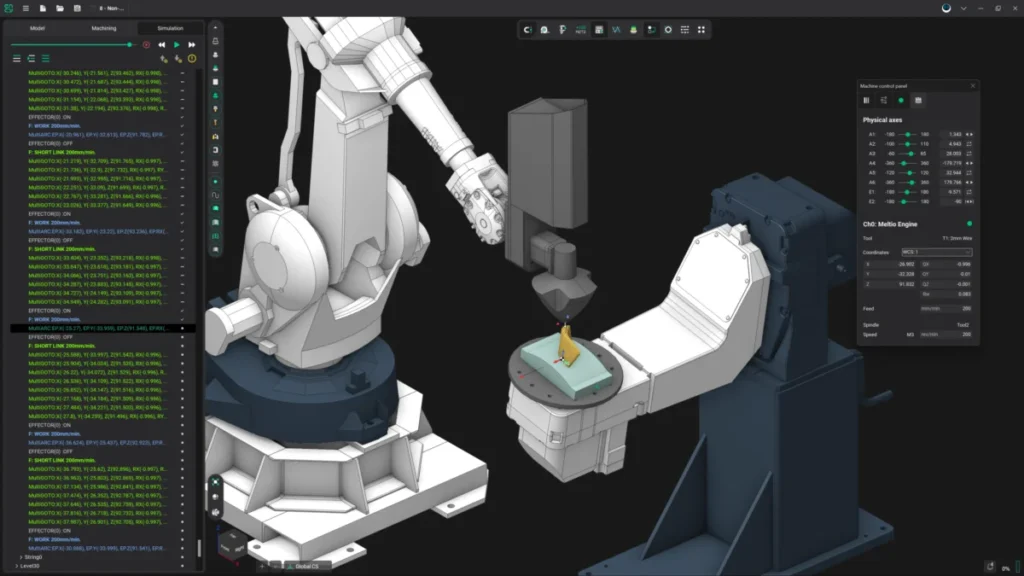
ENCY Robot Software: This offline programming software serves as the intelligent brain of the system. It calculates intricate toolpaths, simulates the entire robotic cell in a virtual environment, and generates the necessary robot instructions without requiring the physical robot to be present or operational. This dramatically reduces commissioning time and eliminates the need for on-the-fly, error-prone manual teaching.
-
Beckhoff Motion Controller: At the heart of the system’s control lies a powerful Beckhoff motion controller. Known for its PC-based automation solutions, Beckhoff provides the robust hardware and software infrastructure to operate the robot using standard CNC commands. This includes precise control over feeds, modes, and frames, effectively transforming the robot’s operation into that of a conventional CNC machine. The Beckhoff platform’s openness and performance are critical for managing the high data throughput and real-time processing required for complex motion control.
-
Stäubli Robots: The physical execution of these complex paths is entrusted to Stäubli robots. Stäubli is renowned for its high-precision, high-repeatability industrial robots, characterized by their robust design and sealed construction. This sealed nature is particularly vital for abrasive applications like grinding and milling, where dust and debris can compromise robot integrity and performance. The seamless integration of a CNC-style motion layer for trajectory execution with Stäubli’s mechanical precision ensures that the calculated paths are executed with utmost fidelity and reliability.

This integrated stack represents years of iterative development and refinement by the CNC Solutions team. The journey involved meticulously tuning robot axis motions to achieve the consistency typically associated with a dedicated CNC machine. The result is a standardized, commercially viable solution that integrators can readily deploy and customize within their own manufacturing cells.
Deep Dive into the Technology Package: Features and Functionality
The Technology Package is engineered to empower integrators and manufacturers to tackle applications previously deemed too complex or costly for industrial robots. Its comprehensive feature set addresses common pain points and introduces advanced capabilities that streamline operations and enhance performance.
ENCY Robot: The Power of Offline Programming and Digital Twin Simulation
A cornerstone of the solution is the reliance on ENCY for its offline robot programming layer. Traditional robot programming often involves significant downtime, as the robot must be taken offline and manually programmed or "taught" each point. ENCY eradicates this inefficiency by providing an all-in-one environment for design, technology setup, toolpath calculation, and exhaustive simulation.
Key functionalities of ENCY include:
- Full Cell Simulation: Simulates the entire robotic cell, including the robot, workpiece, tooling, and fixtures.
- Collision Control: Automatically detects and prevents potential collisions between the robot and its environment, or between different parts of the robot itself.
- Axis Limit Checks and Singularity Avoidance: Ensures that robot movements remain within mechanical limits and avoids singular positions that can lead to unpredictable behavior or damage.
- Zero-Code Digital-Twin Builder: Allows for rapid creation of virtual models (digital twins) of the manufacturing cell, enabling comprehensive testing and optimization before any physical setup.
- Extensive Libraries: Provides access to a rich library of pre-defined tools, processes, and robot models, accelerating setup and programming.
- Direct Translation of CAM Strategies: Trusted CAM strategies are directly translated into reliable robot instructions, ensuring consistency and accuracy from design to execution.
ENCY’s broad functionality supports tasks ranging from simple two-axis movements to highly complex multi-axis cells, making it a versatile tool for diverse manufacturing needs. By managing code paths and models internally, ENCY ensures transparent system behavior, simplifying debugging and optimization.
Beckhoff Control: Bringing CNC Precision to Robotics
The Beckhoff motion controller acts as the central nervous system, translating the sophisticated paths generated by ENCY into real-time robot movements. This integration provides:
- Standard CNC Commands: Operators can interact with the robot using familiar CNC commands, feeds, modes, and frames, significantly reducing the learning curve for those accustomed to machine tools.
- High-Performance Motion Control: Beckhoff’s TwinCAT automation software provides the real-time kernel and motion control functionalities necessary for precise, synchronized multi-axis movements, critical for smooth trajectory execution.
- CNC-Style HMI and Handheld Pendant: The system includes a human-machine interface (HMI) and a handheld pendant designed with a CNC-like layout, offering intuitive control and monitoring. Standard features include Auto, Manual, and Home modes, feed overrides, and integrated emergency-stop logic. Manual moves using encoder-wheel controls further enhance operational flexibility.
Stäubli Robotics: The Foundation of Mechanical Excellence
Stäubli robots provide the physical platform for execution, offering:
- Precision and Repeatability: Essential for high-accuracy applications, ensuring consistent quality across production runs.
- Sealed Construction: Resists ingress of dust, liquids, and abrasive particles, extending robot lifespan and reducing maintenance in harsh manufacturing environments. This is particularly crucial for applications like grinding, blasting, and cutting.
- Single-Cable Connection: A major innovation in the Technology Package is the plug-and-play wiring, connecting the Stäubli robot to the Beckhoff controller with a single cable. This simplifies installation, reduces cabling complexity, and enhances system reliability.
Addressing Real-World Challenges with Advanced Features
Recognizing that real-world manufacturing cells often deviate from idealized specifications, the Technology Package incorporates advanced features that typically require extensive setup time:
- Absolute, TCP, and Frame Calibration: Essential for ensuring the robot’s understanding of its environment and tool center point (TCP) is highly accurate, compensating for installation variations.
- Singularity Management: Automatically handles and avoids singular robot positions, which can cause unpredictable movements or control loss.
- OPC UA Connectivity: Provides a standardized, secure, and reliable communication interface for seamless integration into plant networks and Industry 4.0 ecosystems.
- Real-time Path Adjustments: Allows for minor modifications to the robot’s trajectory during operation, crucial for adaptive manufacturing processes.
- Tool-Wear Compensation: Automatically adjusts toolpaths to account for tool wear, maintaining consistent quality and extending tool life.
The system also comes with predefined and machine-tuned processes for a wide array of applications, including milling, grinding, deburring, polishing, blasting (wet/dry), plasma and laser cutting/welding, waterjet cutting, cladding, painting, cleaning, and gluing. These validated starting points significantly accelerate deployment and reduce the learning curve for integrators.
Implications and Broader Impact on Manufacturing

The commercial offering of CNC Solutions’ Technology Package marks a pivotal moment for industrial integrators and manufacturers seeking to push the boundaries of robotic automation. By effectively transforming an industrial robot into a versatile CNC machine tool, the solution unlocks a host of benefits and opens doors to previously inaccessible applications.
Enhanced Productivity and Efficiency:
- Reduced Time to First Good Part: A key metric in manufacturing, this is drastically improved because complex path planning and simulation are handled offline. This means integrators can focus their efforts on fixtures, tools, and process optimization rather than time-consuming online robot teaching.
- Maximized Robot Utilization: By eliminating idle time associated with manual programming, robots can be kept in production for longer, leading to higher throughput and better return on investment.
- Consistent Quality: The precision and repeatability inherent in the CNC-style motion layer ensure consistent quality across all manufactured parts, reducing scrap and rework.
Expanded Application Horizons:
The ability to perform high-precision milling, intricate trimming, and consistent sanding with robots means that many integrators, who previously avoided these applications due to the limitations of traditional teach-in methods, can now confidently pursue them. This expands the scope of automation, allowing robots to tackle higher-value tasks and contribute more significantly to complex product manufacturing.
Reduced Project Risk and Warranty Exposure:
The standardized nature of the Technology Package means that more project elements are reused rather than developed from scratch. This significantly reduces delivery risk, shortens project timelines, and lowers warranty exposure for integrators. The pre-validated processes and robust integration minimize the chances of unforeseen issues during commissioning and operation.
Democratization of Advanced Robotics:
One of the most profound implications is the simplification of advanced robot programming. By allowing integrators and operators to interact with the robotic system using familiar CNC paradigms, the need to master vendor-specific robot languages is eliminated. Expertise can remain focused on core manufacturing competencies such as PLCs, safety systems, fixturing, end-effectors, and process knowledge, rather than esoteric robot programming syntax. This lowers the barrier to entry for adopting sophisticated robotic solutions.
Statements and Industry Perspective:
While specific individual statements were not provided in the original text, the initiative itself speaks volumes about the collective vision of the collaborating companies. A spokesperson from CNC Solutions might emphasize: "Our Technology Package represents a paradigm shift. We’ve taken the robustness and flexibility of industrial robots and combined it with the precision and predictability of CNC machining. This allows our integrator partners to deliver high-value solutions faster, with less risk, and unlock entirely new possibilities for their customers."
From a Stäubli perspective, the emphasis would likely be on their commitment to high-performance mechanics: "Stäubli’s precision robots are designed for demanding applications. This collaboration with Beckhoff and ENCY demonstrates how our hardware, combined with intelligent control and programming, can achieve unprecedented levels of accuracy and reliability in challenging industrial environments."
Beckhoff, known for its open automation philosophy, would highlight the power of PC-based control: "The integration of our powerful motion controllers with ENCY’s advanced CAM and Stäubli’s robust robots exemplifies the flexibility and scalability of PC-based automation. It enables manufacturers to achieve true CNC-level performance from their robotic assets, driving forward the principles of Industry 4.0."
ENCY’s perspective would underscore the efficiency gains: "Our offline programming and simulation software is designed to transform commissioning time into productive time. By providing a comprehensive digital twin environment, we ensure that complex robot paths are perfected virtually, before any physical interaction, leading to faster deployment and superior results."
The Future of Manufacturing Automation
The Technology Package aligns perfectly with the broader trends of Industry 4.0 and the convergence of manufacturing technologies. It promotes greater flexibility, adaptability, and intelligence in production systems. As manufacturing continues to evolve towards mass customization and increasingly complex product designs, solutions that seamlessly integrate robotics with high-precision machining capabilities will become indispensable. This collaboration by CNC Solutions, Stäubli, Beckhoff, and ENCY is not merely an incremental improvement but a foundational step towards a more automated, precise, and efficient manufacturing future. It empowers businesses to take on higher-value applications, improve product quality, and significantly enhance their competitive edge in a rapidly changing global market.