CNC Solutions, a prominent provider in the machine-tool sector, has unveiled a groundbreaking "Technology Package" designed to redefine precision and efficiency in complex manufacturing operations. This innovative solution addresses the critical shortcomings of traditional robot teach-in methods, which have proven inadequate for the intricate demands of modern CNC-class workloads such as multi-axis milling, abrasive sanding, and advanced laser or plasma cutting. By integrating sophisticated offline programming software, state-of-the-art motion control, and high-precision industrial robots, CNC Solutions offers a unified workflow that dramatically enhances the capabilities of robotic automation, allowing it to perform with the speed and accuracy historically reserved for dedicated CNC machines.
The Evolution of Industrial Automation and a Growing Challenge
For decades, industrial robots have been instrumental in automating repetitive tasks on factory floors. Simple pick-and-place operations, material handling, and basic assembly lines have benefited immensely from their agility and tireless operation. The programming of these robots typically relies on "teach-in" methods, where an operator manually guides the robot arm through a sequence of desired points, recording each position. While effective for straightforward, low-complexity tasks involving a limited number of motion points, this approach falters significantly when confronted with the millions of precise motion points required for high-accuracy applications like contour milling, fine sanding, or intricate cutting paths.
The demand for greater precision, flexibility, and efficiency in manufacturing has steadily grown. Industries ranging from automotive and aerospace to medical device production and general fabrication are increasingly challenged by high-mix, low-volume production scenarios that necessitate adaptable automation solutions. Traditional controller-centric methods, often characterized by vendor-specific programming languages and limited integration capabilities, presented significant bottlenecks. Manufacturers faced idle robots during lengthy online programming sessions, extended project timelines, and inconsistent quality outputs due to the inherent variability of manual teaching. This created a clear gap: the need for robotic systems that could replicate the consistent, high-fidelity path execution of a CNC machine while retaining the flexibility of a robot.
CNC Solutions, with its long-standing expertise in machine tools, recognized this evolving need. Over the years, the company has supported an increasing number of complex projects, observing firsthand the limitations of existing robotic solutions in handling applications demanding CNC-level precision. The company’s vision coalesced around a solution that would start with computer-aided manufacturing (CAM) — the established standard for complex part definition and toolpath generation — and seamlessly extend this digital blueprint through simulation to direct, high-precision robot control.
A Unified Architecture: The Core Components of the Technology Package
The "Technology Package" represents a paradigm shift, moving away from fragmented systems towards a tightly integrated, three-pillar architecture. This innovative stack comprises:

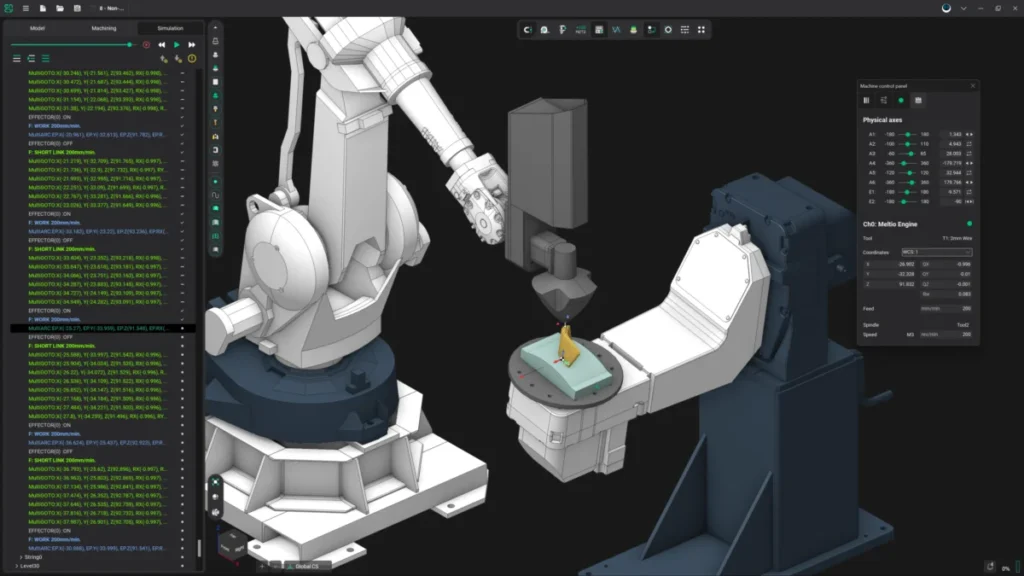
- ENCY Robot Offline Programming Software: At the foundation is ENCY Robot, a sophisticated offline programming and simulation platform. This software is responsible for calculating intricate toolpaths, simulating the entire robotic cell in a virtual environment, and generating robot instructions.
- Beckhoff Motion Controller: A powerful Beckhoff motion controller serves as the operational brain, translating standard CNC commands (including feeds, modes, and frames) into precise movements for the robot. Its PC-based control architecture and TwinCAT automation software facilitate high-performance, real-time control.
- Stäubli Industrial Robot: Stäubli robots, known for their exceptional precision, repeatability, and robust sealed construction, execute the meticulously planned paths. Their mechanical design makes them particularly suitable for demanding industrial environments, including those involving abrasive processes like grinding and milling where dust and debris are prevalent.
This integrated approach ensures that the robot operates not merely as a programmable arm, but as a true machine tool, enabling operators to focus on production optimization rather than manual intervention and error correction.
Deep Dive into ENCY Robot: Revolutionizing Robot Programming
The selection of ENCY as the offline programming layer was pivotal for the Technology Package’s success. Traditional online programming ties up valuable robot time, leading to significant downtime and impacting production schedules. ENCY liberates the programming process from the physical robot, allowing engineers to design, simulate, and refine robot operations concurrently with production.
ENCY offers an all-in-one environment that spans design, technology setup, toolpath calculation, and simulation. Its capabilities include:
- Comprehensive Cell Simulation: ENCY can simulate the entire robotic cell, including the robot, workpiece, fixtures, and surrounding environment. This digital twin capability is crucial for identifying potential issues before they occur on the factory floor.
- Collision Detection and Singularity Avoidance: The software rigorously checks for collisions between the robot, its tooling, and the cell components. It also identifies and mitigates singularities – problematic robot arm configurations that can lead to unpredictable movements or control loss – ensuring smooth and safe operation.
- Axis Limit Checks: ENCY verifies that all robot axis movements remain within their physical limits, preventing mechanical stress or damage.
- Zero-Code Digital-Twin Builder: This feature simplifies the creation and modification of digital twins, making the platform accessible even to users without extensive programming backgrounds.
- Extensive Libraries: ENCY comes equipped with rich libraries of robot models, tools, and process templates, accelerating project setup and development.
- Direct Translation of CAM Strategies: Crucially, ENCY translates trusted CAM strategies directly into reliable robot instructions. This eliminates the need for complex post-processing and manual adjustments, preserving the integrity of the original design intent.
By converting commissioning time into productive simulation time, ENCY significantly reduces the time-to-first-good-part, a key metric for manufacturers. Its broad functionality supports a wide range of applications, from simple two-axis tasks to highly complex multi-axis cells, making it a versatile tool for diverse industrial needs. The internal management of code paths and models ensures transparent system behavior, enhancing reliability and ease of debugging.
Beckhoff and Stäubli: Precision and Robustness at the Core
The seamless integration of the Beckhoff motion controller and Stäubli robot is fundamental to the Technology Package’s ability to achieve CNC-level performance.
Beckhoff Motion Control: Beckhoff’s PC-based control technology, underpinned by its TwinCAT automation software, provides the necessary computational power and real-time capabilities for complex motion control. Unlike traditional hardware-centric controllers, Beckhoff’s open, software-based architecture offers unparalleled flexibility and scalability. The controller operates the robot using standard G-code and M-code commands, familiar to anyone with CNC machining experience. This "CNC-style motion layer" enables precise trajectory execution, fine control over feeds and speeds, and seamless integration with other plant automation systems via standard interfaces like OPC UA. The ability to support external axes further expands the system’s versatility, allowing for synchronized control of additional mechanisms like rotary tables or linear tracks, crucial for larger or more complex workpieces.

Stäubli Robotics: Stäubli robots are engineered for high performance in demanding industrial environments. Their key attributes, which are critical for the Technology Package, include:
- Exceptional Precision and Repeatability: Stäubli robots are renowned for their sub-millimeter accuracy and consistent path execution, vital for applications requiring tight tolerances. This precision is maintained even under continuous operation, a stark contrast to the drift sometimes associated with less robust robotic systems.
- Sealed Construction: The robots feature a fully encapsulated design that resists dust, liquids, and abrasive particles. This is particularly advantageous for applications like grinding, polishing, and deburring, where environmental contamination can significantly impact robot longevity and performance.
- High Rigidity and Dynamics: Their robust mechanical structure ensures minimal vibration and deflection, allowing for high-speed movements without compromising accuracy.
- Single-Cable Connection: For simplified integration, Stäubli robots can connect to the Beckhoff controller with a single cable, streamlining wiring and reducing setup complexity.
This synergy between Beckhoff’s advanced control and Stäubli’s mechanical excellence creates a robust and highly accurate motion system capable of meeting the stringent demands of CNC applications.
Key Innovations and Operational Benefits
The Technology Package’s design incorporates several innovations that directly translate into significant operational benefits for integrators and end-users:
- CNC-Style Operator Experience: The system provides familiar CNC-style modes (Auto, Manual, Home), feed overrides, and emergency-stop logic. Operators accustomed to CNC machines can quickly adapt to controlling the robot, minimizing training time and improving user comfort. Manual moves using encoder-wheel controls are also supported for fine adjustments.
- Predefined and Machine-Tuned Processes: The package comes with validated starting points for common processes such as milling, grinding, deburring, polishing, blasting (wet/dry), plasma and laser cutting/welding, waterjet cutting, cladding, painting, cleaning, and gluing. This drastically reduces development time and risk for integrators.
- Plug-and-Play Integration: The streamlined single-cable connection to the Stäubli robot and the standardized Beckhoff motion cabinet simplify the physical integration process. Integrators can easily expand the system with their own PLCs, fixturing, and process equipment.
- Real-World Adaptability: Recognizing that real-world cells often deviate from theoretical specifications, the package includes features that typically require extensive setup:
- Absolute, TCP, and Frame Calibration: Ensures accurate positioning and tool center point definition.
- Singularity Management: Proactively addresses potential problematic robot configurations.
- OPC UA Connectivity: Provides standardized communication interfaces for plant networks, facilitating integration into broader Industry 4.0 ecosystems.
- Real-time Path Adjustments and Tool-Wear Compensation: Allows for dynamic corrections during operation, maintaining precision and extending tool life.
- Elimination of Vendor-Specific Robot Languages: A significant advantage is that there is no need to master proprietary robot programming languages. The system operates as a standard CNC axis group, allowing expertise to remain focused on PLCs, safety systems, fixturing, end-effectors, and process knowledge, rather than esoteric robot code.
Broader Impact and Implications for Manufacturing
The introduction of CNC Solutions’ Technology Package carries significant implications for the manufacturing sector:
- Democratization of Advanced Robotics: By simplifying the deployment and programming of high-precision robots, the solution makes advanced robotic capabilities accessible to a wider range of manufacturers, including small and medium-sized enterprises (SMEs) that may have previously shied away from complex automation due to cost and technical hurdles.
- Enhanced Productivity and Quality: The ability to handle complex path planning offline, combined with the precision of the integrated hardware, dramatically reduces time-to-first-good-part. This translates into higher throughput, lower defect rates, and consistent quality across production batches.
- Reduced Project Risk and Costs: Integrators benefit from decreased delivery risk and warranty exposure. By leveraging predefined processes and a standardized, validated solution, more project elements can be reused rather than developed from scratch, leading to faster deployment and more predictable outcomes. The reduction in online programming time also directly lowers operational costs.
- Shifting Labor Dynamics: The system allows human operators to transition from tedious, repetitive robot teaching to higher-value tasks such as process optimization, quality control, and managing multiple automated cells. This upskilling of the workforce aligns with the broader trends of smart manufacturing and Industry 4.0.
- Expansion of Robotic Applications: The solution enables integrators to confidently pursue higher-value applications such as precision milling, intricate trimming, and high-quality sanding – tasks that many previously avoided due to the limitations of traditional teach-in methods. This expands the market for industrial robotics into areas traditionally dominated by dedicated CNC machine tools.
- Strengthening the Smart Factory Vision: The integration of offline programming, real-time control, and standardized communication interfaces like OPC UA pushes manufacturing closer to the vision of fully interconnected and intelligent factories, where data flows seamlessly from design to production and beyond.
The CNC Solutions Technology Package is now commercially available, offering integrators a stable, proven solution that empowers industrial robots to perform with the precision, consistency, and operational ease of a machine tool. This integrated approach, refined over time to match the consistency of CNC machines, marks a significant milestone in bridging the gap between flexible robotics and high-precision manufacturing. By allowing teams to concentrate on fixtures, tools, and process optimization, it promises to unlock new levels of efficiency and capability across various shops, industries, and applications.