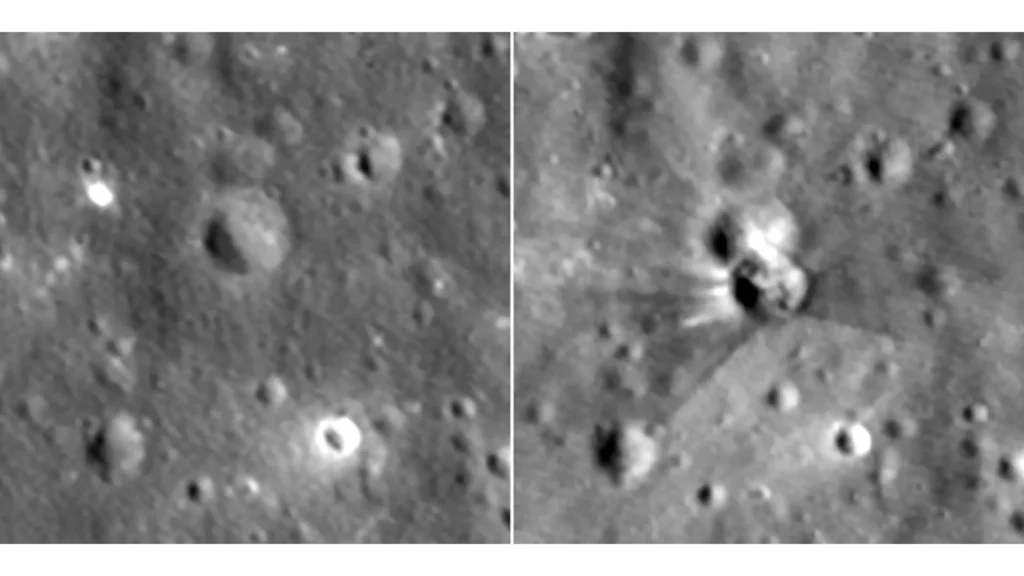
Between August 11 and 12, NASA’s Lunar Reconnaissance Orbiter (LRO) successfully photographed a newly formed crater on the Moon. This impact site is the direct result of a SpaceX Falcon 9 upper stage, which intentionally struck the lunar surface on August 5. The rocket stage had been launched in January 2025 as part of the Firefly Blue Ghost 1 mission, a privately funded lunar lander intended to reach the Moon’s surface. This event marks a significant milestone, offering scientists an unprecedented opportunity to study the immediate aftermath of a human-made impact on another celestial body and to analyze newly exposed lunar regolith.
A Delicate Dance to Capture the Cosmic Collision
Photographing the precise location of the impact demanded exceptional precision and careful maneuvering by the LRO spacecraft. Engineers had to strategically tilt the orbiter, orienting its sophisticated camera systems to capture the nascent crater as LRO passed approximately 60 miles above the lunar surface. Traveling at a brisk speed of about one mile per second, the spacecraft’s trajectory required meticulous planning to align its cameras with the relatively small impact site.
LRO operates in a polar orbit, circling the Moon from pole to pole approximately every two hours. As it completes its orbits, the Moon itself undergoes a slow rotation beneath the orbiter. This celestial ballet means that LRO must wait for a specific geographic location to rotate into a position that is within its field of view and suitable for observation. In the case of the SpaceX impact crater, this rotational dynamic necessitated a waiting period of six days. Only after this waiting period did the spacecraft achieve the optimal alignment and opportunity to capture clear imagery of the newly formed crater.
The timing of the photograph was as critical as the precise pointing of the camera. The LRO’s operational constraints meant that even a slight deviation of merely ten seconds, either too early or too late in its orbital pass, could have shifted the target area by as much as ten miles from the center of the resulting image. This level of precision underscores the sophisticated engineering and operational capabilities of the LRO mission, which has been instrumental in mapping and characterizing the lunar surface for over a decade.
Unveiling Lunar Secrets: Crater Dimensions and Composition
Scientists were able to analyze the crater from multiple vantage points and under a variety of lighting conditions. This multi-angle approach allowed different features of the impact site to become distinctly visible, providing a comprehensive understanding of its morphology. Images that clearly depicted the crater’s rim enabled researchers to accurately measure its width, which was determined to be approximately 60 feet. By meticulously studying the length of the crater’s shadow cast by the Sun, scientists were also able to deduce its depth, estimating it to be less than 10 feet. These measurements are crucial for understanding the energy of the impact and the properties of the lunar regolith at the impact site.
The LRO captured these detailed observations using its Narrow Angle Camera (NAC). This highly capable instrument is designed to detect features on the lunar surface with remarkable detail, capable of discerning objects as small as three feet across. The resolution provided by the NAC is essential for scientific analysis, allowing for the identification and measurement of subtle geological features.
Fresh Lunar Material Revealed by the Impact
One of the most compelling discoveries from the LRO imagery is the revelation of previously undisturbed lunar material. The images clearly show both bright and dark rays extending outwards from the newly formed crater. The darker streaks are composed of surface dust and rocks that have undergone significant alteration over extended periods. This weathering is attributed to the constant bombardment of solar wind, energetic galactic cosmic rays, and the incessant impacts from micrometeorites that have shaped the lunar surface for billions of years.
The sheer force of the collision was powerful enough to excavate this weathered material from depths of up to 1.5 feet beneath the lunar surface. In stark contrast, closer to the crater’s rim, brighter streaks of material are visible. These luminous streaks represent fresher, less weathered material that was ejected from even greater depths underground during the impact event. The analysis of this newly exposed material holds immense scientific value, offering a glimpse into the Moon’s geological history and the composition of its subsurface layers that have been shielded from surface weathering.
An International Collaboration to Pinpoint the Impact
The successful identification of the impact site was not solely the work of NASA but a testament to a remarkable international effort involving professional researchers and dedicated amateur observers worldwide. Independent astronomers played a pivotal role in the initial stages, meticulously determining the rocket’s trajectory. They achieved this by leveraging publicly available trajectory data and performing complex orbital mechanics calculations.
NASA’s Center for Near Earth Object Studies (CNEOS), a vital component of the agency’s Planetary Defense program, monitors natural celestial objects that pose a potential threat to Earth. CNEOS utilized the SpaceX Falcon 9 impact event as a valuable opportunity to test and validate its predictive models and methodologies for anticipating such impacts. Based at NASA’s Jet Propulsion Laboratory in Southern California, the CNEOS team repeatedly refined its calculations, using sophisticated algorithms to pinpoint the predicted impact location on the lunar surface with increasing accuracy.
This precise prediction was subsequently shared with international partners, notably the Republic of Korea and its dedicated Korea Pathfinder Lunar Orbiter (Danuri) mission team. The Danuri spacecraft, equipped with its high-resolution LUTI camera, was tasked with imaging the predicted impact zone. Within hours of receiving the information, the Danuri team successfully photographed the crater, confirming the accuracy of NASA’s prediction. The observation revealed that the predicted impact location had been accurate to within approximately 0.6 miles, a remarkable feat of orbital prediction and observation.
Following its successful imaging of the site, the Danuri mission generously provided the precise coordinates of the newly formed crater to NASA’s LRO team. This invaluable data significantly enhanced the targeting capabilities for LRO’s own subsequent observations, allowing for more precise and efficient data acquisition.
The LRO team then meticulously compared the new images captured by LRO with pre-impact photographs of the same region. This comparative analysis enabled researchers to refine the location of the crater’s center with high precision, establishing its coordinates at 19.4759°N latitude and 266.7138°E longitude, at an elevation of 511 meters above the lunar datum. This level of geodetic accuracy is crucial for future scientific investigations and potential sample return missions.
Context and Background: The Falcon 9’s Lunar Destiny
The SpaceX Falcon 9 upper stage that created this new lunar crater had a more complex journey than initially anticipated. Launched in January 2025 as the second stage of the Firefly Blue Ghost 1 mission, its primary objective was to deliver a lunar lander to the Moon. However, after completing its primary propulsion task, the upper stage was not commanded to perform a deorbit burn to safely re-enter Earth’s atmosphere or to send it on a trajectory away from the Moon. Instead, it entered a complex heliocentric orbit that would eventually bring it back into proximity with the Moon.
This unexpected trajectory meant that the spent rocket stage, weighing several tons, was destined to become an unintentional lunar impactor. While the Moon is no stranger to impacts from natural objects, this event represented a rare instance of a human-made object of this size and origin creating a new crater. The Firefly Blue Ghost 1 mission itself was a significant step in the burgeoning commercial space industry, aiming to demonstrate the capabilities of private companies in lunar exploration. The mission’s lander, unfortunately, did not survive its intended landing attempt, but the fate of its upper stage now provides a unique scientific opportunity.
Broader Implications: Planetary Defense and Lunar Science
The creation of this new lunar crater by a SpaceX Falcon 9 upper stage carries significant implications for both planetary defense and lunar science. From a planetary defense perspective, the event served as a real-world test for the predictive capabilities of organizations like NASA’s CNEOS. The successful tracking and prediction of the impact underscore the agency’s ability to monitor and anticipate potential threats, both natural and man-made, in the near-Earth environment. The collaborative effort between NASA and international partners like the Korea Aerospace Research Institute (KARI) highlights the importance of global cooperation in space situational awareness and hazard mitigation.
For lunar science, the crater offers an unprecedented opportunity to study the immediate effects of a relatively high-velocity impact on the lunar regolith. The analysis of the ejected material, particularly the contrast between the weathered surface material and the fresher subsurface material, can provide valuable insights into the Moon’s geological history, the composition of its subsurface layers, and the processes that have shaped its surface over eons. Scientists can use this data to refine models of impact cratering, understand the mixing of lunar soil, and potentially identify the presence of volatile compounds that may have been preserved beneath the surface.
Furthermore, the event raises important questions about the long-term management of space debris. While this particular impact was intentional in its final stage of its mission profile, the increasing number of launches and the accumulation of spent rocket stages in Earth orbit and beyond necessitate continued attention to responsible space practices. The intentional creation of an impact site, while scientifically valuable in this instance, also highlights the potential for uncontrolled impacts from defunct spacecraft.
The ability of instruments like LRO’s Narrow Angle Camera to detect such features, coupled with the collaborative efforts of international space agencies and the broader astronomical community, demonstrates the evolving capabilities for lunar observation and scientific inquiry. This event underscores the Moon’s continued role as a vital laboratory for understanding our solar system and the potential for human exploration and scientific discovery in the coming years. The data obtained from this new crater will undoubtedly contribute to a deeper understanding of lunar geology and the dynamics of impacts in the extraterrestrial environment.