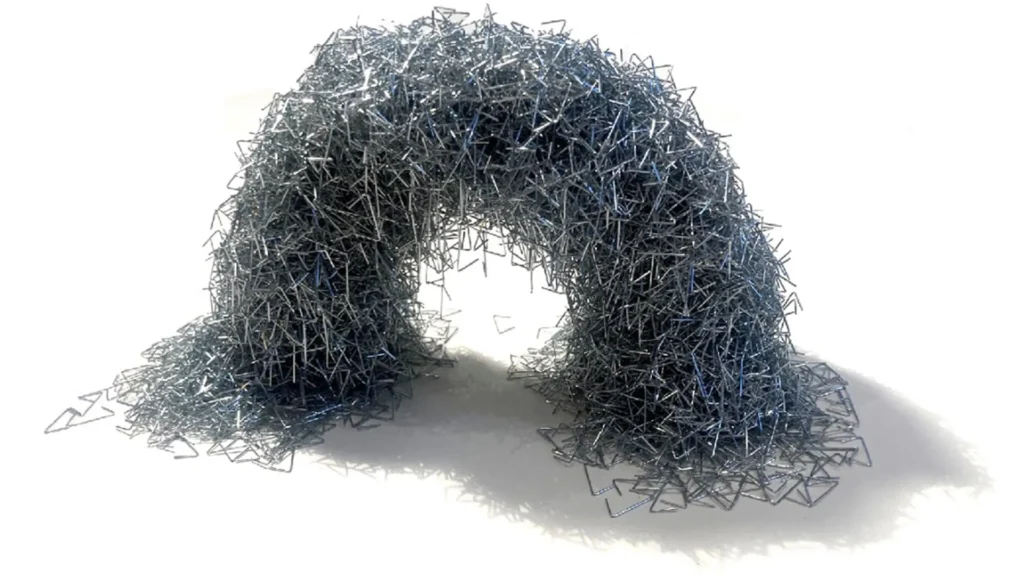
A tightly compressed bundle of office staples can behave in a surprising way, defying its composition of individual metal pieces. This seemingly simple everyday object, when aggregated, forms a tangled mass remarkably difficult to pull apart, exhibiting characteristics akin to a single, solid object. Yet, this very same bundle possesses an equally remarkable capacity for rapid dissolution. With the precise application of vibration or movement, the interwoven staples can quickly disengage, reverting to their original state as a loose collection of individual components. This intriguing dual nature – robust solidarity combined with swift, controlled reversibility – has captured the attention of researchers at the Paul M. Rady Department of Mechanical Engineering at CU Boulder, who believe it could serve as a foundational principle for a new generation of engineered materials. By meticulously designing particles that mimic the interlocking mechanism of staples, their pioneering work aims to develop materials that are not only inherently strong and adaptable but also fundamentally recyclable, ushering in a paradigm shift in sustainable engineering.
This groundbreaking research centers on a phenomenon known as entanglement, a concept deeply rooted in both natural systems and the broader field of materials science. Entanglement occurs when discrete particles or fibers become intertwined and form complex, often robust, mechanical connections with one another. Unlike materials that rely on chemical bonds or high-energy manufacturing processes to achieve cohesion, entangled systems derive their strength from the physical interweaving and friction between their constituent parts. This principle is widely observed in nature; for instance, the structural integrity of a bird’s nest is a testament to the intricate network of interwoven twigs and fibers, which collectively resist external forces. Similarly, the remarkable strength of bones is not solely due to their hard mineral components but also significantly enhanced by the intricate interaction and entanglement of these minerals with softer protein matrices like collagen.
The CU Boulder team, led by Professor Francois Barthelat, head of the Laboratory for Advanced Materials & Bioinspiration, embarked on a mission to systematically understand how these natural principles of entanglement could be harnessed and applied to create manufactured materials. Their investigations, spanning several years of exploring building blocks and geometry, recently narrowed their focus to interlocking, entangled particles. "We’ve been playing around with the idea of building blocks and geometry for many years, but we started looking at interlocking, entangled particles only recently," Barthelat stated, emphasizing the novelty of this specific avenue. "We are excited about the combination of properties we can get out of these systems and we believe this technology has the potential to go in many directions." The initial findings of this promising research were recently published in the prestigious Journal of Applied Physics, marking a significant milestone in the field.
Deciphering the Mechanics of Entanglement: A Computational and Experimental Journey
The core of the CU Boulder team’s work lies in understanding how particle shape dictates the degree and effectiveness of entanglement. To illustrate this, PhD student Youhan Sohn offered a compelling analogy: "Let’s take sand as an example. Sand is smooth and convex-shaped, meaning it cannot interlock from grain to grain." This inherent smoothness prevents sand grains from forming lasting connections, which is why a pile of dry sand collapses easily under pressure. However, Sohn continued, "we found that if we change the shape of a grain of sand, we can drastically affect its behavior and mechanical properties, including the particle’s ability to link with other particles." This insight became the guiding principle for their design process: to identify geometries that would maximize entanglement and, consequently, the material’s strength and stability.
To rigorously investigate this hypothesis, the researchers employed advanced computational techniques, specifically Monte Carlo simulations. These simulations are powerful statistical methods used to model complex systems where randomness plays a significant role. In this context, the Monte Carlo simulations allowed the team to explore a vast parameter space of particle shapes and observe how different geometries interacted under various conditions. By running thousands of simulated scenarios, they could predict which particle designs would lead to the highest degree of intertwining and interlock, effectively acting as a digital laboratory for rapid prototyping and optimization. This computational phase was crucial in narrowing down the most promising candidates before proceeding to physical experimentation.
The Revelation of the "Two-Legged" Particle: Unpacking the Staple’s Superiority
Following the identification of promising designs through meticulous simulation, the team transitioned to real-world validation. They conducted a series of "pickup tests," a practical experimental method to observe how different particle shapes behaved under physical manipulation. These tests involved creating aggregates of the specially designed particles and then assessing their collective strength and resistance to separation. The results were unequivocal and pointed to one specific geometry as a standout performer: a "two-legged" particle, remarkably resembling a common office staple. This staple-like shape consistently produced the highest degree of entanglement among all designs tested.
The superiority of the staple-like particle extended beyond mere entanglement; it also offered several unexpected and highly beneficial mechanical properties. One of the most significant findings was its ability to combine high tensile strength and toughness simultaneously. In conventional materials science, these two properties often present a challenging trade-off. Tensile strength refers to a material’s ability to withstand forces that pull it apart, while toughness describes its capacity to absorb energy and deform plastically without fracturing. Materials engineered for high tensile strength are often brittle, lacking toughness, and vice versa. However, the entangled granular material composed of staple-like particles demonstrated a rare synergy. "Our entangled granular material using the staple-like particle demonstrates both high strength and toughness at the same time," explained PhD student Saeed Pezeshki, highlighting a breakthrough that could have profound implications for engineering design. This innovative approach potentially allows for the creation of materials that can withstand significant stress while also resisting crack propagation and sudden failure, a combination highly sought after in demanding applications.
Dynamic Control: The Power of Reversibility and Adaptability
Beyond its impressive strength and toughness, the staple-like particles exhibited another extraordinary characteristic: their dynamic reversibility. This engineered granular material could rapidly consolidate into a robust, solid-like structure and then, just as quickly, disaggregate and return to a loose collection of individual particles. This controllable transformation is achieved through the precise application of vibrations. The researchers discovered that by varying the patterns and intensity of vibrations, they could modulate the degree of entanglement. Gentle, specific vibrations encouraged the particles to interlock and reinforce the material’s structure, effectively ‘activating’ its strength. Conversely, stronger, more disruptive vibrations caused the intricate network to unravel, allowing the material to revert to its fluid-like, disengaged state.
This ability to dynamically control the material’s mechanical properties, shifting between solid-like rigidity and loose fluidity on demand, places it in a unique category of "smart materials." As Professor Barthelat eloquently put it, "It’s a strange material because it’s obviously not a liquid. However, it’s also not quite solid. This opens new and intriguing engineering possibilities." The sensation of handling such a material, he noted, "feels very remote and exotic," underscoring its departure from conventional material paradigms. This dynamic adaptability represents a significant leap forward, offering functionalities previously confined to theoretical concepts or high-tech composites.
Transforming Industries: Broadening the Horizon of Application
The implications of this research extend across multiple sectors, promising to support more sustainable and adaptable approaches to construction and manufacturing. The researchers envision a future where this technology could revolutionize the construction industry, which currently accounts for a substantial portion of global waste. Annually, construction and demolition waste contributes over 30% of total waste generated globally, with much of it ending up in landfills. Imagine bridges, buildings, and other large structures constructed not with permanent, chemically bonded materials, but with entangled materials that can be easily "unbuilt" rather than demolished. Such a system would allow for the components to be separated, reused, or fully recycled at the end of their service life, drastically reducing material consumption and waste. This aligns perfectly with the principles of a circular economy, where resources are kept in use for as long as possible, extracting maximum value before being recovered and regenerated. For instance, preliminary estimates suggest that such reusable materials could reduce construction-related carbon emissions by 15-20% and decrease material consumption by up to 50% over a structure’s lifecycle.
Beyond construction, the concept of dynamically reconfigurable materials holds immense promise for the field of robotics. The ability of small robots to physically entangle, perform a complex task as a unified entity, and then disentangle to resume individual operations could unlock entirely new capabilities in swarm robotics. Pezeshki articulated this vision: "I was talking with other students who believe this technology can be used in swarm robotics – where small robots can entangle, do a task and then disentangle when they are done." This concept resonates with popular culture examples, such as the iconic liquid metal T-1000 from Terminator 2, which could change shape to slide under a door and then transform back. Barthelat acknowledged the ambition of such a vision: "Yes, kind of like that liquid metal T-1000… It’s expensive and scaling up is a challenge, but it’s something that’s on everybody’s mind." While the challenges of cost and scaling are significant, the fundamental principle of adaptive morphology enabled by entangled particles offers a tangible pathway towards such futuristic robotic systems, potentially leading to robots capable of self-assembly, self-repair, and navigating highly constrained environments. Other potential applications include adaptive tooling, deployable structures for aerospace, or even advanced biomedical devices that can dynamically change properties in situ.
The Path Forward: Enhancing Entanglement with Advanced Geometries
The CU Boulder team is not resting on its laurels but is already advancing into the next stage of this promising research. Their current experiments are focused on developing even more sophisticated particle designs, moving beyond the simple "two-legged" staple. Their latest prototypes include additional protruding "legs" or features, creating geometries that the researchers liken to the spiky burrs commonly found clinging to shoes and clothing after an outdoor excursion. These natural burrs are renowned for their tenacious grip, achieved through multiple points of contact and intricate mechanical interlocks.
The scientific rationale behind these more complex, multi-legged designs is to create even stronger entanglement effects. By increasing the number of contact points and the geometric complexity of each particle, the researchers hypothesize that they can achieve significantly higher inter-particle friction and resistance to separation, leading to materials with enhanced strength, toughness, and potentially even more precise control over their reversible properties. This iterative process of design, simulation, and experimental validation is crucial for optimizing the performance of these novel materials. The exploration of these advanced geometries promises to unlock new possibilities, pushing the boundaries of what is achievable with reconfigurable granular materials and paving the way for a future where materials are not static but dynamic, intelligent, and inherently sustainable.
The work at CU Boulder represents a compelling intersection of fundamental physics, advanced engineering, and biomimetic design. By drawing inspiration from the mundane yet remarkable behavior of office staples, researchers are charting a course toward a future where materials are not merely components but active participants in sustainable design and technological innovation. The journey from initial concept to scalable industrial application will undoubtedly involve further scientific and engineering hurdles, but the foundational discoveries made by Barthelat, Sohn, Pezeshki, and their team offer a powerful vision for materials that are strong when needed, adaptable when required, and ultimately, endlessly reusable. This paradigm shift could redefine how we build our world, interact with our environment, and imagine the next generation of intelligent systems.