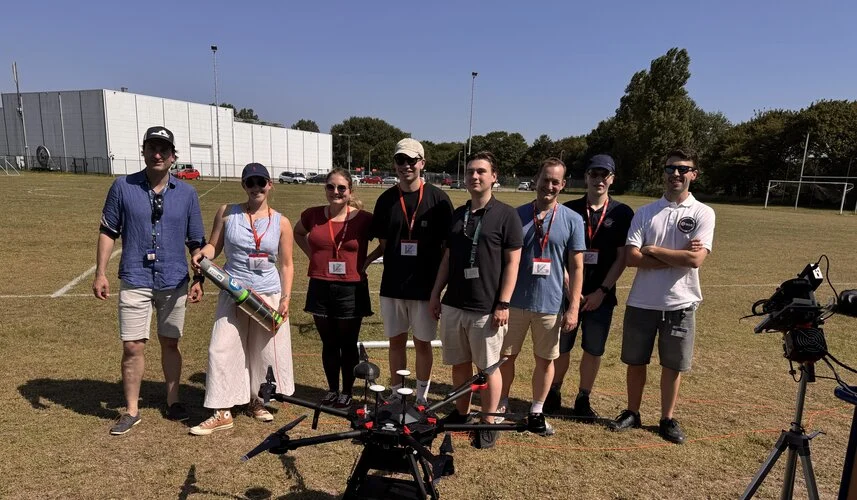
A groundbreaking student-developed radar retroreflector technology has successfully completed its initial test flight, taking to the skies above the European Space Agency’s (ESA) technical centre, ESTEC, in the Netherlands. This significant milestone marks the culmination of an ambitious project that began as a university competition and is now poised for further development and potential integration into future space missions. The innovative device, designed to enhance the detectability of objects by radar, was suspended from a drone and subjected to a series of maneuvers designed to simulate real-world flight conditions.
The testing campaign, held on a notably warm July day, saw the specially equipped drone ascend to an altitude of 120 meters above ESTEC’s sprawling football field. The retroreflector, housed within a 50 cm long plastic tube and suspended by a five-meter rope, was observed to swing gently in the breeze. ESA engineer Giovanni Serafini expertly piloted the drone, executing rapid descents to bring the payload within three meters of the ground, followed by lateral movements across the field. These carefully orchestrated maneuvers were crucial for gathering data on the retroreflector’s performance under varying altitudes and angles, simulating conditions that might be encountered by sounding rockets or other small airborne vehicles. The test team, mindful of the high temperatures, took precautions to shield sensitive equipment from overheating, highlighting the practical challenges of conducting outdoor aerospace tests.

Origins of the Innovation: From Competition to Collaboration
The radar retroreflector is the brainchild of a dedicated student team from Ruhr University Bochum in Germany. Their innovation emerged as the winning design in a competition organized by the Institute of Electrical and Electronics Engineers (IEEE). Daria Tsukanova, a member of the student team, explained the fundamental principle behind their invention: "A retroreflector is a passive structure, in this case a 28 cm long metal tube covered with cavities, designed to reflect signals back towards their source. This makes an object easier to detect and track without requiring active electronics or transmitters onboard." This passive nature is a key advantage, as it eliminates the need for power sources or complex circuitry on the object being tracked, thus reducing weight and complexity.
The primary application envisioned for this technology is to significantly improve the radar visibility of small, often lightweight, airborne vehicles. This includes drones, which are increasingly being used for a wide range of applications from scientific research to commercial delivery, and sounding rockets, which are crucial for launching scientific payloads to the upper atmosphere and the edge of space. These types of vehicles, particularly those constructed from non-metallic materials or at certain angles relative to radar systems, can be difficult to detect and track. The student-developed retroreflector aims to overcome this limitation.
Enhancing Radar Detection: The Technical Advantage
Traditional radar systems rely on the inherent reflectivity of objects, such as the metallic composition of conventional rockets. However, even these can become "invisible" to radar under specific viewing angles. The retroreflector’s design, featuring precisely engineered cavities, ensures that incoming radar signals are bounced back directly to their origin, regardless of the orientation of the reflector relative to the radar source. This characteristic significantly extends the detection window, providing continuous tracking capabilities.

Stephan Hauptmeier, another member of the Ruhr University Bochum team, emphasized the cost-effectiveness and accessibility of their design. "What’s unique about this technology is that it’s very cheap. The reflector itself is passive, made by 3D printing and laser cutting," he stated. This approach democratizes advanced radar detection capabilities, making them accessible for a wider range of projects and budgets. Furthermore, the system leverages existing, well-established radar technology. "Another advantage is that to detect it, we can use a radar technology well-established in the automotive industry – the same one that is part of driver assistance systems and will, for example, cause a car to break automatically if an obstacle is detected. This means no special ‘space-grade’ radar is needed," Hauptmeier added. This integration with automotive radar technology, widely deployed and relatively inexpensive, further reduces the barrier to adoption.
ESA’s Role and the Synergy with Automotive Radar
The collaboration between the student team and ESA highlights a successful transfer of technology and expertise. Václav Valenta, ESA’s microwave engineer, underscored the value of this partnership: "This has been a unique opportunity to leverage hardware previously developed within ESA’s Technology Development Element programme for planetary and in-orbit missions, based on automotive radar technology." ESA has been actively exploring the use of automotive-grade radar components for space applications due to their proven reliability, cost-effectiveness, and advanced performance. By making these prototypes available to students, ESA not only supports emerging talent but also gains valuable insights into novel applications of their research. Valenta further elaborated, "By making one of these prototypes available to students, we enable them to gain practical experience with real radar technology and explore how such systems can be configured and optimised for specific applications."
The radar unit utilized in the ESTEC tests underwent initial modifications at Imperial College London, where engineer Václav Pavlíček adapted its system configuration and operating parameters for terrestrial use. This preparatory work ensured that the radar was optimized for the specific conditions and objectives of the drone-based testing campaign, bridging the gap between its original intended space applications and the immediate needs of the student project.

A Phased Approach: From Ground Tests to Rocket Launch
The successful drone test at ESTEC represents a critical step in the project’s progression. Within a single afternoon, the team was able to validate the retroreflector’s fundamental functionality. The next phase of testing is even more ambitious: the device is scheduled to be launched aboard a sounding rocket. This will propel the retroreflector up to one kilometer above a designated field in Brno, Czech Republic, later this summer. This high-altitude test will provide crucial data on the retroreflector’s performance in a more dynamic and demanding environment, closer to the conditions experienced by operational sounding rockets.
Karol Masztalerz, an ESA Graduate Trainee, commented on the project’s trajectory, stating, "This project is a great example of how student initiatives can evolve beyond the competition environment." He highlighted the project’s growth from a university-led challenge into a significant international collaboration. This expanded network now includes ESA, two prominent European universities – Ruhr University Bochum and Imperial College London – various industry partners, and the Czech Rocket Society. The latter is providing their new Sherpa rocket, a critical asset for the upcoming high-altitude launch. This multifaceted collaboration underscores the project’s growing importance and the diverse stakeholders involved in advancing this innovative technology.
Broader Implications and Future Potential
The successful development and testing of this student-designed radar retroreflector hold significant implications for various sectors. For space agencies like ESA, it offers a cost-effective method to enhance the tracking of small satellites, debris, and scientific payloads. The ability to improve the radar visibility of such objects is crucial for space situational awareness, collision avoidance, and efficient mission operations.

In the burgeoning field of unmanned aerial vehicles (UAVs), improved radar detectability is paramount for air traffic management and safety. As drone operations become more widespread, particularly in urban environments, reliable tracking systems are essential to prevent conflicts with other aircraft and ground-based infrastructure. This technology could provide a vital component in developing robust drone traffic management systems.
Furthermore, the project’s emphasis on leveraging existing automotive radar technology democratizes access to advanced tracking capabilities. This could foster innovation in numerous fields, from environmental monitoring and disaster response to precision agriculture and infrastructure inspection, where reliable object tracking is often a critical requirement. The low cost and ease of integration mean that even smaller organizations or research groups could implement these enhanced tracking solutions.
The collaborative model employed in this project, uniting academic institutions, a major space agency, and industry partners, serves as a blueprint for future innovation. By providing students with access to cutting-edge technology and real-world testing environments, ESA and its partners are nurturing the next generation of aerospace engineers and scientists, ensuring a pipeline of talent capable of tackling complex challenges in space exploration and beyond. The evolution of this project from a university competition to a potential space-ready technology exemplifies the power of interdisciplinary collaboration and student-driven innovation in shaping the future of aerospace. The upcoming sounding rocket launch will be a key indicator of the technology’s readiness for more demanding applications, potentially paving the way for its widespread adoption in both space and terrestrial scenarios.