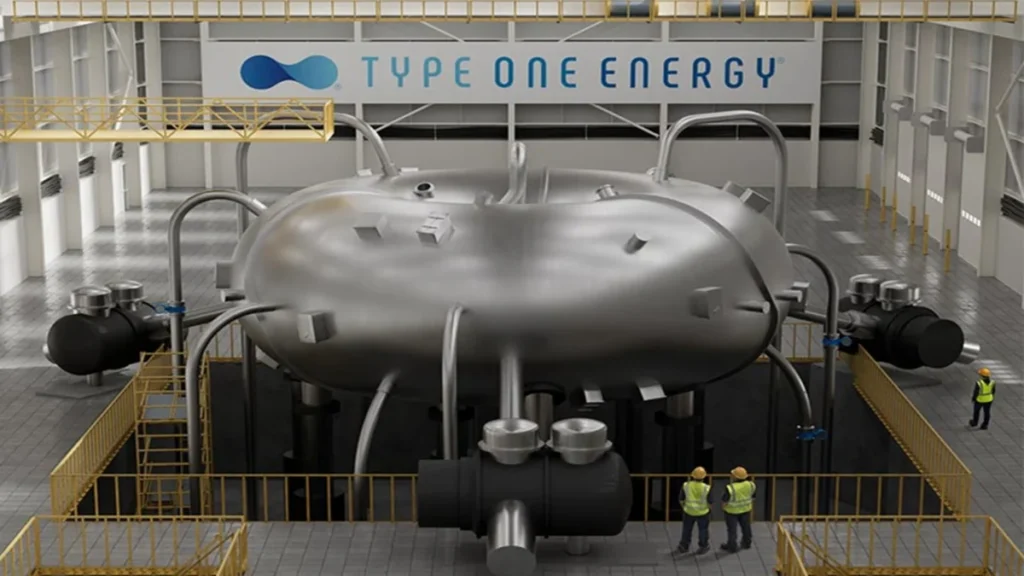
Type One Energy has secured a groundbreaking fusion-specific license from the state of Tennessee, marking a pivotal moment in the global pursuit of commercial fusion energy. This license clears a key regulatory hurdle for Project Infinity, a planned 400-megawatt (MW) fusion power plant utilizing a stellarator design, slated for construction at the Tennessee Valley Authority’s (TVA) Bull Run Energy Complex in Clinton. The company intends to break ground on the project’s initial phase this year, with full commercial operation anticipated by 2034, positioning Tennessee at the forefront of the emerging fusion industry.
The announcement signifies not only a major step for Type One Energy and its partners, including TVA, Oak Ridge National Laboratory (ORNL), and the University of Tennessee, but also a landmark achievement for the regulatory landscape of fusion power. This is the first license issued under a state regulatory framework specifically developed for nuclear fusion machines, following the Nuclear Regulatory Commission’s (NRC) decision to delegate oversight of fusion energy production to individual states. This proactive move by Tennessee establishes a clear and defined pathway for the commercialization of fusion technology, a crucial element that has long been a bottleneck for advanced energy projects.
A New Regulatory Frontier: Tennessee’s Pioneering Framework
The regulatory clarity provided by Tennessee is perhaps as significant as the technological advancement itself. For decades, the nascent fusion industry has operated largely within a research and development paradigm, with regulatory oversight often ambiguous or tailored for traditional nuclear fission reactors, which present fundamentally different safety profiles and waste characteristics. The NRC’s recent determination to regulate fusion as a distinct energy source, and subsequently to delegate licensing authority to states, created an immediate need for state-level frameworks. Tennessee swiftly responded, demonstrating a forward-thinking approach to fostering innovation within its borders.
This new framework offers Type One Energy, and potentially other fusion developers, a predictable and efficient route from experimental development to grid-scale deployment. Christofer Mowry, CEO of Type One Energy, underscored the profound implications of this development: “For the first time, a fusion power plant-specific licensing process has been developed and then used to grant a fusion-specific license to operate a fusion machine, consistent with a national regulatory framework for fusion energy. The importance of this milestone cannot be overstated. Tennessee’s licensing process is now the international benchmark for how to ensure fusion power plant ‘safety by design’ in a manner that can unlock the compelling economics of this transformational power generation technology.” This statement highlights the potential for Tennessee’s model to influence global regulatory practices, accelerating the commercialization of fusion worldwide.
The concept of "safety by design" is central to modern fusion reactor development. Unlike fission, a runaway chain reaction in a fusion reactor is physically impossible; if conditions for fusion are not precisely met, the reaction simply ceases. This inherent safety characteristic significantly reduces the risk profile compared to conventional nuclear power. Tennessee’s framework is expected to leverage these intrinsic safety features, streamlining the regulatory burden while maintaining rigorous oversight.
Stellarators: The Twisted Path to Fusion Energy
Project Infinity’s reliance on the stellarator design represents a notable commitment to an alternative magnetic confinement approach, diverging from the more widely known tokamak concept. Both designs aim to confine superheated plasma – an ionized gas of fuel atoms – at temperatures exceeding 100 million degrees Celsius, necessary for atomic nuclei to overcome their natural repulsion and fuse, releasing immense energy.
Tokamaks, first developed in the Soviet Union in the 1950s, use a toroidal (doughnut-shaped) vacuum chamber where strong magnetic fields confine the plasma. A critical component of a tokamak’s confinement is a large electrical current induced within the plasma itself, which generates a poloidal magnetic field that twists the overall magnetic field lines, improving stability. However, this internal current must be precisely controlled and is typically pulsed, making continuous operation challenging. Disruptions, or sudden losses of plasma confinement, can also occur, posing engineering challenges. Notable tokamak projects include ITER (International Thermonuclear Experimental Reactor) under construction in France, a monumental international collaboration aimed at demonstrating fusion’s scientific and technological feasibility on a large scale.
Stellarators, on the other hand, employ an intrinsically twisted, three-dimensional magnetic field generated entirely by external coils. This complex geometry creates a magnetic cage that confines the plasma without requiring a large electrical current running through it. The absence of an internal current eliminates the need for pulsed operation, allowing for continuous, steady-state fusion, and significantly reduces the risk of plasma disruptions. The trade-off has traditionally been the extreme complexity of designing and fabricating the non-planar superconducting coils required. Early stellarators struggled with plasma confinement, but advanced computational design tools and manufacturing techniques have led to a renaissance in stellarator research. Recent breakthroughs, particularly at facilities like the Wendelstein 7-X stellarator in Germany, have demonstrated impressive plasma performance and stability, revitalizing interest in the design. Type One Energy’s "Infinity Two" design aims to harness these advancements, with a net electrical output of 400 MW, derived from 800 MW of gross fusion power. This would make it one of the largest and most powerful stellarators ever conceived.
The fuel source for Infinity Two will be deuterium-tritium (D-T), the most accessible fusion reaction to achieve on Earth. Deuterium is readily available from water, while tritium, a radioactive isotope of hydrogen, is scarcer and typically produced through neutron bombardment of lithium within the reactor itself, creating a self-sustaining fuel cycle.
Project Infinity: A Phased Approach to Grid-Scale Power
The development of Project Infinity is structured in distinct phases, reflecting a methodical approach to scaling up fusion technology. The first phase, named Infinity One, is conceived as a prototype and workforce training facility. Scheduled for commissioning and startup in 2029, Infinity One will allow Type One Energy and TVA to rigorously test the technologies and operational protocols intended for the larger commercial power plant. This intermediate step is crucial for de-risking the subsequent construction and operation of Infinity Two. It will also serve as a vital hub for developing the specialized workforce required for the fusion industry, from plasma physicists and engineers to skilled technicians and operators.
Following the successful demonstration and validation through Infinity One, the full-scale Project Infinity (Infinity Two) is targeted for groundbreaking and subsequent construction, with commercial operation projected by 2034. A 400 MW power plant is substantial, capable of powering hundreds of thousands of homes, comparable to many existing natural gas or small-to-medium nuclear fission reactors. The rapid timeline, particularly for a technology as complex as fusion, speaks to the confidence of Type One Energy and its partners in the maturity of the stellarator design and the efficiency of the new regulatory pathway.
Collaborative Ecosystem: Powering Innovation in the Tennessee Valley
The Tennessee Valley has a rich history as a hub for energy innovation, largely due to the presence of the Tennessee Valley Authority and Oak Ridge National Laboratory. TVA, one of the largest public power providers in the United States, serves millions of customers across seven southeastern states. Its involvement as a utility partner is critical, providing not only the site at Bull Run but also invaluable expertise in power generation, grid integration, and project management. TVA’s commitment signals a serious intent to integrate fusion energy into its future portfolio, aligning with its mission to provide reliable and affordable power.
Oak Ridge National Laboratory (ORNL), a multi-program science and technology national laboratory sponsored by the U.S. Department of Energy, has been a cornerstone of nuclear research for over 80 years. Its scientific and engineering prowess, particularly in materials science, high-performance computing, and nuclear technologies, will be indispensable for Project Infinity. ORNL’s deep bench of researchers and state-of-the-art facilities will contribute to solving the complex scientific and engineering challenges inherent in fusion power. Similarly, the University of Tennessee, Knoxville, with its strong engineering and physics programs, will play a vital role in research, development, and workforce training, ensuring a pipeline of talent for the burgeoning fusion industry. This collaborative ecosystem, integrating a private developer, a major utility, a national laboratory, and a leading university, creates a powerful synergy for accelerating fusion commercialization.
Repurposing Legacy Infrastructure for a Future Energy Landscape
A significant and strategically advantageous aspect of Project Infinity is its location at the Bull Run Energy Complex, a former fossil-fuel power site. This decision embodies a forward-thinking approach to energy transition, demonstrating how existing energy infrastructure can be repurposed for advanced, clean technologies. Utilizing a brownfield site mitigates many of the challenges associated with greenfield development, such as land acquisition, environmental impact assessments, and grid interconnection. The Bull Run site already possesses essential infrastructure like transmission lines, cooling water access, and existing site permits, which can substantially reduce project timelines and costs.
Moreover, the plan to transform the Bull Run site into a broader "fusion development campus" further amplifies its strategic importance. This vision extends beyond a single power plant, aiming to create a vibrant hub for ongoing fusion research, development, and commercialization activities. Such a campus could attract further investment, talent, and ancillary industries, solidifying Tennessee’s position as a global leader in fusion energy. This model of repurposing legacy energy sites for next-generation clean power could serve as a blueprint for other regions grappling with the transition away from fossil fuels.
The Global Race for Fusion: Context and Competition
Project Infinity enters a global landscape where the race for practical fusion energy is intensifying. For decades, fusion research was primarily the domain of national laboratories and large international consortia like ITER. However, in recent years, private companies have emerged, fueled by venture capital and driven by innovative approaches and aggressive timelines. Companies like Commonwealth Fusion Systems (tokamak-based, backed by MIT), Helion Energy (pulsed, field-reversed configuration), and General Fusion (magnetized target fusion) are actively pursuing different paths to commercial fusion.
The U.S. Department of Energy has also launched initiatives like the "Milestone-Based Fusion Development Program" to support private-sector fusion companies. This renewed interest and investment reflect a growing optimism that fusion is no longer a distant dream but a tangible possibility within the next decade or two. Project Infinity’s advancement places Type One Energy firmly within this competitive field, with its stellarator design offering a distinct alternative that could prove highly advantageous for continuous, baseload power generation. If successful, Project Infinity would be among the very first grid-connected fusion power plants in the world, marking a truly historic achievement.
Economic and Environmental Implications for Tennessee and Beyond
The implications of Project Infinity extend far beyond technological innovation. Economically, the project represents a significant investment in Tennessee, promising job creation across various sectors – from highly skilled scientists and engineers to construction workers and support staff. The development of a fusion campus could also foster an ecosystem of related industries and educational programs, creating a long-term economic boon for the region. Governor Lee emphasized this broader vision, stating, “As the global epicenter of nuclear energy, Tennessee is building the workforce, infrastructure and regulatory framework needed to lead the next generation of nuclear innovation. By creating a clear path for emerging technologies like fusion, we’re advancing the reliable, abundant American energy we’ll need for generations to come.”
Environmentally, fusion energy offers a transformative solution to the climate crisis. It produces no greenhouse gases during operation and generates minimal, short-lived radioactive waste, primarily from the activation of reactor components by neutrons, which can be managed and stored far more easily than fission waste. The fuel source, derived from water and lithium, is virtually inexhaustible, providing a truly sustainable and carbon-free energy option. The successful deployment of Project Infinity would provide a compelling demonstration of fusion’s potential to deliver clean, baseload power, complementing intermittent renewable sources like solar and wind, and significantly contributing to global decarbonization efforts.
Challenges and the Road Ahead
While the Tennessee license is a monumental step, significant challenges remain on the path to commercial fusion. Scaling up experimental results to a full-scale power plant involves complex engineering hurdles, including the development of advanced materials that can withstand the extreme neutron flux and high temperatures within the reactor. Cost remains a major factor, with fusion projects historically requiring substantial capital investment. Achieving sustained, high-performance plasma confinement for continuous power generation at an economically viable cost is the ultimate goal.
However, the rapid progress in fusion science and engineering, coupled with the increasing urgency of climate action, provides powerful impetus. The collaborative model, the clear regulatory pathway, and the phased development approach adopted by Type One Energy and its partners are designed to systematically address these challenges. If Project Infinity stays on schedule, Tennessee could become an early and crucial test case for whether stellarator technology can successfully transition from experimental systems to a reliable, grid-scale power plant, paving the way for a new era of clean, abundant energy.