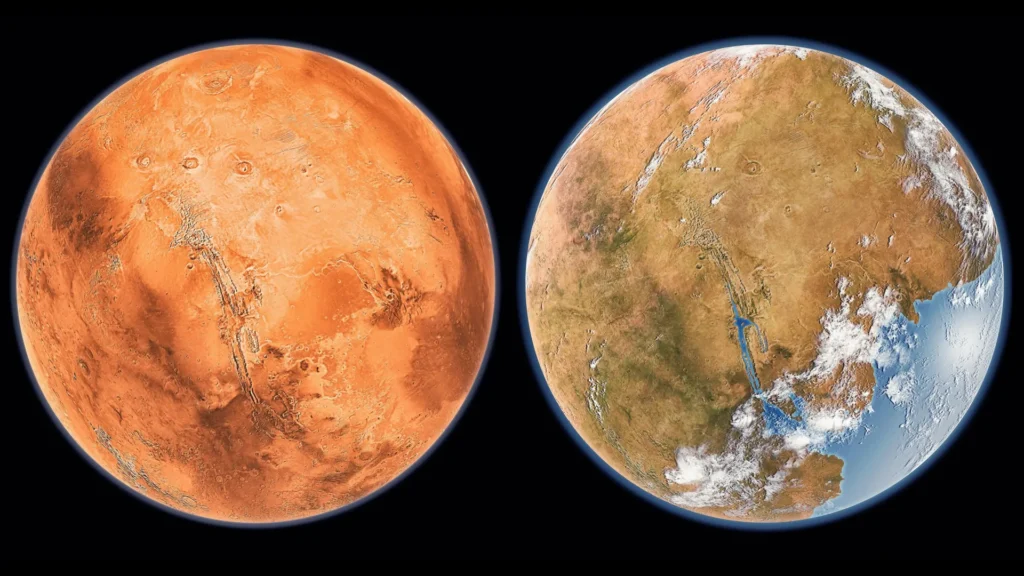
For generations, the idea of transforming Mars into a second Earth has been a staple of science fiction, a distant dream fueled by the allure of interplanetary colonization. This ambitious process, known as terraforming, aims to reshape a celestial body’s atmosphere, climate, and surface to support human life and Earth-like ecosystems. While the concept often conjures images of lush, Earth-like landscapes on the Red Planet, most scientists have historically relegated it to the realm of fantasy, deeming it technologically insurmountable. However, a recent workshop summary suggests a paradigm shift: recent scientific and technological advancements have propelled terraforming from theoretical impossibility to a legitimate, albeit long-term, area of scientific research.
A New Dawn for Martian Ambitions
The groundbreaking assessment comes from a summary prepared for the 2025 Green Mars Workshop, authored by Dr. Erika DeBenedictis, CEO of Pioneer Labs. Her report posits that what was considered practically impossible just a few decades ago is now within the purview of serious scientific inquiry. This re-evaluation is largely attributed to a confluence of factors, most notably the dramatic projected reductions in launch costs promised by SpaceX’s Starship program. This innovation, coupled with significant breakthroughs in synthetic biology and sophisticated climate modeling, has moved the discussion from "if" to "how" and "should we." The fundamental questions are no longer about violating the laws of physics but about the ethical considerations, feasibility, and the safest pathways to potentially altering another planet.
The Genesis of the Green Mars Workshop
The Green Mars Workshop itself represents a growing interest within the scientific community to move beyond abstract discussions and engage in tangible, albeit nascent, planning. While the exact inception date of the workshop series is not detailed, its progression to a 2025 iteration signifies sustained engagement and a commitment to advancing the conversation. The workshop format, bringing together experts from diverse fields, aims to foster interdisciplinary collaboration essential for tackling such a monumental undertaking. Dr. DeBenedictis’s summary serves as a pivotal document, consolidating the workshop’s findings and charting a potential course forward.
Charting a Path: A Backward-Looking Roadmap
Instead of beginning with the technological limitations of today, the workshop summary adopts a visionary approach, first sketching out what a habitable Mars might eventually resemble and then meticulously working backward to identify the necessary steps. This strategic methodology allows for a clearer understanding of the monumental challenges and the incremental progress required.
Phase 1: Warming the Martian Chills
The initial and most critical stage of terraforming Mars would focus on elevating the planet’s frigid temperatures. Researchers envision a multi-pronged approach, utilizing engineered aerosols or potent greenhouse gases to incrementally increase the average Martian temperature by several tens of degrees Celsius over a period of decades. Current scientific estimates suggest that Mars harbors substantial reserves of frozen water, enough to potentially fill an ocean spanning nearly four million square kilometers with an average depth of approximately 300 meters. Achieving a temperature increase of around 30 degrees Celsius could initiate the melting of these vast ice reserves, paving the way for the appearance of stable bodies of liquid water on the Martian surface – a fundamental prerequisite for life as we know it.
Supporting Data:
- Martian Water Ice Reserves: Estimates suggest Mars has enough water ice to cover its surface in a layer 11 to 60 meters deep, or enough to fill an ocean significantly larger than Earth’s Arctic Ocean.
- Current Martian Temperature: The average surface temperature on Mars is about -63 degrees Celsius (-81 degrees Fahrenheit), a stark contrast to Earth’s average of 15 degrees Celsius (59 degrees Fahrenheit). A 30-degree Celsius increase would still leave Mars significantly colder than Earth but would enable liquid water stability.
Phase 2: The Dawn of Microbial Life
Once conditions become marginally less hostile, with the potential for liquid water, the introduction of microbial life becomes the next logical step. The research proposes engineering extremophiles – organisms that naturally thrive in extreme environments. These engineered microbes would be designed to possess enhanced resistance to Mars’s harsh conditions, including extreme temperatures, high radiation levels, and low atmospheric pressure. The vision is for these specially designed organisms to proliferate across the Martian landscape, forming algae-like layers within decades. Through the process of photosynthesis, these microbes would embark on the incredibly slow, yet vital, task of altering the planet’s atmosphere, a process that could take centuries.
Synthetic Biology and Extremophiles:
- Extremophile Research: Scientists have identified numerous extremophiles on Earth, such as Deinococcus radiodurans (highly resistant to radiation) and Chroococcidiopsis (resistant to desiccation and radiation). These serve as blueprints for engineering Martian counterparts.
- Photosynthesis Efficiency: The efficiency of photosynthesis in engineered microbes would be crucial. Even with optimized strains, the sheer scale of Mars necessitates an extremely long timescale for significant atmospheric change.
Phase 3: Cultivating a Breathable Atmosphere
The creation of an oxygen-rich atmosphere capable of supporting complex, breathable air for humans is the most protracted and challenging phase, projected to take centuries, if not millennia. The initial stages of atmospheric transformation would likely occur within controlled environments. Researchers envision the construction of enormous domed habitats, perhaps as tall as 100 meters. Within these enclosed ecosystems, breathable oxygen could be generated through a combination of photosynthesis and water electrolysis. As vegetation gradually expands beyond these domes, it would contribute to the slow oxygenation of the wider Martian atmosphere. Current estimates suggest that natural oxygen production through biological means alone could require approximately a thousand years to reach breathable levels. The ultimate goal is a Mars where future explorers and inhabitants could live and breathe freely, unhindered by protective suits and domes.
Atmospheric Engineering Challenges:
- Oxygen Levels: Earth’s atmosphere is approximately 21% oxygen. Mars’s current atmosphere is about 95% carbon dioxide, with trace amounts of nitrogen, argon, and virtually no oxygen.
- Atmospheric Pressure: Mars’s atmospheric pressure is less than 1% of Earth’s. Increasing atmospheric pressure is as crucial as increasing oxygen content for habitability.
- Time Scales: Reaching even 1% of Earth’s atmospheric pressure with significant oxygen content would require immense quantities of gases and an extended period of generation.
Unanswered Questions and Uncharted Territories
Despite the burgeoning optimism, the path to terraforming Mars is fraught with significant scientific unknowns and formidable obstacles that must be addressed before any large-scale endeavor can be seriously contemplated.
The Mysteries Beneath the Surface
A primary concern is the lack of comprehensive knowledge about what lies beneath Mars’s vast ice sheets. Understanding the composition, extent, and potential biological activity within these subsurface regions is critical. Furthermore, scientists need a more robust understanding of how Martian dust storms, a defining characteristic of the planet, might evolve and intensify in a warmer, wetter environment. The implications for equipment, infrastructure, and human safety are substantial.
Resource Availability and Logistics
Another crucial unknown is the availability of essential materials required for large-scale terraforming operations. Specifically, the feasibility of widespread water electrolysis, a process that splits water into hydrogen and oxygen, hinges on the presence of sufficient raw materials. If these resources are scarce, it would necessitate transporting them from Earth, a logistical and economic undertaking of unprecedented scale and cost. The current cost of launching a kilogram into orbit is a significant factor, and while SpaceX’s Starship aims to drastically reduce this, the sheer volume of materials needed for terraforming would still represent an astronomical expense.
Supporting Data:
- Starship Launch Costs: While specific figures are projections, SpaceX has indicated a goal of reducing launch costs to a fraction of current rates, potentially making large-scale cargo transport more viable. However, "viable" for terraforming is a relative term given the immense scale.
- Martian Regolith Analysis: Ongoing missions like Perseverance are analyzing Martian soil and rock composition, providing crucial data for resource assessment, but comprehensive subsurface mapping remains a challenge.
The Ethical Imperative: Weighing the Costs of Change
Beyond the scientific and engineering hurdles, the prospect of terraforming Mars raises profound ethical questions that demand careful consideration.
The Preservation of Martian Heritage
Any large-scale transformation of Mars carries the inherent risk of permanently erasing aspects of its natural history. This could significantly limit future opportunities for scientific study, potentially diminishing our understanding of planetary evolution and the conditions that lead to habitability.
The Potential for Indigenous Life
Perhaps the most significant ethical dilemma revolves around the potential existence of indigenous Martian life. Even if life on Mars exists only in microscopic forms, introducing Earth-based organisms could irrevocably disrupt or even annihilate it before it is fully understood. The implications of extinguishing an entire alien biosphere are immense, prompting a deep moral obligation to proceed with extreme caution.
Benefits for Earth: A Counterbalance?
Paradoxically, the pursuit of terraforming Mars could yield significant benefits for our home planet. Technologies developed to sustain life in extreme extraterrestrial environments, such as drought-resistant crops, advanced water recycling systems, and highly efficient closed-loop life support, could have direct applications in addressing sustainability challenges on Earth. Furthermore, the environmentally conscious technologies designed for space exploration might offer innovative solutions for terrestrial environmental issues.
The Evolving Conversation: From "Can We?" to "Should We?"
The shift in scientific discourse, as highlighted by the Green Mars Workshop summary, is not a call to immediately embark on planetary engineering. Instead, it advocates for a structured, phased approach that begins with rigorous laboratory research, enhanced climate modeling, and potentially small-scale, localized experiments on future Mars missions to test warming techniques.
The journey toward making Mars habitable is undeniably a long-term endeavor, stretching across generations. Before any attempt to fundamentally reshape an entire planet, humanity must cultivate a far deeper understanding of Mars itself, alongside a comprehensive assessment of the scientific, environmental, and ethical ramifications of such an undertaking. The conversation is steadily moving away from the purely speculative question of "could we?" towards the more nuanced and critical inquiries of "should we, and if so, how?" This evolution in thinking represents, perhaps, the most significant and meaningful step forward in our interplanetary aspirations thus far.