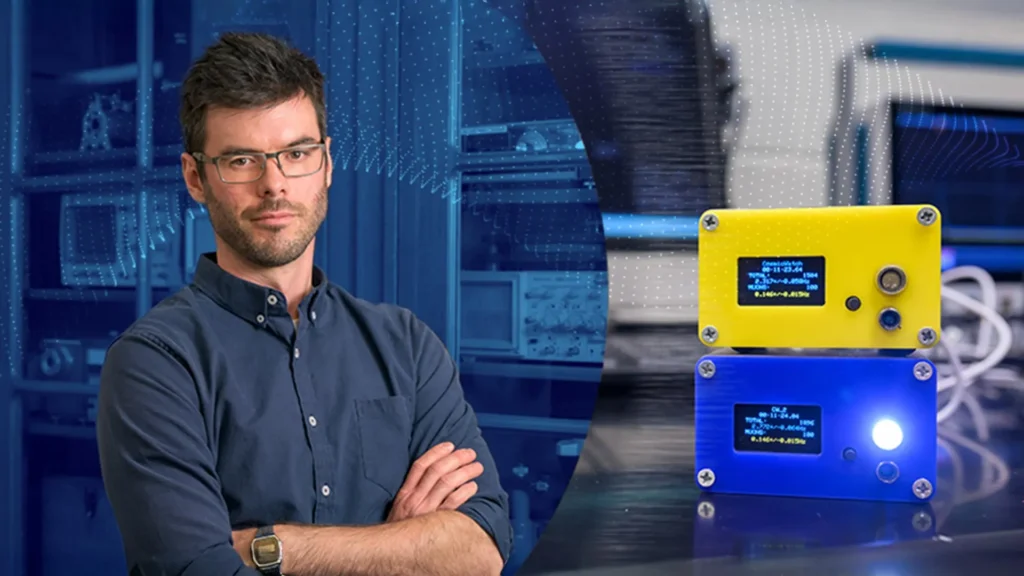
Every second of every day, Earth is bombarded by a silent, invisible rain of subatomic particles originating from the deepest reaches of the cosmos. These particles pass through buildings, mountains, and human bodies at nearly the speed of light, leaving no trace for our biological senses to detect. For decades, the study of these phenomena was reserved for elite research institutions equipped with massive, multi-million-dollar arrays and bulky electronic racks. However, a technological breakthrough led by University of Delaware physics professor Spencer Axani is fundamentally altering this landscape. Through the development of CosmicWatch—a portable, $100 muon detector—the invisible universe is becoming accessible to high school students, hobbyists, and professional researchers alike, signaling a new era of "citizen science" in high-energy physics.
The Nature of the Invisible: From Cosmic Rays to Muons
To understand the significance of the CosmicWatch device, one must first understand the celestial mechanics that produce the particles it detects. The journey begins far beyond our solar system, where cataclysmic events such as supernovae (exploding stars), gamma-ray bursts, and the activity of blazars—supermassive black holes at the centers of distant galaxies—accelerate protons and atomic nuclei to extreme energies. These are known as primary cosmic rays.
When these high-energy primary cosmic rays collide with oxygen and nitrogen atoms in Earth’s upper atmosphere, they trigger a "particle shower." This cascade produces a variety of secondary particles, including pioins, which quickly decay into muons. Muons are essentially the "heavy cousins" of electrons; they carry the same negative charge but possess approximately 207 times the mass.
Because muons are relatively heavy and travel at relativistic speeds, they can penetrate hundreds of meters of solid rock before decaying or being absorbed. This penetrative power makes them unique tools for scientific inquiry, yet their detection has historically required expensive and cumbersome equipment. A typical undergraduate physics laboratory might require an electronics rack the size of a small bookshelf just to register the passage of a single muon. CosmicWatch compresses this capability into a device roughly the size of a box of animal crackers.
The Genesis of CosmicWatch: From IceCube to the Classroom
The trajectory of CosmicWatch began in 2017, while Spencer Axani was a graduate student at the Massachusetts Institute of Technology (MIT). His primary objective at the time was not education, but the refinement of the IceCube Neutrino Observatory—a massive cubic-kilometer detector buried deep beneath the Antarctic ice.
IceCube is designed to detect neutrinos, nearly massless particles that are notoriously difficult to capture. However, muons often "pollute" the data by mimicking neutrino signals. Axani sought to create a compact, energy-efficient muon detector that could help researchers distinguish between these particles more effectively. As the design took shape, Axani recognized that the underlying technology—silicon photomultipliers (SiPMs) and plastic scintillators—could be adapted for broader use.
By leveraging mass-produced electronic components and open-source software, Axani realized he could drive the cost of a detector down to approximately $100. This price point was a paradigm shift. It transformed a piece of high-level research equipment into an accessible tool for outreach and education. After moving to the University of Delaware in 2022, Axani continued to refine the device, culminating in the recent release of Version 3, which offers enhanced radiation tolerance and faster data processing capabilities.
Technical Innovation and the Scintillation Process
The CosmicWatch detector operates on the principle of scintillation. Inside the compact casing is a small slab of plastic scintillator material. When a muon passes through this plastic, it excites the atoms within the material, causing them to emit a tiny, brief flash of light.
In traditional detectors, this light would be captured by a large, fragile, and expensive photomultiplier tube (PMT). CosmicWatch replaces the PMT with a Silicon Photomultiplier (SiPM), a solid-state sensor that is much smaller and more durable. The SiPM converts the flash of light into an electrical pulse, which is then processed by an onboard microcontroller (such as an Arduino). The device then flashes an LED and records the event on a microSD card, allowing the user to track muon "counts" over time.
The October 2024 publication in the Journal of Instrumentation detailed the advancements in Version 3. Unlike previous iterations, the new model includes sensors to monitor environmental variables like temperature and pressure, which can affect muon flux rates. This allows for more precise calibration and enables the device to function in extreme environments, such as high-altitude balloons or even space-faring vessels.
A Timeline of Muon Discovery and Application
The utility of muon detection stretches back nearly a century, providing a historical context that CosmicWatch users can now explore firsthand.
- 1936: Muons are first discovered by Carl D. Anderson and Seth Neddermeyer at Caltech while studying cosmic radiation.
- 1941: In a landmark experiment, physicists Bruno Rossi and David B. Hall used muon decay rates to provide the first experimental confirmation of Albert Einstein’s theory of special relativity. They showed that because muons travel so fast, "time dilation" allows them to reach the Earth’s surface before decaying, a feat that would be impossible under classical Newtonian physics.
- 1960s: Luis Alvarez, a Nobel Prize-winning physicist, used muon detectors to search for hidden chambers in the Pyramid of Khafre in Giza, pioneering the field of "muon tomography."
- 2016: A massive international project called "ScanPyramids" used muon detectors to uncover a previously unknown 30-meter-long corridor (the "Big Void") inside the Great Pyramid of Giza.
- 2017–Present: The development and iterative release of CosmicWatch, making this same technology available to the general public.
Educational Impact: "Real Science" in the Classroom
One of the most significant impacts of the CosmicWatch project is its role in transforming physics education. Traditionally, particle physics is taught through abstract equations and theoretical models because the actual particles are invisible and the equipment to see them is too expensive for most schools.
At the University of Delaware and Cornell University, students are now building these detectors from scratch. This hands-on approach teaches soldering, circuit design, and coding, but more importantly, it demystifies the scientific process. Natasha Holmes, the Ann S. Bowers Associate Professor of Physics at Cornell, has observed a shift in student engagement. When students build a device that detects particles from a supernova that happened thousands of years ago, the science becomes tangible.
"The students seem really excited about doing this thing that is more like what particle physicists and experimental physicists actually do," Holmes noted. This sentiment is echoed by students like Musarate Shams, a doctoral student who sent a modified CosmicWatch to the edge of space—100,000 feet—on a high-altitude balloon. By measuring how muon counts increased with altitude, Shams was able to map the density of the atmosphere’s interaction with cosmic rays, turning a lab project into a literal space-edge experiment.
Professional Research and Global Implications
While education remains a core pillar, CosmicWatch is increasingly finding its way into high-stakes professional research. The device is currently utilized in the NuDot experiment at the University of Delaware and the Coherent CAPTAIN-Mills (CCM) dark matter detector at Los Alamos National Laboratory. In these settings, CosmicWatch serves as a calibration tool, helping researchers fine-tune massive detectors that search for the universe’s most elusive particles.
Furthermore, the technology is being adapted for the aerospace industry. Axani is developing a version of the detector designed to monitor radiation environments for satellite constellations. As space becomes more crowded with commercial satellites, the ability for these machines to "sense" an incoming solar flare or a spike in cosmic radiation is vital. A network of CosmicWatch-style sensors could allow satellites to communicate and power down sensitive electronics before radiation damage occurs.
The Vision for a Global Citizen Science Network
Looking forward, Spencer Axani envisions a world where thousands of CosmicWatch detectors are interconnected. With an estimated several thousand units already in existence, the potential for a global "muon weather map" is becoming a reality.
In this citizen science model, users across the globe could upload their muon count data to a centralized open-source platform. Because muon flux is affected by atmospheric pressure, solar activity, and Earth’s magnetic field, a global network would allow scientists to track large-scale geophysical and solar events in real-time.
This democratization of data collection represents a shift in how humanity interacts with the cosmos. No longer is the study of the subatomic realm restricted to those with access to multi-billion-dollar particle accelerators like CERN. Through the clever application of affordable electronics, the CosmicWatch project has proven that a $100 box and a curious mind are all that is needed to participate in the grand journey of cosmic discovery. As Axani aptly summarized, what began as a simple educational tool has evolved into a versatile instrument that is "pretty cool" for both the classroom and the frontiers of space.