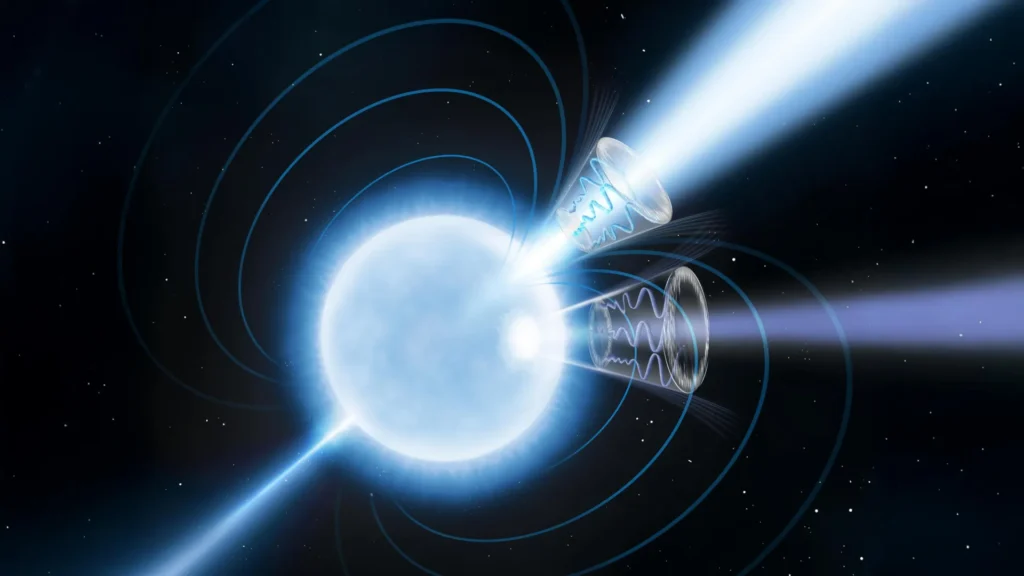
This groundbreaking finding, recently published in the prestigious journal Nature, represents a significant step towards confirming a nearly 90-year-old quantum mystery. Researchers, led by an international team including Dr. Marcus Lower from Swinburne University of Technology, have potentially observed a phenomenon known as ‘vacuum birefringence’ within the extraordinarily powerful magnetic field of a magnetar, a rare type of neutron star. If confirmed, this detection would not only validate a fundamental prediction of quantum electrodynamics but also provide scientists with an unprecedented tool to investigate the quantum universe under conditions impossible to replicate on Earth.
The Quantum Enigma: When "Empty" Space Isn’t So Empty
The concept of vacuum birefringence was first predicted in the 1930s by Werner Heisenberg, one of the pioneering figures of quantum mechanics. At the time, the classical view of a vacuum was simply an absence of matter, a void. However, Heisenberg’s theoretical work, rooted in the nascent field of quantum electrodynamics (QED), suggested a far more dynamic reality. According to QED, a perfect vacuum is not truly empty but rather a bustling arena of ‘virtual particles’ – fleeting pairs of particles and antiparticles, such as electrons and positrons, that spontaneously appear and disappear from existence in accordance with the Heisenberg Uncertainty Principle. These virtual particles exist for such minuscule durations that they cannot be directly observed, but their transient presence has profound implications for the properties of space itself.
Vacuum birefringence, therefore, describes a scenario where these virtual particles, under the influence of an exceptionally strong external magnetic field, temporarily become aligned or polarized. This alignment effectively transforms the vacuum into a medium with anisotropic optical properties, similar to certain crystals that exhibit birefringence. In such a polarized vacuum, light traveling through it would interact with these aligned virtual particles, causing its two perpendicular polarization components to travel at slightly different speeds. This differential speed leads to a rotation in the plane of polarization of the light, a measurable effect that would serve as direct evidence of vacuum birefringence. For decades, this intriguing prediction remained purely theoretical, awaiting an environment extreme enough to render its subtle effects observable.
Magnetars: Nature’s Unrivaled Magnetic Laboratories
The quest to observe vacuum birefringence led astronomers to the most extreme magnetic environments known in the universe: magnetars. These cosmic powerhouses are a rare subclass of neutron stars, the ultra-dense remnants of massive stars that have undergone supernova explosions. While all neutron stars are incredibly compact – packing the mass of our sun into a sphere just 20 kilometers across – magnetars possess magnetic fields that dwarf any other known object. Their magnetic fields can be upwards of 10^14 to 10^15 Gauss, a staggering figure that is a million billion times stronger than Earth’s magnetic field (approximately 0.5 Gauss) and tens of thousands of times more powerful than the strongest magnets ever created in terrestrial laboratories.
Such immense magnetic fields are thought to originate from a rapid dynamo process occurring in the incredibly hot, rapidly rotating core of the progenitor star during its supernova collapse. These fields are so powerful that they can distort atoms into cigar shapes, crack the star’s crust, and power intense bursts of X-rays and gamma rays. For physicists attempting to test fundamental quantum predictions, magnetars offer a unique and otherwise unobtainable cosmic laboratory where the conditions are finally extreme enough to potentially trigger observable vacuum birefringence.
The specific magnetar investigated in this study is 1E 1547.0-5408, or 1E1547 for short. Located approximately 15,000 light-years away in the constellation Norma, 1E1547 is one of the most active and well-studied magnetars, known for its frequent X-ray bursts and occasional giant flares. Its estimated magnetic field strength is well within the range considered necessary for vacuum birefringence to become detectable.
An Observational Breakthrough: Peering into the Extreme
The international research team employed a multi-observatory approach to study 1E1547, leveraging cutting-edge telescopes across different wavelengths. The primary instrument for this investigation was NASA’s Imaging X-ray Polarimetry Explorer (IXPE). Launched in December 2021, IXPE is a groundbreaking space observatory designed specifically to measure the polarization of X-rays from cosmic sources. X-ray polarization carries crucial information about the magnetic fields and geometries of extreme objects, making IXPE an ideal tool for probing the magnetar’s environment.
Dr. Marcus Lower highlighted the critical role of IXPE: "Detecting vacuum birefringence requires a magnetic field that is over 100 million times stronger than any we’ve ever made on Earth. Thankfully, nature has provided us with magnetars, which are the perfect cosmic laboratories to go looking for this effect."
In addition to IXPE, the observations were supported by the Neutron star Interior Composition Explorer (NICER) X-ray telescope aboard the International Space Station, which provided complementary timing and spectral data. Crucially, radio observations were also collected by Dr. Lower using Murriyang, CSIRO’s Parkes radio telescope, located in Australia. This iconic dish, owned and operated by Australia’s national science agency, provided vital information about the magnetar’s radio emission and its polarization characteristics. The combined data from these instruments, followed by extensive analysis on Swinburne’s Ngarrgu Tindebeek supercomputer, allowed researchers to meticulously investigate the light emanating from 1E1547.
The "Ideal Viewing Geometry" and Key Findings
The success of this study hinged not only on the extreme magnetic field of 1E1547 but also on its unique orientation relative to Earth. The researchers meticulously tracked how the radio waves coming from the magnetar changed direction as the star rotated, a measurement known as its ‘polarization state.’ From these observations, they determined that the magnetic and rotational axes of 1E1547 are almost perfectly aligned. Furthermore, the magnetar is observed from a nearly pole-on perspective.
These characteristics collectively provide scientists with an unusually favorable viewing geometry for searching for vacuum birefringence. A pole-on view of an aligned magnetar simplifies the complex magnetic field geometry that light would traverse, minimizing confounding factors and allowing for a clearer interpretation of polarization changes.
The team then identified two critical clues strongly pointing towards the quantum effect:
- Extremely High X-ray Polarization: IXPE detected exceptionally high levels of polarization in the X-rays generated by the magnetar. This high degree of polarization is a predicted signature of vacuum birefringence, as the vacuum’s anisotropic properties would preferentially transmit certain polarization states.
- Consistent Polarization Alignment: The direction of that X-ray polarization remained consistently tied to the magnetic field of 1E1547, mirroring the behavior observed in the radio wavelengths. This consistency across different energy bands and its alignment with the magnetar’s magnetic field direction are crucial. As Dr. Lower explained, "Because of the magnetic field’s strength, Heisenberg’s virtual particles become aligned with the direction the field is pointing. By carefully tracking the direction the radio waves and X-rays oscillate as the magnetar rotates, the team found that the alignment of 1E1547’s magnetic and rotational poles were ideal for detecting vacuum birefringence."
This alignment, coupled with the high polarization, provides the strongest evidence to date for the presence of vacuum birefringence in a cosmic environment.
A Decades-Long Pursuit: From Theory to Observation
The journey to potentially detect vacuum birefringence spans nearly a century, reflecting the profound challenges inherent in testing predictions of quantum mechanics under such extreme conditions. When Werner Heisenberg first proposed the concept in the 1930s, the technology to observe such a subtle effect was unimaginably far off. Terrestrial experiments to detect vacuum birefringence have been attempted in various forms over the decades, primarily by trying to create intensely strong magnetic fields in laboratories and observing their effect on laser light. Experiments like the PVLAS (Polarization of Vacuum with Laser) collaboration have pushed the boundaries of what’s possible on Earth, achieving magnetic fields up to 9 Tesla (90,000 Gauss). While these experiments have set stringent limits on the magnitude of vacuum birefringence, they have yet to achieve a definitive detection, primarily because the required magnetic field strengths are still many orders of magnitude short of what QED predicts is needed for a clear signal.
The sheer scale of a magnetar’s magnetic field – up to 10^15 Gauss – offers a natural environment where the effect should be amplified sufficiently to be detectable by modern astronomical instruments. This study, therefore, marks a pivotal moment, shifting the search from the laboratory to the cosmos, and potentially fulfilling a long-held ambition of physicists.
Profound Implications for Fundamental Physics and Astrophysics
If the interpretation of these observations is confirmed, the implications for both fundamental physics and astrophysics would be profound.
Validation of Quantum Electrodynamics (QED): QED is often hailed as one of the most successful and precisely tested theories in physics. It describes how light and matter interact and underpins much of our understanding of electromagnetism at the quantum level. However, direct experimental verification of vacuum birefringence has remained an elusive cornerstone. A confirmed detection from a magnetar would represent a powerful, direct astrophysical test of QED in a regime previously inaccessible to human experimentation, extending its validated domain to the most extreme environments in the universe. This would bolster confidence in QED’s predictive power under conditions far removed from everyday experience.
New Insights into Extreme Environments: Understanding how light propagates through the intensely magnetized vacuum around a magnetar offers new insights into the physics governing these enigmatic objects. It could help refine models of magnetar magnetospheres, the mechanisms behind their powerful X-ray and radio emissions, and their evolution. Beyond magnetars, this understanding could be applied to other extreme cosmic phenomena where magnetic fields play a dominant role, such as around accreting black holes or in the early universe.
A Novel Astrophysical Tool: The detection of vacuum birefringence could transform into a new diagnostic tool for astrophysicists. By measuring the polarization of light from distant, highly magnetized objects, researchers might be able to infer the strength and geometry of magnetic fields that are otherwise impossible to measure directly. This opens up exciting possibilities for mapping the magnetic topology of neutron stars, probing the physics of gamma-ray bursts, and even potentially investigating magnetic fields in the vicinity of nascent black holes.
Testing the Boundaries of the Standard Model: While primarily a confirmation of existing QED predictions, pushing the boundaries of observation always offers the tantalizing prospect of discovering deviations from theoretical predictions. Such deviations, however subtle, could hint at new physics beyond the Standard Model, potentially revealing previously unknown particles or interactions that modify the properties of the quantum vacuum.
The Path Forward: Confirming the Quantum Signature
Despite the compelling evidence, the scientific community emphasizes the need for further confirmation. The complex environment around magnetars involves numerous physical processes that could potentially mimic or obscure the signature of vacuum birefringence, such as plasma birefringence or scattering effects within the magnetar’s magnetosphere. Distinguishing the precise quantum signature from these other astrophysical phenomena is a critical next step.
Dr. Lower underscored this point: "With these future data on hand and our updated simulations, we may finally be able to complete the quest started by Heisenberg nearly 90 years ago." The researchers plan to pursue additional observations with IXPE and other instruments, aiming for longer exposure times and potentially observing other magnetars with different characteristics. This will help build a more robust statistical sample and rule out alternative explanations.
Furthermore, more advanced computer simulations are crucial. These simulations will need to precisely model the complex interplay of magnetic fields, plasma, and radiation within a magnetar’s magnetosphere, allowing researchers to isolate the specific effects attributable to vacuum birefringence. By comparing these sophisticated models with new, more precise observational data, scientists hope to definitively establish whether the signal truly originates from this long-sought quantum phenomenon.
The paper titled "Vacuum birefringence and the polarized X-ray emission of a radio magnetar" has been published in Nature, marking a significant milestone in our understanding of the universe’s most fundamental laws and its most extreme environments. If confirmed, this detection will stand as a testament to the enduring power of theoretical prediction, the ingenuity of experimental physics, and the unparalleled capacity of the cosmos to serve as a laboratory for the grandest scientific inquiries.