The enduring allure of vintage timepieces often transcends mere nostalgia, delving into the complex psychology of collecting and the unique emotional attachments that form around certain objects. For many enthusiasts, certain watches become recurring characters in their horological narratives – pieces that are acquired, enjoyed, and then, for reasons both rational and inexplicable, depart, only to reappear later in the collector’s journey. This phenomenon, often described as the "on-again, off-again timepiece," finds a compelling embodiment in the Heuer Camaro, particularly in distinctive examples like the tropical dial ref. 73343NT. This article delves into the history, design, and collector’s appeal of this specific model, exploring its place within the broader context of vintage Heuer chronographs and the evolving landscape of watch collecting.
A Legacy of American Muscle and Swiss Craftsmanship
The Heuer Camaro line, launched in the late 1960s, was conceived as a more youthful and American-inspired counterpart to the brand’s esteemed Carrera collection. The name itself, borrowed from Chevrolet’s iconic muscle car, signaled an intent to capture a spirit of dynamism and accessible luxury. The Chevrolet Camaro, introduced in 1967, was famously described by its creators as "a small, vicious animal that eats Mustangs," a moniker that immediately conveyed a sense of aggressive style and performance. Heuer sought to imbue its watches with a similar character, opting for a more robust and visually striking design compared to the sleeker Carrera.

The Camaro watches typically featured a compact 37mm stainless steel case, a size that, while modest by modern standards, offered a comfortable and balanced presence on the wrist. Their dial designs were often bold and colorful, incorporating tachymeter scales and sub-dials that underscored their chronograph functionality. This design ethos was intended to appeal to a new generation of watch buyers who appreciated both sporty aesthetics and reliable mechanical movements.
The Ref. 73343NT: A Unique Expression of the Camaro
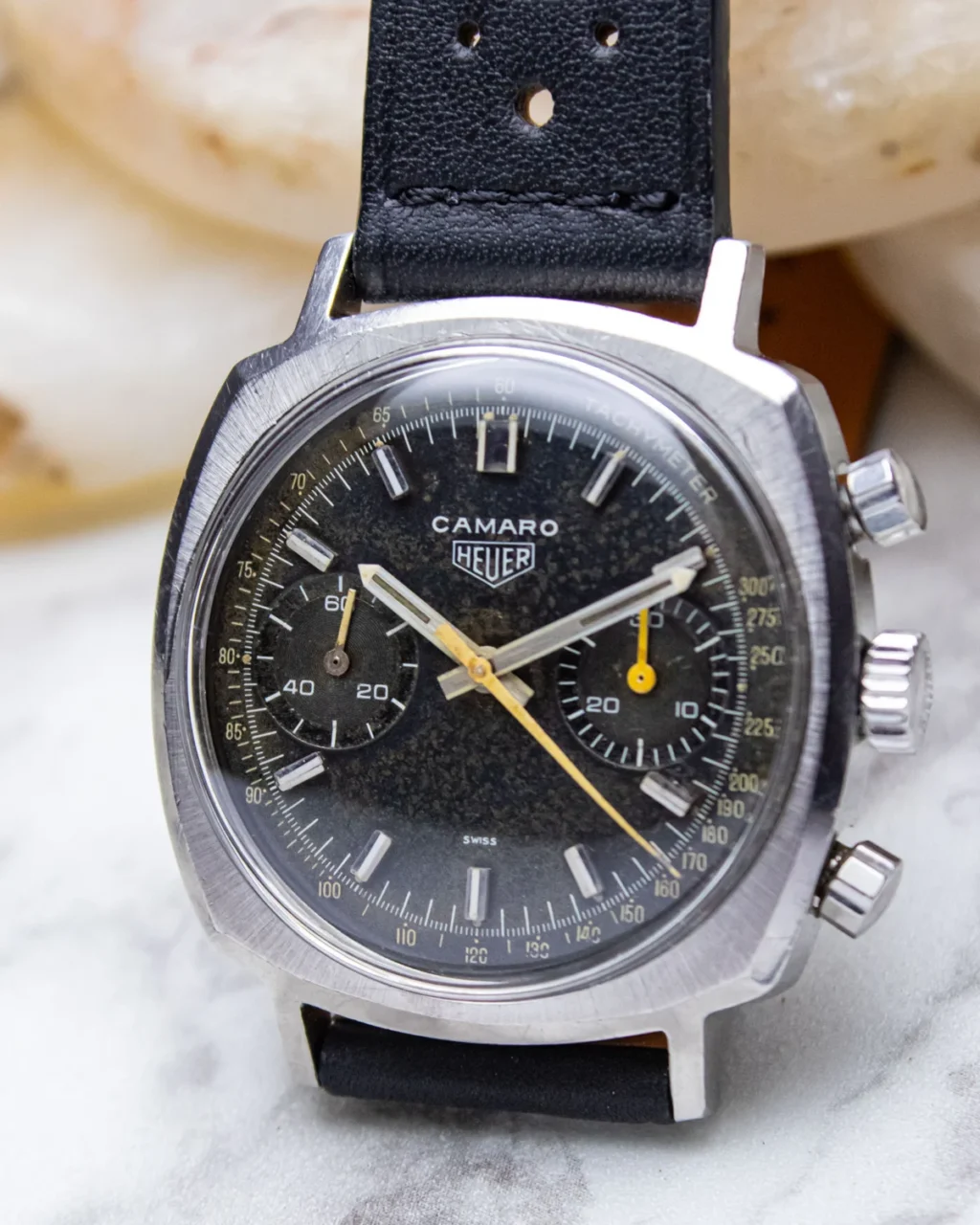
The Heuer Camaro ref. 73343NT represents a specific iteration within the Camaro family, distinguished by its "exotic dial" and the characteristic tropical aging that gives it a unique character. Produced in the final production runs of the Camaro line, likely around mid-to-late 1972, this reference belongs to the "Fourth Execution" of the model, which often featured the most vibrant color palettes.
Unlike more uniform examples, this particular ref. 73343NT showcases a remarkable transformation of its original design through the natural process of tropical aging. The watch features a black main dial, with the exception of the subdials, which remarkably retain their crispness and gloss. The aging process has introduced mottled, soft brown inclusions across the black surface, imbuing the stark color scheme with a "lived-in" warmth. This patina is particularly fascinating in its distribution, exhibiting a reverse fumé effect. The mottling is more pronounced towards the outer tachymeter scale and gradually subsides as it moves inward towards the handset. A darker patch organically encircles the logo and dial text at 12 o’clock, elegantly framing these elements.

Perhaps the most striking aspect of this watch’s tropical aging is its effect on the handset and associated markers. While the broad, white-tipped baton hands show only a subtle creamy off-white hue, the tachymeter scale, subdial hands, and central chronograph hand have undergone a dramatic metamorphosis. Originally rendered in a bright, saturated racing orange – a hallmark of the ref. 73343NT – these elements have been transformed by time and exposure into various shades of yellow. This accidental black-and-yellow colorway offers a softer, less stark contrast than the original, yet it retains the inherent racing charm of the design, creating a visually captivating and unique aesthetic that many collectors find even more appealing than the factory-original specification.
The Valjoux 7733: A Workhorse of Vintage Chronography
The mechanical heart of the Heuer Camaro ref. 73343NT is the Valjoux 7733 hand-wound chronograph movement. This movement, though perhaps less celebrated than some high-end in-house calibers, holds a significant place in horological history as a reliable and robust workhorse. Produced by Valjoux from 1969 until 1978, the 7733 was a foundational movement that powered a vast array of chronographs from numerous Swiss watch brands, including established names like Breitling and Hamilton.
The Valjoux 7733 is characterized by its mechanical simplicity and durable construction, making it relatively straightforward to service and maintain. Its architectural design served as a basis for later movements, most notably the legendary automatic chronograph caliber, the Valjoux 7750. The influence of the 7733 even extended beyond Switzerland; the Soviet-made Poljot 3133 chronograph movement is a heavily built, near-direct descendant of the 7733, adapted for the manufacturing capabilities of the era in Russia.

While purists might favor movements developed entirely in-house by watch brands, the Valjoux 7733 offers a practical advantage for vintage watch enthusiasts: it is a movement that is designed for actual use and longevity. Its robust nature ensures consistent performance, and its widespread use means that parts and servicing expertise are generally accessible. This makes watches powered by the 7733 highly functional and enjoyable to wear on a regular basis, a crucial factor for collectors who intend to integrate their vintage pieces into their daily lives.
The Collector’s Dilemma: The "On-Again, Off-Again" Timepiece
The author’s personal connection to the Heuer Camaro, as articulated in the original piece, highlights a common yet intriguing aspect of watch collecting: the "on-again, off-again timepiece." This refers to a watch that a collector deeply appreciates and enjoys, yet struggles to commit to keeping permanently within their collection. Such pieces are often traded, sold, and later repurchased or replaced by similar examples. The Heuer Camaro, with its distinct design and historical significance, seems to be one such watch for many enthusiasts, including the author, who has previously owned and traded various Camaro models.
The reasons for this cyclical behavior can be multifaceted. It might stem from a desire to explore different facets of a particular brand or model line, or from a financial imperative to fund new acquisitions. Sometimes, it’s simply the pursuit of a "better" example – a watch in superior condition, with rarer features, or with a more compelling provenance. In other cases, the emotional connection might wax and wane, leading to periods of detachment followed by renewed affection.

The tropical dial ref. 73343NT, however, represents a potential turning point in this collector’s relationship with the Camaro. The article suggests that this particular watch, with its unique patina and compelling aesthetic transformation, might foster a deeper, more lasting commitment. The "reunited and it feels so good" moment, as described, can indeed blossom into a more profound appreciation, especially when the object of affection has evolved so beautifully over time.
The Unpolished Appeal: Embracing the Signs of Time
A key factor contributing to the appeal of this specific ref. 73343NT is its unpolished state. While many vintage watches undergo case refinishing to restore their pristine appearance, this example retains its original, unpolished surfaces. This approach, while showcasing more visible signs of wear such as scratches, scuffs, and minor dings, preserves the integrity of the original case finishing. On this Camaro, the delicate sunburst brushing on the upper case, a feature often diminished or lost during polishing, remains intact.
This unpolished condition aligns with a growing appreciation within the collector community for watches that bear the authentic marks of their history. Just as a well-worn pair of jeans can be more desirable than a brand-new pair, a vintage sports watch with visible signs of a life well-lived can possess a unique charm and authenticity. The original design elements, such as the fluted pushers and the polished chamfers surrounding the case, still contribute to a sense of brightness and visual appeal on the wrist, even amidst the patina. This approach allows the watch to tell its story, reflecting the environments and activities it has witnessed over its nearly five decades of existence.

Broader Implications for the Vintage Watch Market
The Heuer Camaro, particularly in desirable configurations like the tropical dial ref. 73343NT, occupies a significant niche within the vintage watch market. While not as universally recognized as some of Rolex’s iconic models or the zenith of Patek Philippe complications, Heuers from the 1960s and 1970s have experienced a substantial surge in value and collector interest. This is driven by several factors:
- Historical Significance: Heuer’s pioneering role in chronometry, particularly in motorsports, has cemented its legacy. Watches like the Carrera and the Camaro are tangible links to this heritage.
- Design Innovation: The brand consistently pushed design boundaries, offering watches that were both functional and aesthetically forward-thinking for their time.
- Rarity and Condition: As time progresses, well-preserved examples of vintage Heuers become increasingly rare, driving up demand among collectors.
- Investment Potential: The increasing demand has translated into strong investment returns for many vintage Heuer models, attracting both seasoned collectors and new investors.
- The "Cool Factor": The inherent association with racing, speed, and a certain mid-century cool continues to resonate with a broad audience.
The ref. 73343NT, with its unique tropical dial and unpolished case, represents an example of a watch that transcends mere market trends. Its appeal lies in its individual story, its visual intrigue, and the connection it fosters with the past. The phenomenon of the "on-again, off-again" collector also speaks to the dynamic nature of the hobby, where personal journeys and evolving tastes play as significant a role as the objective qualities of the watches themselves.
Conclusion: A Timeless Appeal
The Heuer Camaro ref. 73343NT, with its distinctive tropical dial and unpolished case, stands as a testament to the enduring appeal of vintage chronographs. It embodies the spirit of its American muscle car namesake, blending robust functionality with a bold aesthetic. The natural aging process has transformed its dial into a unique work of art, offering a visual narrative that is both captivating and personal.

For collectors, the Camaro represents more than just a timepiece; it is a piece of history, a conversation starter, and, in the case of this particular example, a potential long-term companion. Whether it represents a fleeting reunion or the beginning of a lasting horological romance, the journey with such a watch is rich with appreciation for design, craftsmanship, and the passage of time. The "on-again, off-again" cycle, while sometimes frustrating, ultimately underscores the deep emotional connections that vintage watches forge with their custodians, proving that some flames, even if they flicker, can reignite with renewed brilliance.