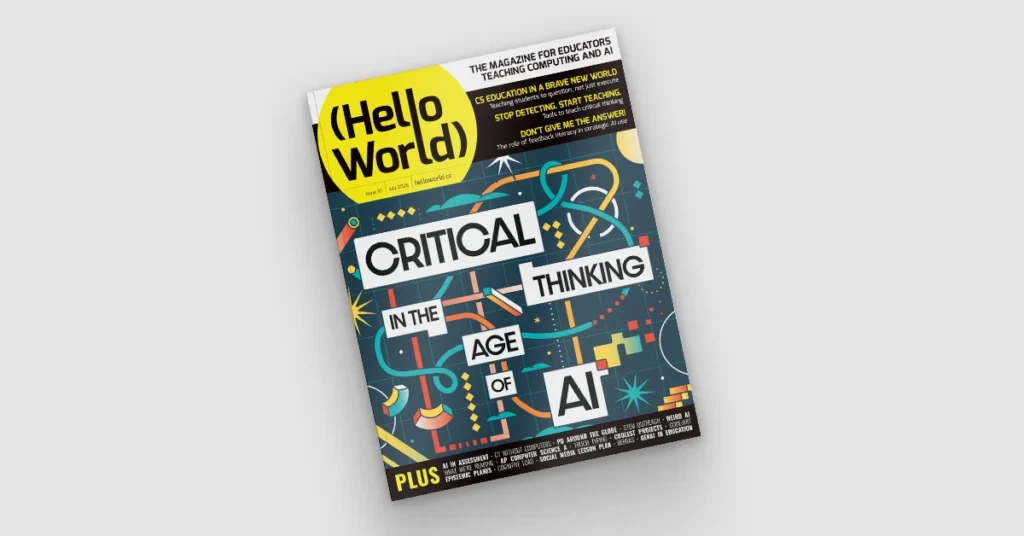
The rapid integration of generative artificial intelligence into daily life has prompted a significant shift in pedagogical priorities, leading the Raspberry Pi Foundation to dedicate the 30th issue of Hello World magazine to the preservation and development of critical thinking skills. As data-driven tools increasingly automate personal decision-making, from predictive text and algorithm-based entertainment recommendations to AI chatbots that synthesize complex information, educators are raising alarms regarding the potential "outsourcing" of human cognition. This latest publication, supported by a new podcast mini-series and sponsored by Oracle, serves as a comprehensive resource for educators grappling with the dual nature of AI as both a productivity booster and a potential cognitive crutch.
The Paradigm Shift in Educational Technology
For decades, educational technology focused on "digital literacy," which primarily involved teaching students how to use hardware and software to achieve specific outcomes. However, the emergence of Large Language Models (LLMs) like ChatGPT, Claude, and Gemini has fundamentally altered this landscape. The challenge has shifted from learning how to operate tools to learning how to interrogate the outputs those tools provide. Issue 30 of Hello World argues that while AI can provide immediate answers, the ability to evaluate the veracity, bias, and context of those answers remains a uniquely human responsibility.
The "outsourcing" of thought, as described by contributors to the magazine, refers to a growing reliance on automated systems to make choices that were previously the result of active mental engagement. This includes the loss of "accidental delights"—the serendipitous learning that occurs when one navigates a city without a GPS or researches a topic through various primary sources rather than receiving a summarized AI response. The editorial stance suggests that these non-assisted acts are not merely inconveniences but essential exercises that build the mental musculature required for complex problem-solving.
A Chronology of AI Integration in the Classroom
The urgency surrounding this issue stems from the unprecedented speed of AI adoption. In November 2022, the public release of ChatGPT triggered a global debate on academic integrity and the future of learning. By early 2023, many school districts initially responded with bans, citing concerns over plagiarism and the erosion of foundational writing skills. However, by late 2023 and early 2024, the narrative shifted toward "AI literacy," with educational bodies recognizing that students must be prepared for an AI-augmented workforce.
The release of Hello World Issue 30 in 2024 marks a mature phase in this timeline. Rather than focusing on how to use AI to grade papers or generate lesson plans, the focus has moved toward the philosophical and psychological impacts of the technology. The Computer Science Teachers Association (CSTA) in the United States recently reflected this evolution by rewriting its K–12 Standards. These research-backed frameworks are designed to prepare students for a future where they must direct AI rather than be directed by it.
Supporting Data: The Cognitive and Social Impact of Automation
Current research into cognitive load theory suggests that when tools make decisions too easy, the "desirable difficulties" required for deep learning are removed. According to a 2023 study by the Reboot Foundation, while 95% of educators believe critical thinking is a core skill, only a small fraction feel they have the specific resources to teach it in the context of algorithmic bias and AI hallucinations.
Furthermore, data from various educational technology surveys indicate that students who use AI as a "starting point" for research often struggle to identify errors in the AI’s logic if they lack prior domain knowledge. This "automation bias"—the tendency of humans to favor suggestions from automated decision-making systems—is a central theme in the new Hello World issue. Educators are now tasked with teaching students to be "human-in-the-loop" monitors, a role that requires more, not less, critical thinking than traditional research methods.
Official Responses and Educator Perspectives
The release features contributions from a diverse array of experts, including Amanda O’Mara, Smita Kolhatkar, and Tiffany Jones, who contributed to the CSTA standards update. Their perspective emphasizes that AI can generate answers at "supersonic speed," but human judgment is the only safeguard against misinformation.
Key questions addressed by these educators include:
- Whose knowledge is shaping AI? This addresses the inherent biases in training data, which often reflect Western-centric or specific socioeconomic viewpoints, potentially marginalizing other forms of knowledge.
- Why AI professional learning must build teacher critical thinking: The magazine posits that simply training teachers on how to use AI tools is insufficient. Professional development must instead focus on helping teachers understand the underlying mechanics of AI so they can mentor students in skeptical inquiry.
- Managing cognitive load for deeper thinking: Contributors discuss how to use AI to offload mundane tasks without sacrificing the mental effort required for high-level synthesis.
The CSTA’s inclusion in this issue is particularly significant. As the leading body for computer science education in the U.S., their updated standards serve as a roadmap for thousands of schools. Their stance is clear: computing education is uniquely situated to cultivate a critical mindset because it allows students to look "under the hood" of the technologies they use daily.
The Role of Industry and Community Support
The production of Hello World Issue 30 was made possible through a partnership with Oracle, reflecting a broader industry recognition that the future workforce requires individuals who can think independently of the tools they use. This sponsorship highlights the intersection between corporate interests and educational integrity, suggesting that even the creators of high-level data tools see the necessity of human critical thinking.
The Raspberry Pi Foundation has also expanded the reach of these ideas through a podcast mini-series. This multi-media approach acknowledges that educators are themselves under high cognitive load and require various formats to digest complex research and practical advice. The podcast allows for a deeper dive into "Flatgames," predictive classroom systems, and the intersection of physics and technology—topics that further illustrate the diverse applications of critical thinking in modern STEM education.
Analysis of Implications for the Future of Education
The move toward prioritizing critical thinking over technical proficiency signals a "re-humanization" of the classroom. If AI can handle the "what" and the "how," the human role becomes focused on the "why" and the "should." This has several long-term implications:
- Redefinition of Assessment: As AI becomes capable of passing standardized tests and writing essays, educators are being forced to develop new methods of assessment that value the process of thinking over the final product. Hello World Issue 30 explores "AI systems in assessment," looking at how educators can promote human decision-making in an automated world.
- The Digital Thinking Divide: There is a growing concern that students who are taught to use AI critically will become the "directors" of technology, while those who are merely taught to follow AI prompts will become "directed" by it. This issue of Hello World seeks to close that gap by providing free, accessible resources to all educators.
- Interdisciplinary Learning: Critical thinking in the age of AI is not confined to computer science. The magazine emphasizes that these skills are vital regardless of the discipline, from history students analyzing AI-generated historical narratives to science students using predictive models in physics projects.
Conclusion and Resources
The release of Hello World Issue 30 serves as a call to action for the global educational community. By providing research, advice, and practical resources for free, the Raspberry Pi Foundation and its partners are attempting to ensure that the "age of AI" does not become an "age of intellectual passivity."
The magazine is available for free download, offering articles on managing cognitive load, promoting human decision-making, and understanding the updated CSTA K–12 Standards. As the digital landscape continues to move at a rapid pace, the goal remains clear: to empower the next generation to engage thoughtfully, skeptically, and creatively with the tools that define their world. Educators are encouraged to share their experiences with these resources, fostering a community of practice that values human judgment in an increasingly automated society.