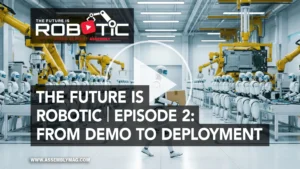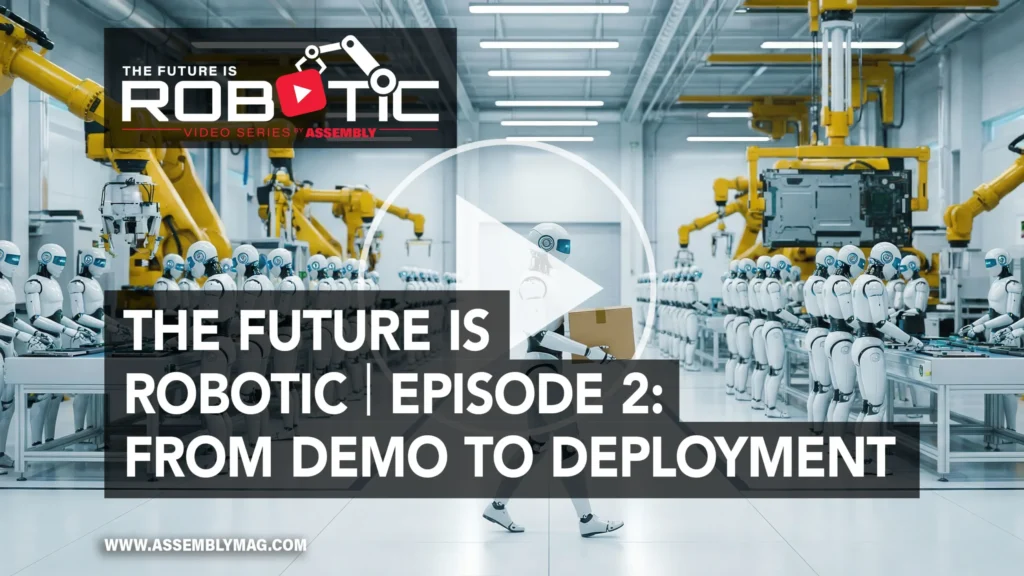
BIRMINGHAM, Mich. – The second installment of ASSEMBLY’s insightful monthly video series, The Future Is Robotic, delves into one of the most critical questions confronting manufacturers as advancements in robotics and physical artificial intelligence accelerate: what precisely does it take to successfully transition a promising technological demonstration into a consistently reliable production reality? This inquiry forms the bedrock of Episode 2, titled "From Demo to Deployment," which scrutinizes the formidable challenges and transformative opportunities inherent in integrating cutting-edge robotic solutions onto the factory floor.
The episode initiates its deep dive by spotlighting Generalist’s innovative GEN-1.5 robot foundation model, presenting it as a pivotal starting point for this crucial industry conversation. Generalist asserts that GEN-1.5 possesses the groundbreaking capability to acquire new physical tasks from mere seconds of demonstration data, a methodology the company terms "physical prompting." This novel approach is engineered to allow the model to learn effectively from one or a limited number of examples, adapt seamlessly to unforeseen situations, and even improvise deftly when existing tools or operational conditions undergo change. Such attributes signal a significant leap forward from traditional, labor-intensive robot programming, promising a more agile and responsive automation ecosystem.
The Evolving Landscape of Industrial Automation
The manufacturing sector stands at a precipice, grappling with a confluence of pressures ranging from escalating global competition and persistent labor shortages to the ever-increasing demand for product customization and shorter product lifecycles. For decades, industrial robotics has been a cornerstone of efficiency, primarily through highly specialized, fixed automation systems programmed for repetitive tasks. Early industrial robots, pioneered by companies like Unimation in the 1960s, revolutionized mass production, particularly in industries like automotive. These robots, while robust, required extensive, often complex, programming for each new task, making them less suitable for high-mix, low-volume production or environments requiring frequent retooling.
The late 20th and early 21st centuries saw the emergence of more flexible robots, collaborative robots (cobots), and advanced vision systems, broadening their applicability. However, a significant bottleneck remained: the difficulty and time required to teach robots new tasks. This programming burden often negated the benefits of flexibility, especially for small and medium-sized enterprises (SMEs) lacking dedicated robotics engineers. The current "automation boom," as referenced in Episode 1 of The Future Is Robotic ("The Robot Recession"), is not merely a rebound but a fundamental shift driven by advancements in artificial intelligence and machine learning. This shift promises to address the long-standing challenge of robot adaptability and ease of deployment, pushing the boundaries beyond repetitive tasks into more nuanced, human-like manipulation.
Generalist’s GEN-1.5: A New Paradigm for Robot Learning
Generalist’s GEN-1.5 robot foundation model represents a paradigm shift, drawing parallels to the transformative impact of large language models (LLMs) in the field of natural language processing. Just as LLMs learn patterns and relationships from vast datasets of text to generate human-like language, robot foundation models aim to learn fundamental principles of physical interaction and manipulation from extensive datasets of real-world and simulated robotic actions. This foundational understanding allows them to generalize and apply learned skills to novel tasks and environments with minimal specific training.
The concept of "physical prompting" is central to GEN-1.5’s appeal. Unlike traditional programming that requires explicit instructions for every movement and condition, physical prompting involves demonstrating a task a few times, perhaps even once, and allowing the robot to infer the underlying objective and necessary actions. This could involve a human physically guiding the robot arm, showing it how to pick up an irregularly shaped part, place it in an assembly, or operate a machine tool. The model then leverages its extensive pre-trained knowledge to generalize this demonstration, understanding the intent behind the human action rather than just mimicking precise joint angles.
This capability is particularly vital for manufacturers navigating the complexities of shorter product cycles and increasingly higher-mix production. In environments where parts, tools, and entire processes change frequently, the ability to rapidly re-task or adapt automation is not just an advantage—it’s a necessity. If robots can learn new manipulation tasks more quickly and intuitively, they could significantly enhance agility in assembly lines, logistics, and even intricate manufacturing operations, reducing downtime associated with reprogramming and facilitating more dynamic production strategies. Furthermore, the inherent adaptability of models like GEN-1.5 to new situations and their capacity to improvise when tools or conditions deviate from the norm are crucial for real-world robustness, where perfect, controlled environments are rare.
Bridging the Gap: The Reality of Factory Floors
While the potential of emerging robotics technology is undeniably exciting, Episode 2 thoughtfully poses the critical follow-up question: how does this advanced capability truly perform when confronted with the unfiltered realities of real equipment, stringent cycle times, and the indispensable presence of human operators? This is precisely where Ken Macken, CEO and founder of Workr, contributes his invaluable perspective to the discourse.

Macken, a seasoned expert in industrial deployment, strongly advises manufacturers to look beyond the meticulously curated lab demonstration or the polished trade show video. He urges them to scrutinize whether a robotics team has genuinely deployed their technology within the challenging, dynamic environment of actual manufacturing facilities. For Macken, the ultimate litmus test for any advanced robotic system is not its ability to execute a task flawlessly once under highly controlled, optimized conditions. Instead, the true measure of its efficacy and value lies in its unwavering capacity to perform day after day, week after week, across multiple shifts, within a plant replete with all its inherent variations, operational constraints, and often, legacy equipment.
The distinctions between a lab demo and factory deployment are stark and numerous. Lab environments are typically clean, well-lit, and controlled, with consistent part presentation, ideal network conditions, and expert oversight. Factory floors, conversely, are characterized by dust, vibrations, fluctuating temperatures, inconsistent part tolerances, varying material properties, and the presence of human workers with whom robots must safely and efficiently collaborate. "Real equipment" implies integration with existing machinery, which might not have modern interfaces. "Real cycle times" mean meeting demanding production targets without faltering, requiring not just speed but consistent precision and minimal errors. "Real operators" necessitate intuitive human-robot interfaces, clear safety protocols, and the ability for robots to gracefully handle human intervention or unexpected events. The robustness of a system in the face of sensor noise, calibration drift, and minor mechanical wear is paramount for sustained operation.
The Economic Imperative and Market Trends
The drive towards more adaptable and easily programmable robots is not merely a technological pursuit; it is an economic imperative. According to the International Federation of Robotics (IFR), global robot installations have been on an upward trajectory, with significant growth predicted for the coming years, driven largely by the need for increased automation and productivity. The global industrial robotics market size, valued at billions of dollars, is projected to expand significantly, fueled by innovations in AI, vision systems, and collaborative robotics.
Manufacturers are facing unprecedented challenges in securing and retaining skilled labor. Data from various industry reports consistently highlight a widening skills gap in manufacturing, with millions of jobs projected to go unfilled in the coming decade. Automation, particularly intelligent automation, is seen not as a replacement for human workers but as a force multiplier, enabling existing workforces to be more productive and freeing them from dangerous, dull, or dirty tasks.
The total cost of ownership (TCO) for robotic systems is also a critical factor. While the initial capital expenditure for advanced robotics can be substantial, the long-term costs associated with programming, integration, maintenance, and retraining are often overlooked. Technologies like GEN-1.5, by significantly reducing programming time and increasing adaptability, promise to lower the TCO, making advanced automation more accessible and economically viable for a broader range of manufacturers, including SMEs who have historically found complex robotics deployment prohibitive. Investment in AI and robotics startups continues to surge, indicating strong confidence from the venture capital community in the transformative potential of these technologies for industrial applications.
Broader Implications for Manufacturing
The successful deployment of robot foundation models and physical AI systems carries profound implications across the manufacturing ecosystem:
- Enhanced Agility and Responsiveness: Manufacturers can more rapidly pivot to new product designs, respond to fluctuating market demands, and offer greater product customization without incurring prohibitive retooling costs or downtime. This is critical for industries like consumer electronics, fashion, and even automotive, where model lifecycles are shrinking.
- Workforce Transformation and Upskilling: While concerns about job displacement are natural, the more likely scenario is job transformation. New roles will emerge for "robot trainers" who demonstrate tasks, "robot supervisors" who monitor performance and troubleshoot, and advanced maintenance technicians. The emphasis will shift from manual labor to cognitive tasks, requiring significant investment in workforce education and reskilling programs.
- Democratization of Automation: Easier programming and greater adaptability could lower the barrier to entry for automation, allowing smaller manufacturers to leverage advanced robotics to compete more effectively with larger enterprises. This could foster innovation and resilience across the supply chain.
- Improved Productivity and Quality: Robots capable of learning and adapting can operate with greater precision and consistency, leading to higher quality products and reduced waste. Their ability to work continuously can significantly boost throughput and overall operational efficiency.
- Safety and Human-Robot Collaboration: As robots become more intelligent and context-aware, their ability to safely collaborate with humans improves. Advanced sensors and AI can enable robots to predict human movements and react accordingly, paving the way for more seamless and safer human-robot teaming on the factory floor.
The Road Ahead: Evaluating and Adopting New Technologies
As robot foundation models, sophisticated physical AI systems, and a plethora of new automation tools steadily progress closer to widespread factory floor integration, manufacturers face a critical juncture. They must meticulously decide how to effectively evaluate these emerging technologies, strategically pilot them within their unique operational contexts, and, perhaps most importantly, set realistic expectations for their performance and return on investment. The journey from a compelling lab demonstration to reliable, scalable production is often fraught with unforeseen challenges, demanding a pragmatic approach that balances innovation with operational realities.
The Future Is Robotic series is designed precisely to illuminate these complex questions. Each month, through short, focused episodes, the series dissects these critical issues, drawing upon in-depth expert interviews and ASSEMBLY’s comprehensive reporting on the latest advancements in automation, robotics, and broader manufacturing technology. For those who missed the series debut, Episode 1: "The Robot Recession," offers valuable historical context, exploring how the lessons gleaned from past robotics trends connect directly to the current era’s rapid automation boom. The series continues its exploration of these vital topics, promising further insights into the evolving world of industrial robotics in the coming months, with its next installment slated for October. The future of manufacturing hinges on understanding and mastering this transition.