Microcontrollers (MCUs) have undergone a profound transformation over the last two decades, evolving far beyond their initial roles as simple control units. This evolution encompasses not only a dramatic surge in processing power and memory capacity but also a fundamental shift in the methodologies engineers employ for development. A recent Electropages Podcast delved into these critical advancements and the prospective trajectory of MCU technology, featuring insights from Robin Mitchell and Kevin Jones, Business Development Manager at GigaDevice, a prominent player in the semiconductor industry. Their discussion illuminated key trends poised to redefine embedded systems: the burgeoning influence of RISC-V architecture, the integration of advanced intelligence into industrial robotics, and the accelerating migration of artificial intelligence capabilities to the edge.
The Unfolding Evolution of Microcontroller Technology
The journey of microcontrollers from rudimentary 8-bit devices to today’s sophisticated 32-bit and even 64-bit platforms represents one of the most significant narratives in modern electronics. Early MCUs were characterized by limited resources, often featuring kilobytes of flash memory and a few hundred bytes of RAM, primarily tasked with basic input/output control in consumer appliances or simple industrial applications. Development typically involved low-level assembly language or rudimentary C compilers, with debugging often a laborious hardware-centric process.
However, the turn of the millennium ushered in an era of rapid innovation. Driven by Moore’s Law, which posited the doubling of transistors on an integrated circuit every two years, MCUs began to integrate more complex peripherals directly onto the chip – from sophisticated analog-to-digital converters (ADCs) and digital-to-analog converters (DACs) to advanced communication interfaces like CAN, USB, and Ethernet. The advent of highly efficient ARM Cortex-M processors further accelerated this trend, offering a powerful yet low-power architecture that became the de facto standard for embedded systems. This integration significantly reduced bill-of-materials (BOM) costs, simplified board designs, and opened the door for MCUs to tackle more demanding applications, from complex motor control to advanced human-machine interfaces (HMIs) and sophisticated sensor fusion. Development environments also matured, offering integrated development environments (IDEs), real-time operating systems (RTOS), and extensive software libraries, democratizing access to complex embedded design. GigaDevice, through its extensive portfolio of GD32 series MCUs, has been a key contributor to this evolution, offering a wide range of devices that cater to diverse application needs.
RISC-V: An Open Architecture Reshaping Silicon Design
One of the most disruptive forces currently at play in the embedded processor landscape is the RISC-V instruction set architecture (ISA). As highlighted by Kevin Jones, GigaDevice distinguished itself as an early mainstream adopter of RISC-V, notably with the introduction of its GD32VF103 series in 2019. This strategic move underscored GigaDevice’s commitment to innovation and its recognition of RISC-V’s transformative potential. Today, RISC-V based devices continue to play a crucial role in GigaDevice’s wireless strategy, signaling a deeper integration into their product development roadmap.
Background and Chronology:
RISC-V originated from research at the University of California, Berkeley, in 2010, initially conceived as a clean-slate approach to ISA design for academic research. Its defining characteristic is its open-source nature, meaning it is freely available for anyone to use, modify, and implement without licensing fees. This stands in stark contrast to proprietary ISAs like ARM, which require licensing agreements and royalties. The RISC-V Foundation, later rebranded as RISC-V International, was established in 2015 to standardize and promote the architecture globally, fostering a collaborative ecosystem. GigaDevice’s launch of the GD32VF103 in 2019 marked a significant milestone, being one of the first commercially available general-purpose MCUs to leverage the RISC-V architecture, thereby validating its viability for mainstream applications.
Supporting Data and Market Dynamics:
The flexibility inherent in RISC-V allows semiconductor manufacturers to develop highly customized processors optimized for specific applications and workloads, a key advantage emphasized by Kevin Jones. This capability enables designers to add custom instructions or extend the ISA to meet unique performance or power requirements, a level of control largely unavailable with proprietary architectures. Market analysts predict substantial growth for RISC-V. A report by Semico Research Corporation projected that RISC-V CPU core shipments would reach 62.4 billion units by 2030, representing a compound annual growth rate (CAGR) of 62.4%. This exponential growth is driven by its appeal in various sectors, including IoT, AI/ML, automotive, and data centers. The open-source model has fostered a rapidly expanding ecosystem of tools, software, and intellectual property (IP) providers, further accelerating its adoption.
Implications:
The rise of RISC-V carries profound implications for the semiconductor industry and global technology landscape. Firstly, it democratizes hardware innovation, lowering the barrier to entry for new players and fostering greater competition. Smaller companies and startups can design custom silicon without the prohibitive licensing costs associated with established ISAs. Secondly, it offers unprecedented flexibility, allowing for the creation of application-specific integrated circuits (ASICs) or highly optimized processors that can deliver superior performance or power efficiency for niche tasks. This is particularly relevant in the era of specialized computing for AI and edge processing. Lastly, RISC-V offers a potential pathway to greater supply chain resilience and reduced geopolitical dependencies. By providing an open standard, it can mitigate concerns about single-vendor lock-in or export controls, offering a more diversified and secure foundation for critical national infrastructure and technological development. GigaDevice’s early and continued investment in RISC-V positions it strategically to capitalize on these evolving market dynamics, offering customers innovative and flexible solutions.
Bringing Advanced Intelligence to Industrial Robotics
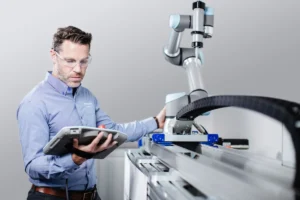
The industrial robotics sector is undergoing a profound transformation, moving beyond repetitive, pre-programmed tasks towards more agile, collaborative, and intelligent systems. This evolution places a distinct and demanding set of requirements on embedded hardware, particularly concerning communication and control. As robots become more sophisticated, incorporating a greater number of motors, sensors, and intricate movement capabilities, the need for highly deterministic communication between various controllers becomes paramount.
Main Facts and Technical Deep Dive:
Kevin Jones highlighted GigaDevice’s GD32H7 devices, which feature EtherCAT capabilities, as a solution addressing these challenges. EtherCAT (Ethernet for Control Automation Technology) is a high-performance, real-time industrial Ethernet fieldbus system specifically designed for automation applications requiring extreme precision and speed. Unlike traditional Ethernet, EtherCAT processes data on the fly, allowing for very low latency and high synchronization accuracy across distributed nodes. This capability enables a paradigm shift in robotic control: rather than relying on a single, powerful central processor to manage every decision and motor movement, future robotic systems can increasingly leverage distributed microcontrollers. These localized MCUs can control individual motors, sensor arrays, or entire sections of a robotic system, making time-critical decisions locally.

Background Context and Supporting Data:
The industrial robotics market is experiencing robust growth, with the International Federation of Robotics (IFR) reporting record installations globally. The drive towards Industry 4.0 and smart manufacturing necessitates robots that are more adaptable, collaborative, and capable of complex tasks in dynamic environments. This demands not just raw processing power but also guaranteed real-time responsiveness. In applications like high-speed pick-and-place, precision machining, or collaborative human-robot interaction, communication latency measured in microseconds can be critical. A deviation of even a few milliseconds can lead to inaccuracies, safety hazards, or production bottlenecks. EtherCAT, with its typical cycle times ranging from 100 microseconds to several milliseconds, ensures the necessary determinism. The GD32H7 series, with its high-performance ARM Cortex-M7 core and integrated EtherCAT slave controller, is precisely engineered to meet these rigorous demands, enabling complex motion control, precise sensor data acquisition, and rapid command execution in a distributed network.
Implications:
The shift towards distributed, intelligent robotic control, facilitated by technologies like EtherCAT and powerful MCUs, carries several significant implications. Firstly, it enhances the overall scalability and modularity of robotic systems. Engineers can design more complex robots by adding specialized modules, each controlled by its dedicated MCU, without overwhelming a central processor. Secondly, it improves fault tolerance; a failure in one localized control unit might not bring down the entire system. Thirdly, and perhaps most importantly, it enables greater autonomy and responsiveness. By processing data and making decisions closer to the point of action, robots can react faster to changes in their environment, perform more intricate movements, and ultimately operate more efficiently and safely. This distributed intelligence is a cornerstone for the next generation of industrial automation, paving the way for truly intelligent factories where robots can adapt and learn on the fly.
Edge AI: Intelligent Processing at the Source
The conversation on the Electropages Podcast also pivoted to the rapidly expanding field of edge AI, underscoring another critical area where MCUs are poised to play a pivotal role. Traditionally, artificial intelligence workloads, especially those involving complex neural networks, were largely confined to powerful cloud servers due to their immense computational requirements. However, a growing number of applications are demonstrating the feasibility and indeed the necessity of deploying AI inference capabilities directly at the "edge" – on local devices rather than in remote data centers.
Main Facts and Technical Feasibility:
Kevin Jones explained that many edge AI applications, such as motor anomaly detection, human presence detection, predictive maintenance, and other local inference tasks, do not necessarily demand the processing power of a high-end AI accelerator or a cloud GPU. Instead, these workloads can often be efficiently handled by contemporary microcontrollers. Specifically, Cortex-M7 and Cortex-M33 microcontrollers are increasingly capable of managing these tasks, particularly when AI models are carefully optimized and reduced in complexity to match the available processing resources. This field, often referred to as "TinyML," focuses on bringing machine learning to tiny, low-power embedded devices.
Background Context and Supporting Data:
The impetus for moving AI to the edge stems from several limitations of cloud-centric AI:
- Latency: Sending data to the cloud, processing it, and receiving a response introduces delays that are unacceptable for real-time applications like autonomous driving or industrial control.
- Bandwidth: Continuously streaming large volumes of sensor data to the cloud can overwhelm network infrastructure and incur significant costs.
- Privacy and Security: Processing sensitive data locally reduces the risk of data breaches and addresses privacy concerns, especially in consumer and industrial applications.
- Cost and Power: Cloud processing incurs ongoing operational costs and consumes substantial energy. Local processing on low-power MCUs can be significantly more economical and energy-efficient.
The market for edge AI is projected to grow substantially. Reports suggest the global edge AI hardware market could reach tens of billions of dollars within the next few years. This growth is fueled by advancements in model compression techniques, such as quantization (reducing the precision of model weights and activations) and pruning (removing redundant connections in neural networks), which allow complex models to run efficiently on resource-constrained MCUs. ARM Cortex-M7 and Cortex-M33 processors, with their DSP extensions, floating-point units, and enhanced memory architectures, are particularly well-suited for these tasks. The Cortex-M33, for instance, also incorporates ARM TrustZone for security, which is crucial for protecting AI models and data at the edge.
Implications:
The ability of MCUs to handle local AI inference makes artificial intelligence practical in a much broader array of cost-sensitive embedded applications. This has profound implications:
- Cost Reduction: By reducing the reliance on cloud processing, businesses can significantly lower their operational expenditures related to data transfer, storage, and cloud compute time.
- Enhanced Privacy and Security: Processing data locally keeps sensitive information on the device, enhancing user privacy and system security.
- Improved Responsiveness: Real-time decision-making at the edge means applications can react instantaneously to events, crucial for safety-critical systems and responsive user experiences.
- Reduced Cloud Dependence: This trend fosters greater autonomy for embedded systems, allowing them to function effectively even in environments with intermittent or no network connectivity.
- Environmental Benefits: Less data transmission to the cloud translates to reduced energy consumption for network infrastructure, contributing to more sustainable computing.
GigaDevice’s range of Cortex-M based MCUs, combined with their focus on optimizing performance for edge workloads, positions them to be a key enabler in this transformative shift towards ubiquitous, intelligent embedded systems.
The Convergence of Innovation: A GigaDevice Perspective
The discussions on the Electropages Podcast underscore a pivotal moment in embedded systems development. The convergence of powerful, versatile microcontrollers, open and customizable architectures like RISC-V, sophisticated real-time communication protocols such as EtherCAT, and the accelerating migration of AI to the edge is creating an unprecedented landscape of possibilities. GigaDevice, through its strategic investments and product offerings—from pioneering RISC-V MCUs like the GD32VF103, to high-performance GD32H7 devices for deterministic industrial control, and its robust portfolio of Cortex-M based solutions—is demonstrably at the forefront of these transformative trends.
The future of embedded intelligence will be characterized by greater autonomy, enhanced responsiveness, increased security, and a more distributed processing paradigm. MCUs are no longer just controllers; they are becoming intelligent nodes capable of complex computation, communication, and decision-making, driving innovation across industrial automation, IoT, automotive, and consumer electronics sectors. As Kevin Jones and Robin Mitchell elucidated, the path forward for microcontroller technology is one of relentless innovation, empowering engineers to build the intelligent, connected, and autonomous systems that will define the next generation of technology.