BIRMINGHAM, Mich. – The widespread adoption of humanoid robots, particularly their transition from experimental prototypes to practical, large-scale factory applications, will necessitate increasingly sophisticated and integrated sensing capabilities. A new report from market research firm IDTechEx highlights that the market for sensors specifically designed for humanoid robots is poised for explosive growth, with projections indicating it could surpass $6.59 billion annually by 2037, demonstrating a robust compound annual growth rate (CAGR) of 21.4%. This surge underscores a fundamental truth: for humanoids to operate effectively and safely alongside humans and complex machinery, their ability to perceive, understand, and interact with their environment must evolve dramatically.
The Drive Towards Humanoid Automation and the Sensor Imperative
The push for humanoid robots in manufacturing is not merely a futuristic aspiration but a strategic response to evolving industrial demands. As global economies grapple with labor shortages, rising production costs, and the need for greater flexibility and efficiency, automation stands as a critical solution. While traditional industrial robots excel at repetitive tasks in controlled environments, humanoids offer the promise of adaptability, capable of navigating dynamic workspaces, operating existing human-centric tools, and performing a wider array of complex, non-repetitive tasks. This versatility, however, is entirely dependent on their sensory apparatus.
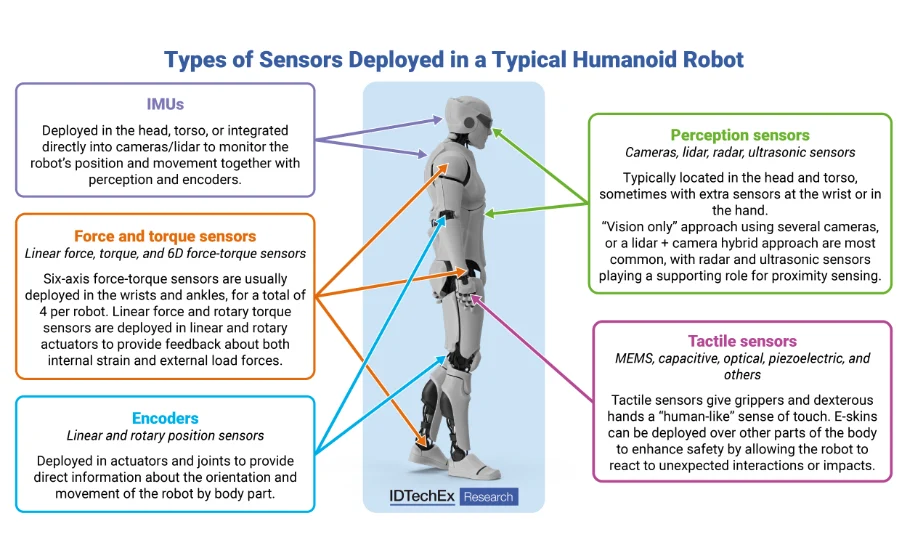
IDTechEx, in its comprehensive "Sensors for Humanoid Robots 2027-2037: Technologies, Players, Forecasts" report, identifies five foundational categories of sensors crucial for humanoid functionality: perception sensors, force-torque sensors, encoders, inertial measurement units (IMUs), and tactile sensors. The synergy between these diverse sensor types, facilitated by advanced sensor fusion techniques, is paramount. Sensor fusion allows a robot to integrate data from multiple sources, creating a holistic understanding of its internal state – its posture, movement, and forces exerted – and its external environment, including the presence of objects, people, and spatial relationships. This integrated awareness is the cornerstone for determining appropriate actions and ensuring safe, efficient operation.
Deep Dive into Essential Sensor Categories
Each sensor category plays a distinct yet interconnected role in enabling humanoid intelligence and dexterity.
Perception Sensors: These are the robot’s "eyes" and "ears," enabling it to understand its surroundings. Technologies in this domain include depth cameras, lidar (Light Detection and Ranging), ultrasonic sensors, and millimeter-wave radar. Depth cameras provide 3D spatial information, crucial for object recognition and navigation. Lidar offers high-resolution depth mapping, particularly effective in varying lighting conditions and for long-range environmental awareness, a capability often debated against camera-only vision systems. Ultrasonic sensors are excellent for proximity detection, especially in cluttered environments, while millimeter-wave radar can penetrate dust and fog, providing robust detection of objects and their velocities. The debate among developers often centers on whether camera-based vision alone can suffice for complex navigation and mapping, or if the added precision and environmental resilience of lidar are indispensable. This mirrors similar discussions in the autonomous vehicle industry, highlighting a significant technological overlap.
Force-Torque Sensors: These sensors are critical for enabling a humanoid robot to interact physically with its environment, providing feedback on loads, impacts, and strains. Six-axis force-torque sensors, which measure linear forces and rotational torques across three dimensions, are particularly vital. They are typically integrated into a humanoid’s wrists, allowing for precise object manipulation, delicate assembly tasks, and tool handling. Their application extends to the ankles, where they are instrumental in maintaining balance, especially during locomotion or when carrying loads. However, IDTechEx notes that these sophisticated sensors are currently among the most expensive components in a humanoid robot. Unlike some perception technologies that benefit from high-volume production in other sectors, six-axis force-torque sensors have a relatively limited supply chain overlap. Existing applications, such as medical equipment and specialized industrial robot arms, involve lower annual volumes, leading to higher unit costs. This presents a significant challenge for mass production of humanoid robots.
Encoders: Encoders are fundamental for precise control over a robot’s movements. These devices monitor the rotational or linear position of a joint, providing feedback to the robot’s control system about the exact angle or displacement of its limbs. They are essential for accurate posture, smooth motion, and repetitive task execution. Without highly accurate encoders, a humanoid robot would struggle with the fine motor control required for manipulating objects or navigating with precision. As humanoids become more agile and dexterous, the resolution and speed of encoders will need to keep pace.
Inertial Measurement Units (IMUs): An IMU combines accelerometers, gyroscopes, and often magnetometers to measure a robot’s orientation, angular velocity, and linear acceleration. These sensors are vital for maintaining balance, estimating position, and understanding the robot’s dynamic state in space. They are crucial for bipedal locomotion, allowing the robot to detect shifts in its center of gravity and make immediate adjustments to prevent falls. IMUs also play a role in estimating movement without relying solely on external visual cues, offering a degree of dead reckoning in GPS-denied or visually ambiguous environments. The advancement of MEMS (Micro-Electro-Mechanical Systems) technology has made IMUs smaller, more power-efficient, and increasingly accurate, benefiting their integration into complex robotic systems.
Tactile Sensors: Perhaps the most human-like of the sensor categories, tactile sensing is poised to revolutionize humanoids’ ability to interact with objects and their surroundings. These sensors mimic the human sense of touch, providing information about pressure, texture, temperature, and grip force. Technologies under active development include MEMS-based tactile sensors, capacitive sensors, printed and flexible sensors, optical sensors, and magnetic sensors. Tactile sensors can be integrated into the dexterous hands and grippers of robots, allowing them to grasp delicate objects without crushing them or to feel for optimal grip points. Furthermore, the concept of "electronic skin" involves distributing tactile sensors across larger portions of a humanoid’s body, enabling it to detect contact, impacts, or even the presence of objects without direct visual confirmation, significantly enhancing safety and interaction capabilities.

The Cross-Pollination with Autonomous Systems
A critical factor driving the rapid advancement and cost reduction of some humanoid robot sensor technologies is their significant overlap with advanced driver assistance systems (ADAS) and autonomous vehicles (AVs). Both applications demand machines capable of continuous environmental sensing, prediction, and safe action determination. Technologies like lidar, radar, and advanced cameras, initially developed for self-driving cars, are now being adapted and refined for humanoid robots.
This synergy is particularly evident in the strategies of companies like Tesla, a prominent player in both the automotive and robotics sectors. Tesla is actively developing its Optimus humanoid robot, explicitly promoting its potential for automotive manufacturing applications. Notably, IDTechEx reports that Tesla’s humanoid robots and autonomous vehicles reportedly leverage similar camera-based approaches for vision sensing and mapping. This dual-application strategy allows for economies of scale, faster development cycles, and cross-pollination of innovation, potentially accelerating the maturity and affordability of key sensor components for humanoids.
Manufacturing Applications and Broader Implications
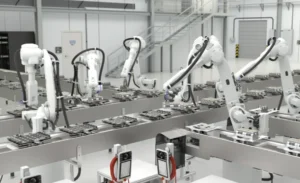
The primary target for initial large-scale humanoid deployments remains manufacturing. Here, humanoids can perform tasks that are currently difficult to automate with traditional robots, such as operating legacy machinery designed for human interaction, navigating dynamic factory floors alongside human workers, and handling a diverse range of components. The ability to "see" and "feel" with precision allows them to pick and place irregularly shaped objects, perform quality control inspections, or even assist in complex assembly sequences.
The implications of this sensor-driven evolution extend beyond mere efficiency gains. Enhanced sensing capabilities will be crucial for worker safety in shared workspaces, allowing robots to detect and avoid collisions, and to respond appropriately to human presence. It also opens doors to more flexible production lines, where robots can be reprogrammed on the fly for new tasks, adapting to changing product demands without extensive retooling.
Economically, the growth of the humanoid sensor market is a microcosm of the broader automation trend. As demand for humanoids increases, so too will the demand for sophisticated sensor components, creating new opportunities for sensor manufacturers and driving further innovation in materials science, miniaturization, and data processing.
Challenges and the Road Ahead
Despite the optimistic projections, several challenges remain. The high cost of specialized sensors, particularly six-axis force-torque sensors, needs to be addressed through increased production volumes and potentially new manufacturing techniques. The integration of multiple sensor types, managing the vast streams of data they generate, and developing robust sensor fusion algorithms are complex engineering feats.
Furthermore, as humanoid deployments scale, sensor manufacturers will face the formidable task of ramping up production capacity without creating bottlenecks that could impede the commercialization of these robots. This requires strategic investments in manufacturing infrastructure, supply chain optimization, and potentially greater standardization across the industry.
The journey of humanoid robots from advanced prototypes to ubiquitous factory assistants is intricately linked to their sensory evolution. The projected $6.59 billion market by 2037 is not just a financial forecast; it represents the immense technological investment and innovation required to endow these machines with the perception, dexterity, and intelligence necessary to truly integrate into the human world of work. As sensor technologies continue to advance, driven by both dedicated robotics research and cross-industry applications like autonomous vehicles, the vision of humanoids working seamlessly alongside people moves closer to reality.