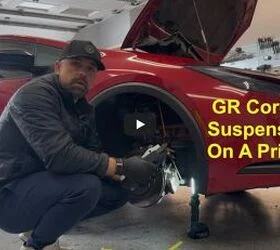
In a meticulous exploration of automotive engineering and parts compatibility, Bozidar "Bozi" Tatarevic, a seasoned racing mechanic and technical consultant, has embarked on a groundbreaking project to transplant the performance-oriented suspension and braking components of the Toyota GR Corolla into a Toyota Prius Prime. This ambitious endeavor, meticulously documented and shared, delves into the intricate details of mounting points, dimensional tolerances, and potential ride height modifications, revealing a surprising degree of interchangeability that could unlock significant performance upgrades for hybrid vehicle enthusiasts.
Tatarevic, a figure well-respected in the automotive technical community, approached this project with the methodical precision honed through years of professional racing and consulting. His background, which includes experience with Vasser Sullivan Racing in IMSA, where he holds a GTD Pro title, and his extensive writing for prominent automotive publications such as TTAC, Motorsport.com, Road & Track, and Racecar Engineering, provides a robust foundation for his technical investigations. This particular project, originally presented in an earlier episode of "The Bozi Breakdown" podcast, has been re-highlighted to offer a wider audience the opportunity to explore its findings.
The Genesis of an Unconventional Swap
The core of Tatarevic’s investigation lies in a comparative analysis of the front strut assemblies and brake calipers. The initial hypothesis was that Toyota’s dedication to parts commonality across its diverse model range might extend to performance-oriented platforms like the GR Corolla and more eco-focused models such as the Prius Prime. This isn’t an entirely unprecedented concept in the automotive world; manufacturers often leverage shared architectures and components to streamline production and reduce costs. However, applying this principle between a rally-bred hot hatch and a hybrid sedan represents a novel and compelling challenge.
Tatarevic began by visually inspecting and physically measuring a factory Prius Prime front strut assembly against a low-mileage GR Corolla strut assembly. The findings were immediately encouraging. At first glance, the overall dimensions appeared remarkably similar. Subtle differences were noted, particularly in the design of the spring perch and the specific location of the sway bar end-link mounting point. These minor variations, however, did not immediately preclude the possibility of a swap.
A Precise Measurement and Test-Fit Protocol
The true test of compatibility lies in the minutiae of mounting hardware. Tatarevic meticulously measured the crucial mounting flanges, the spacing of the bolt holes, and the dimensions of the top mount where the strut attaches to the vehicle’s chassis. The results were striking: these critical interfaces were found to be "almost identical." This high degree of similarity strongly suggested that the GR Corolla strut assembly could, in principle, be directly fitted onto the Prius Prime.
To confirm these initial findings, Tatarevic proceeded with a practical test fit. The GR Corolla strut was installed onto the Prius Prime, allowing for direct observation of its interaction with the chassis and surrounding components. This hands-on approach is invaluable in identifying any unforeseen interference issues that might not be apparent from static measurements alone. The successful test fit of the strut assembly marked a significant milestone in the project, validating the initial measurements and opening the door for further exploration of the braking system.
Unveiling the Suspension Height Implications
With the GR Corolla strut successfully installed, Tatarevic turned his attention to the impact on the Prius Prime’s ride height. After allowing the suspension to settle under its own weight, measurements were taken. The data revealed a subtle, yet noticeable, increase in ride height compared to the Prius Prime’s existing aftermarket lowering springs. This resulted in a slightly larger gap between the fender and the tire.
Tatarevic’s analysis of this outcome is pragmatic. He concluded that while the GR Corolla strut itself introduces a slight lift, this can be readily addressed with aftermarket lowering springs specifically designed for the GR Corolla. Such springs, when paired with the GR Corolla struts on the Prius Prime, would likely restore the desired ride height while retaining the benefits of the upgraded suspension hardware. This finding suggests that a comprehensive performance suspension upgrade, encompassing both struts and springs, is a viable path forward.
The GR Corolla Brake Upgrade: A Deeper Dive
The next critical phase of the project focused on the braking system. Tatarevic aimed to install the GR Corolla’s potent four-piston front brake calipers onto the Prius Prime. This upgrade is a significant step towards enhancing the vehicle’s stopping power, a crucial element for any performance-oriented modification. To facilitate this swap, Tatarevic utilized a Yaris RC rally adapter bracket. These specialized brackets are designed to bridge the dimensional and mounting differences between various Toyota brake caliper and hub configurations.
The objectives for the brake upgrade were clear: to assess the physical fitment of the GR Corolla calipers, to determine the compatibility with the Prius Prime’s existing brake rotors, and to evaluate the overall clearance between the caliper, rotor, and wheel. While Tatarevic had already acquired custom performance brake pads suitable for this setup, he strategically postponed the full, final brake conversion. This decision was driven by a need for further research into the Prius Prime’s sophisticated brake-by-wire system. Understanding the nuances of its bleeding procedures and electronic calibration requirements is paramount to ensuring the safe and effective integration of the upgraded braking hardware.
Encouraging Brake Test Results and Future Considerations
The evaluation of the brake hardware proved to be as successful as the suspension component test. The GR Corolla calipers, when fitted with the Yaris RC adapter bracket, demonstrated a remarkable degree of compatibility. The adapter bracket effectively aligned the caliper with the Prius Prime’s hub, allowing for proper positioning over the brake rotor. Crucially, initial checks indicated sufficient clearance between the caliper, the rotor, and the test wheel, suggesting that the upgraded braking system could be accommodated without necessitating a change in wheel size or offset.
The primary remaining hurdle for the complete brake system integration lies in the electronic control systems. The Prius Prime’s brake-by-wire technology, which relies on electronic signals rather than a direct hydraulic link for brake actuation, presents a complex challenge. Ensuring that the vehicle’s Electronic Stability Control (ESC), Anti-lock Braking System (ABS), and other related safety features function correctly and safely with the upgraded hardware will require careful calibration and potentially specialized software adjustments. This aspect of the project highlights the increasing complexity of modern automotive systems and the need for a holistic approach to performance modifications.
Reaffirming Compatibility and Future Performance Potential
Following the test fit, Tatarevic reinstalled the original Prius Prime suspension components to conduct a direct comparison of ride height measurements. This comparative analysis reinforced his earlier findings regarding the GR Corolla strut’s impact on the vehicle’s stance.
In summary, Tatarevic’s experiment revealed an unexpectedly high level of compatibility between the front suspension and brake components of the GR Corolla and the Toyota Prius Prime. The project demonstrated that the core mechanical interfaces for the suspension struts are remarkably similar, facilitated by Toyota’s strategic use of shared parts. Furthermore, with the aid of a Yaris RC rally adapter bracket, the GR Corolla’s four-piston front brake calipers can be physically mounted onto the Prius Prime, albeit with further consideration required for the electronic braking system.
This investigation opens up exciting possibilities for Prius Prime owners who desire a significant enhancement in handling and braking performance. By leveraging components from a dedicated performance model like the GR Corolla, enthusiasts can potentially achieve a more engaging driving experience without resorting to entirely custom fabrication. The compatibility extends beyond mere bolt-on potential; it suggests a pathway for a more integrated and sophisticated performance upgrade.
The broader implications of Tatarevic’s work extend beyond this specific swap. It underscores the increasing trend of parts consolidation within automotive platforms, a practice that can benefit aftermarket tuners and DIY enthusiasts. As manufacturers continue to develop modular vehicle architectures, the potential for cross-model performance upgrades may become more prevalent. This meticulous, data-driven approach to automotive modification, as exemplified by Tatarevic, is invaluable for pushing the boundaries of what is possible and for providing clear, actionable insights to the wider automotive community. The successful integration of GR Corolla suspension and brakes into the Prius Prime is not just a technical feat; it is a testament to innovative thinking and a deep understanding of automotive engineering principles.