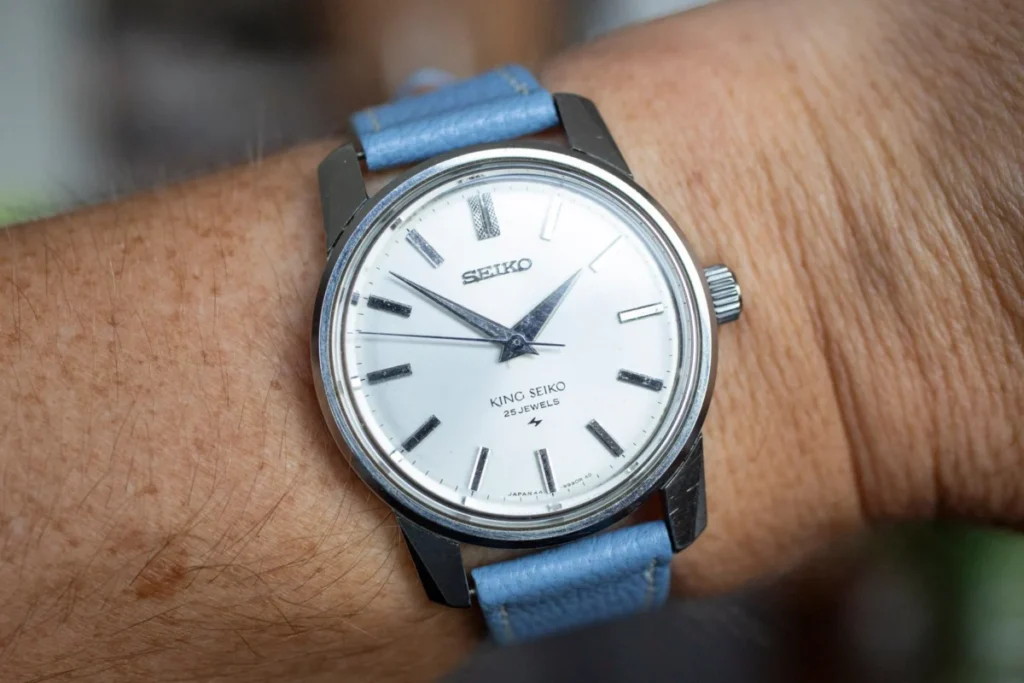
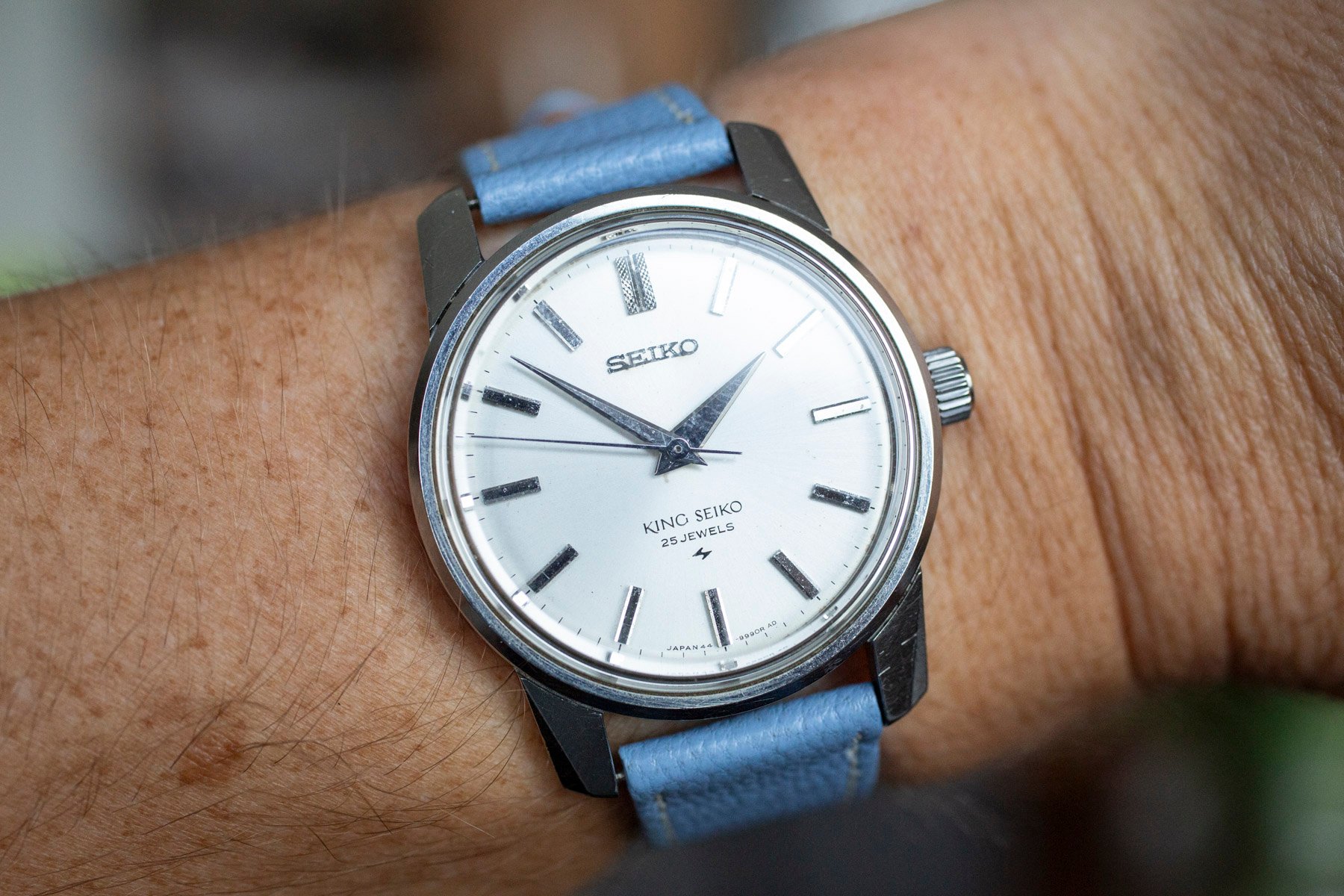
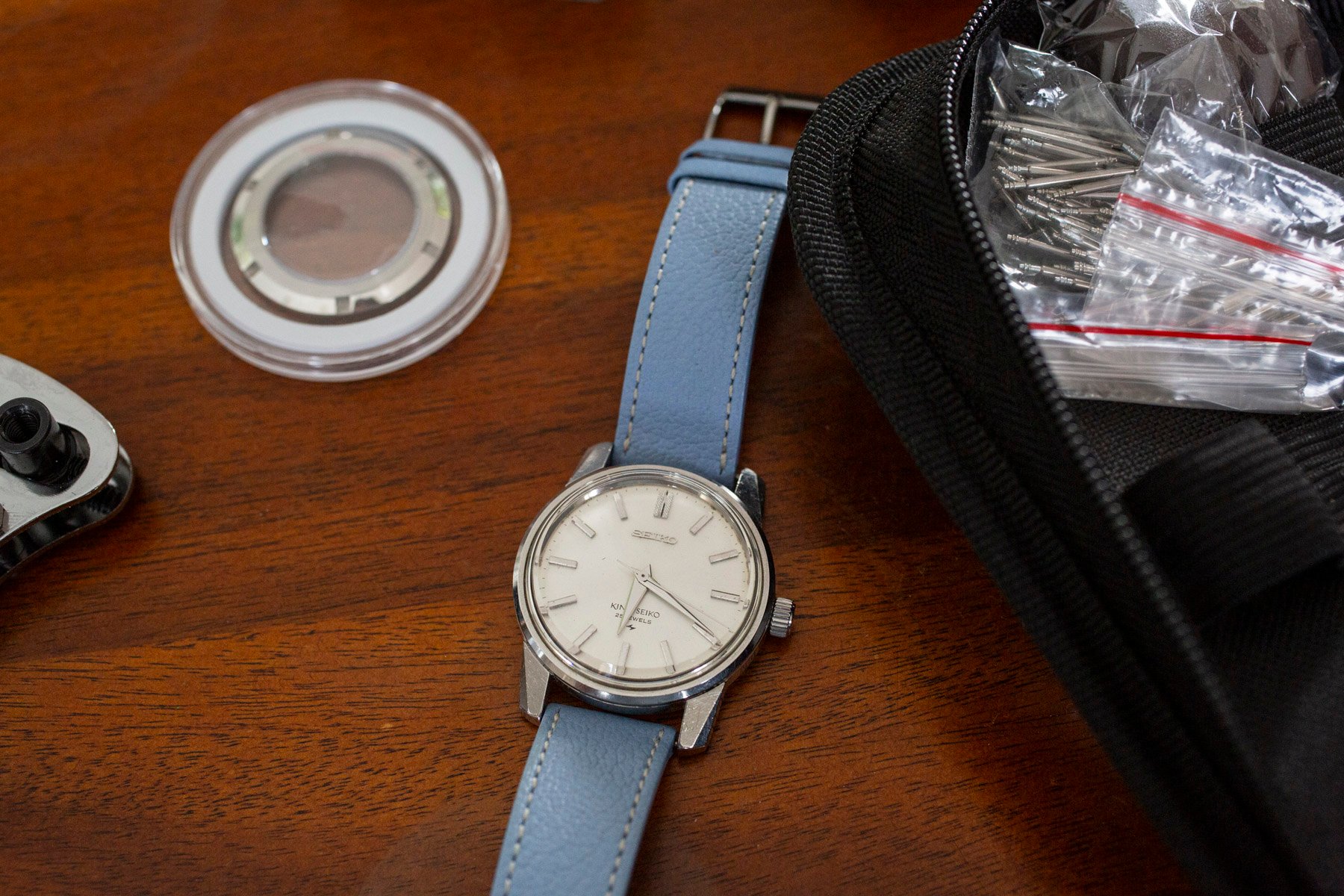
The journey into horology often begins with admiration for a timepiece’s external beauty, but for many enthusiasts, a deeper curiosity soon takes hold. This fascination with the intricate mechanics concealed beneath the dial is a common trajectory, and for one collector, this pivotal moment arrived with a vintage King Seiko 44-9990. This particular model holds a significant place in Seiko’s rich history, representing a period of burgeoning Japanese watchmaking prowess in the 1960s. Its design, characterized by sharp lugs, meticulously polished facets, elegant dauphine hands, and a restrained silver dial, embodies many of the principles that would later define Seiko’s acclaimed "Grammar of Design" philosophy. Yet, beneath this exquisite exterior lies the true magic, residing within the manually wound 44A movement.
The 44A caliber, a testament to an era when mechanical watches were daily companions rather than mere nostalgic relics, possesses a distinct warmth and personality absent in many modern, mass-produced movements. Its mechanical simplicity is elegantly executed, transforming the act of winding the watch each morning into a cherished ritual. The author’s experience of observing the gears engage through a sapphire display back catalyzed a familiar path for watch enthusiasts: the acquisition of a watch tool kit and the initiation of home-based modifications.
The Enticing Descent: From Tool Kit to Obsession
Watch tool kits represent a curious duality in the watch hobby. Ostensibly practical purchases intended for simple tasks like bracelet resizing or strap changes, they often serve as gateways to a more profound engagement with watch mechanics. This initial curiosity can rapidly escalate into an earnest exploration of specialized tools, including spring bar tools, case back openers, hand levers, movement cushions, and loupes, all approached with a growing sense of dedication.
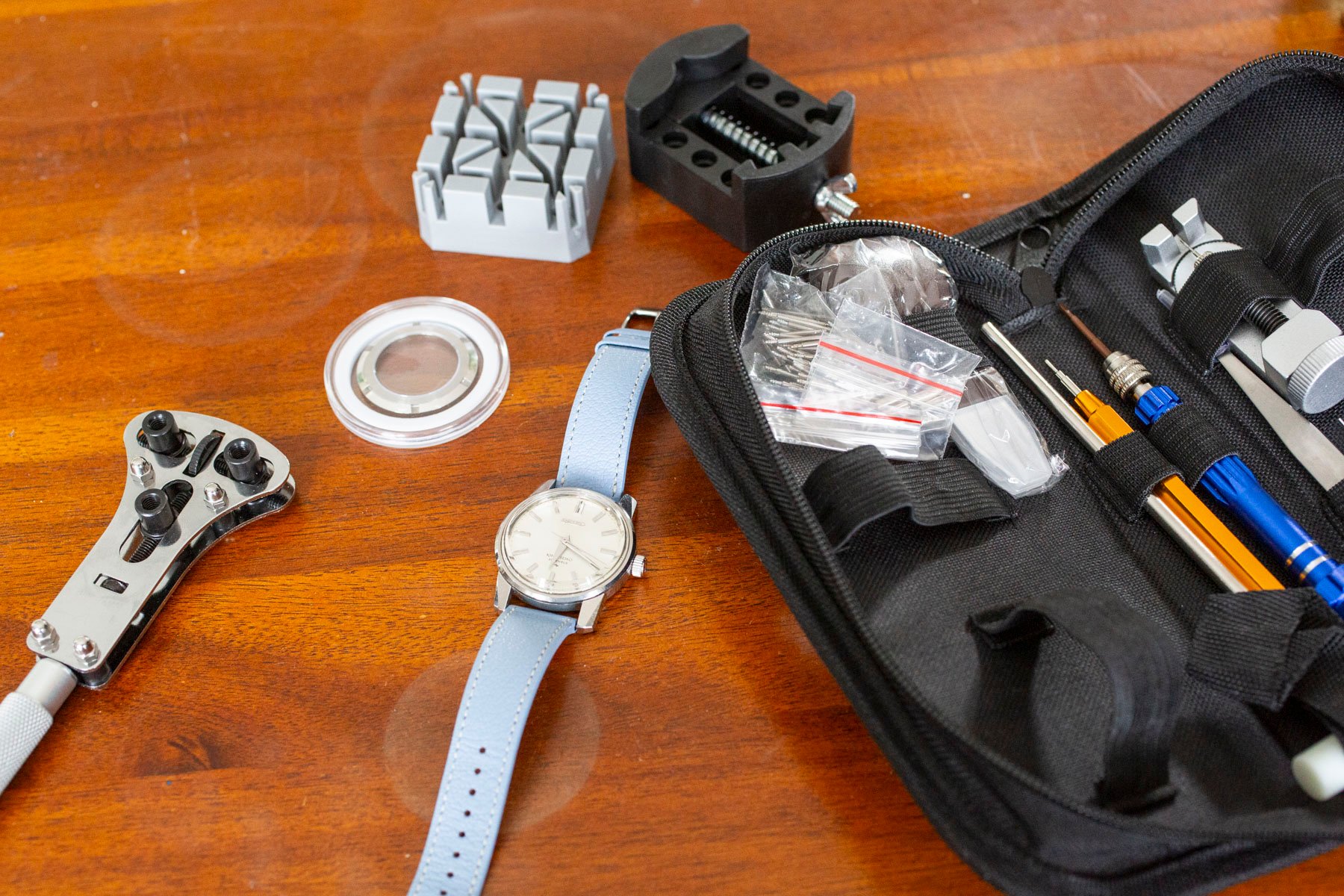
Fortunately, embarking on this path does not necessitate significant financial outlay. A foundational kit should comprise essential items such as a spring bar tool, a case holder, microfiber cloths, a case back opener, tweezers, finger cots, and a dust blower. A soft movement cushion proves invaluable for safely handling watches in an inverted position. While many affordable kits include a surplus of tools for beginners, this abundance often contributes to the learning process and the overall enjoyment. The author notes the acquisition of an entry-level kit from Amazon for approximately 40 Australian dollars, highlighting the accessibility of initial tools.
The Delicate Dance: Navigating Vintage Cases
However, the quality of tools becomes paramount when dealing with vintage timepieces like the King Seiko 44-9990. This is not a disposable watch; its case boasts sharp lines that are susceptible to damage from ill-fitting or poorly manufactured tools. Inferior case back openers, lacking precision, can pose a greater risk than benefit. Consequently, a more judicious approach involves investing in a few high-quality individual tools rather than opting for the cheapest all-in-one kits.
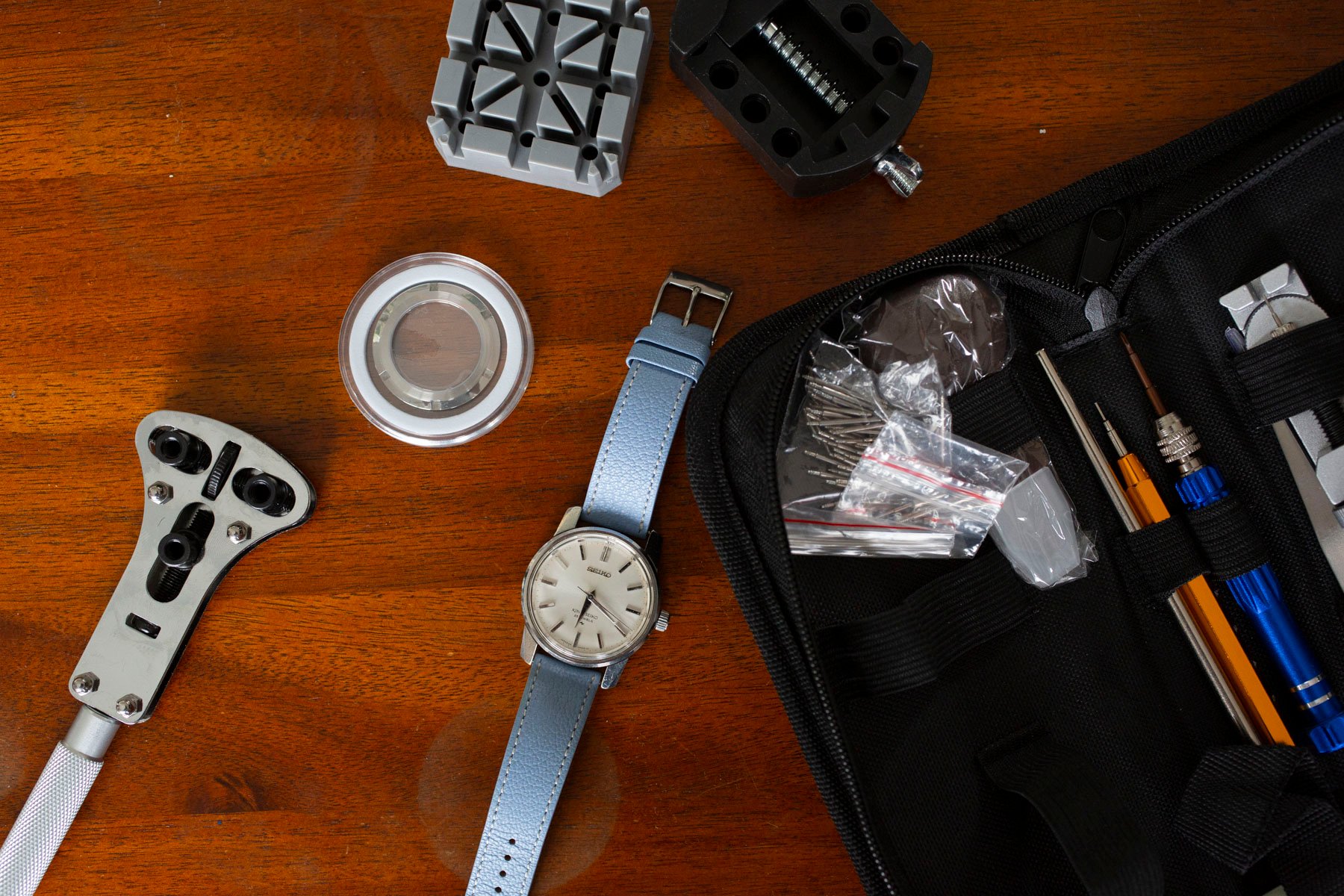
Essential acquisitions for a less stressful experience include a robust Jaxa-style case back opener, a reliable case holder, and a set of quality screwdrivers. The arrival of these tools often precipitates a psychological shift, transforming the watch from a sealed enigma into a tangible mechanical object. This transition, while potentially intimidating with a vintage piece steeped in history, ultimately proves deeply rewarding.
The Case for Transparency: Replacing the Original Case Back
The prospect of replacing an original King Seiko case back may initially elicit reservations from purists, and their concerns are not without merit. The original screw-in case back of the 44KS is an attractive component in its own right, often featuring the iconic gold medallion, and the preservation of original parts is a cornerstone of vintage collecting. Fortunately, the installation of an aftermarket sapphire display back is a reversible modification. The original case back can be safely stored and reinstalled at any time, preserving the watch’s provenance.
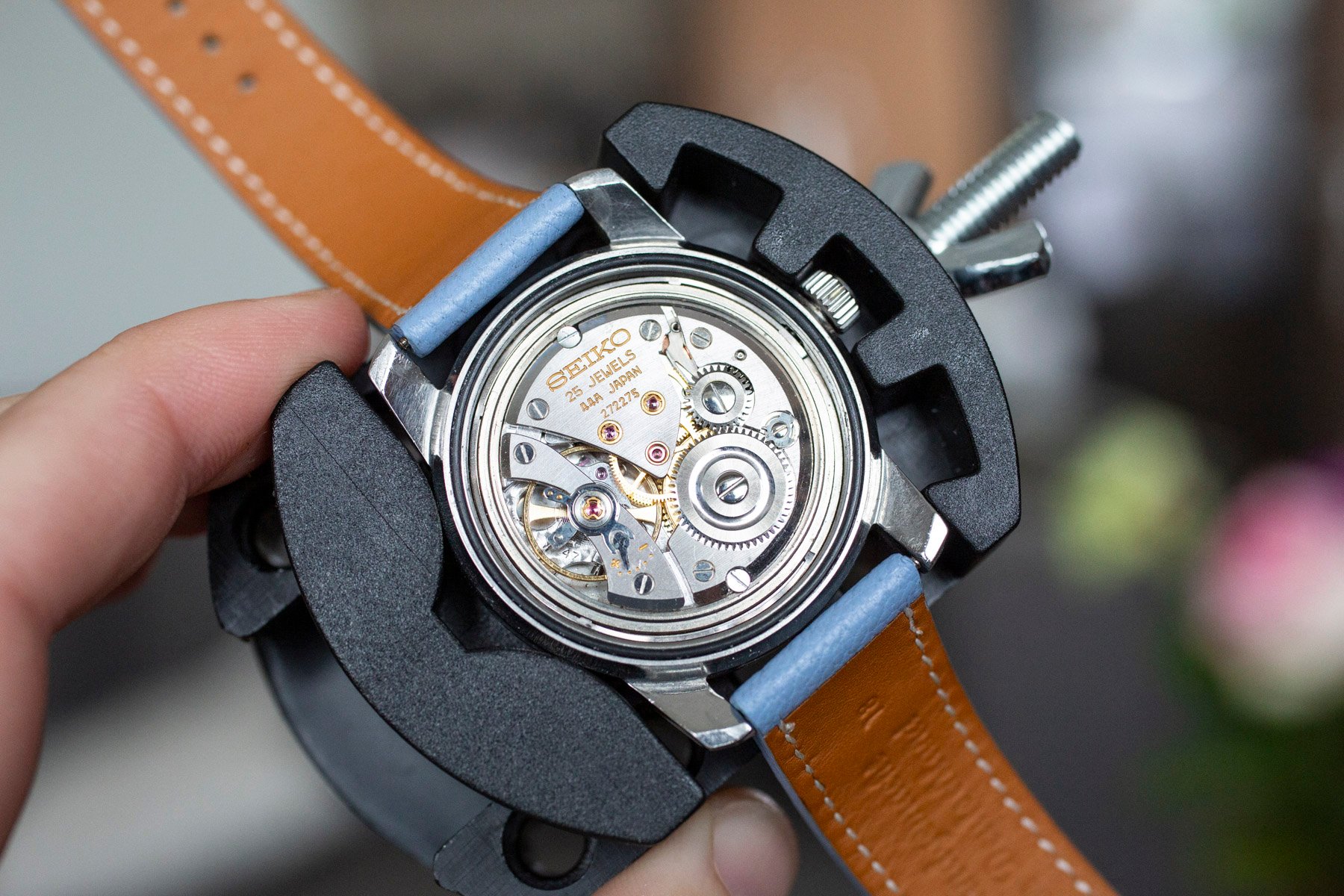
The motivation behind this alteration is not mere novelty but a desire to showcase the aesthetically pleasing 44A movement. Seiko’s vintage manual-wind calibers possess an understated elegance that often goes unseen. Their bridges are thoughtfully shaped, their architecture balanced, and their slower 18,000 vph beat rate imparts a visually soothing rhythm. The aftermarket sapphire display back, sourced from The Time Collective, allows this movement to be appreciated while retaining the watch’s character. Crucially, it enhances the ownership experience. Vintage watches can sometimes feel distant and fragile, objects to be carefully preserved. Viewing the movement through sapphire fosters a stronger emotional connection, increasing awareness of the mechanical life within.
The Ritual of Preparation: Creating the Ideal Workspace
Before any intervention, meticulous preparation is key. While not a surgical procedure, patience and cleanliness are paramount. An ideal workspace involves a clean desk bathed in soft lighting, with a microfiber cloth placed beneath the watch to prevent scratches. Finger cots or gloves are essential to avoid leaving fingerprints on the movement or the interior of the crystal.
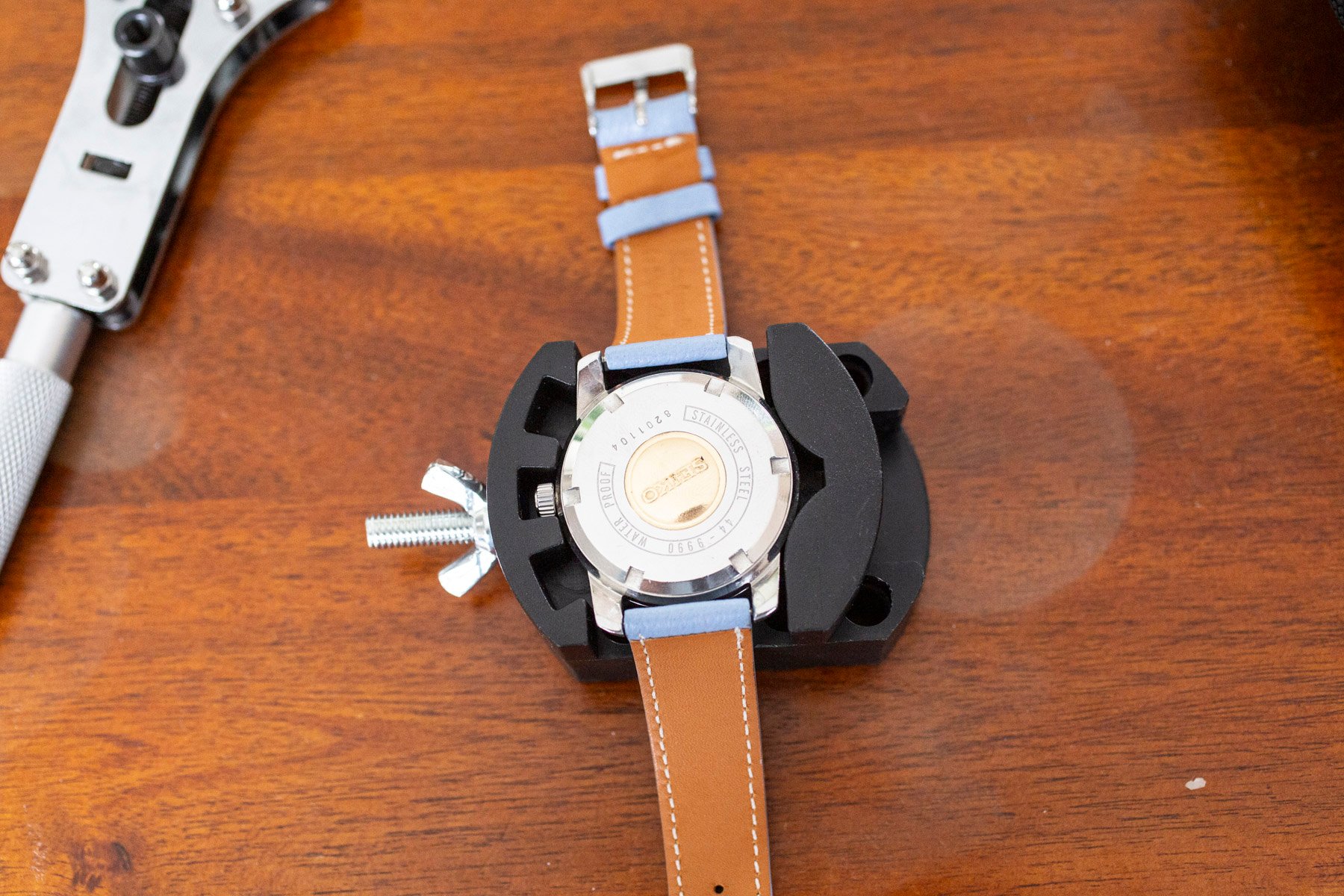
The initial step involves removing the strap, which provides better access to the case back and reduces strain while securing the watch in the case holder. Once secured, the King Seiko reveals a hallmark of vintage watchmaking: a design ethos centered on serviceability. Unlike some modern watches that can feel overly engineered and difficult to access, the 44KS was built during an era when ease of servicing was integral to watch design.
Nonetheless, caution is advised. The primary technique involves applying firm, consistent pressure with the case back opener, ensuring the watch remains stable to prevent slipping and damaging the sharp lugs. After a slight initial resistance, the case back will loosen, leading to a memorable moment for any enthusiast.
First Glimpse: The Artistry of the 44A Caliber
The act of opening a vintage watch for the first time is an intimate experience. A machine that has diligently measured time for decades is suddenly revealed. The 44A movement immediately conveys a sense of purpose. While devoid of unnecessary embellishment or ostentatious finishing, it is undeniably a well-crafted and visually appealing caliber. Its bridges exhibit a clean industrial beauty, its jewel settings catch the light, and the balance wheel oscillates with a serene confidence. Every component appears engineered for reliable function rather than mere visual appeal.
This inherent honesty is a significant part of the enduring allure of vintage Seiko watches. While Swiss watchmaking often embraced romanticism and decorative flourishes, Seiko, particularly during this period, approached precision with a distinct philosophy. The emphasis was squarely on robust engineering, practical accuracy, and disciplined design.
Observing the movement in operation while gently winding the crown fosters a profound appreciation for the individuals who assembled it decades ago. This is also a critical juncture where restraint is paramount. Opening a watch case can tempt novices into attempting more than they are equipped for. Without formal training, this is not the time to explore the intricacies of the movement itself, as dust, magnetism, or accidental contact can readily lead to complications. The objective at this stage is admiration, not amateur horology.
The Transformation: Installing the Sapphire Case Back
The installation of the aftermarket display back is a straightforward process. The sapphire case back from The Time Collective is designed with the correct threading and gasket specifications for the 44KS case. Prior to installation, it is prudent to inspect the gasket for any damage and ensure that no dust adheres to the sapphire crystal. A small dust blower proves surprisingly useful in this regard. Once properly aligned, the display back threads smoothly into place. Avoiding cross-threading by rushing the process is crucial, as vintage steel threads demand patience.
As the case back is tightened, the transformation becomes immediately apparent. Upon turning the watch over, the previously enclosed King Seiko 44-9990 takes on a new dimension of dynamism. The 44A caliber is now fully visible beneath the sapphire crystal, elevating a historically significant dress watch into an unexpectedly interactive object. This change significantly alters the emotional cadence of ownership. The wearer finds themselves removing the watch simply to admire the movement. The daily winding ritual becomes more engaging, and the subtle ticking sound seems newly noticeable, accompanied by the visible mechanical heartbeat.
A More Personal Connection: Vintage Watch Personalization
The realm of vintage collecting invariably sparks debates concerning originality versus personalization. These discussions are vital, reflecting a genuine passion for preservation. However, reversible modifications such as a sapphire display back occupy a relatively innocuous middle ground. The original case back remains intact and safely stored, while the watch becomes demonstrably more enjoyable for daily wear. This enhancement in user experience is a significant consideration.
Vintage watches should transcend their status as mere museum artifacts. The most cherished examples continue to live on wrists, accumulating new narratives while retaining echoes of their past. If a carefully selected aftermarket component enhances one’s appreciation for the watch without permanently altering it, such an endeavor is entirely justifiable. In many respects, the acquisition of the tool kit proved to be as meaningful as the installation of the sapphire case back itself.
Concluding Thoughts: The Ever-Deepening Fascination
This process cultivates a profound connection with the object itself. The watch transcends its perception as an inaccessible luxury item, evolving into an understood mechanical system meticulously assembled by human hands. This shift in perspective deepens appreciation not only for the King Seiko 44-9990 but for the broader art of watchmaking. And, as is often the case with enthusiast pursuits, this exploration is unlikely to be the final destination.
Today, the focus is on a sapphire display back and a basic tool kit. Tomorrow, it may involve regulation tools, vintage chronographs, or the endeavor of learning to service a manual-wind caliber in its entirety. This is the inherent "danger" of mechanical watches: the deeper one delves, the more profoundly fascinating they become.