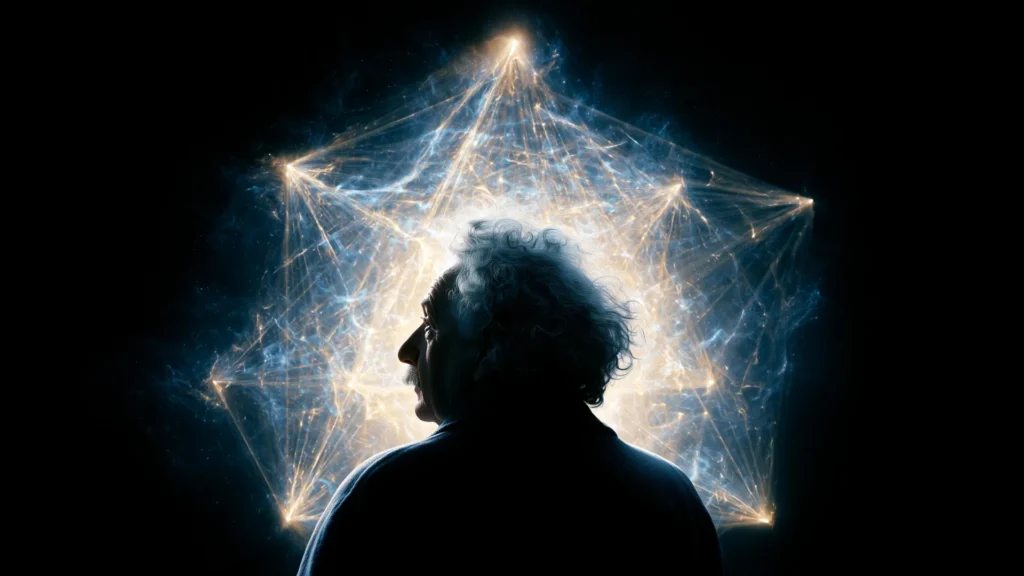
A little more than a century ago, Albert Einstein turned his attention from gravity itself to the fate of the entire universe. In 1917, shortly after developing his general theory of relativity, he began applying his new equations to cosmology. General relativity had transformed our understanding of gravity, so it made sense to ask what those same equations said about the universe on the largest possible scales. Gravity was the natural place to start. On average, the universe is electrically neutral, which means electromagnetism does not dominate its large-scale behavior. Einstein also knew nothing about the strong and weak nuclear forces (to be fair, nobody did), but those interactions only operate over very short distances.
The Genesis of a Cosmic Quandary: Einstein’s Dynamic Universe
Einstein’s groundbreaking general theory of relativity, published in 1915, offered a revolutionary new perspective on gravity. Instead of a mysterious force acting at a distance, Einstein described gravity as the curvature of spacetime caused by mass and energy. This paradigm shift, which successfully explained phenomena like the anomalous orbit of Mercury and the bending of starlight by massive objects, naturally led to questions about the universe’s grand architecture. Applying these powerful new equations to the cosmos on its largest scales was a logical, albeit audacious, next step.
The prevailing cosmological view of the early 20th century was one of a static, unchanging universe. This idea had been deeply ingrained in scientific thought for centuries, supported by philosophical and religious frameworks. The universe, in this conception, was a celestial clockwork, set in motion and destined to remain in a perpetual state of equilibrium.
However, when Einstein plugged his equations for gravity into the vastness of space, they painted a decidedly different picture. The mathematics of general relativity, when applied to a universe filled with matter, indicated that it could not be static. The inherent attractive nature of gravity, as described by his theory, would inevitably cause a universe filled with matter to collapse in on itself. Conversely, if the universe were expanding, gravity would act to slow that expansion down. There was no inherent mechanism within the original equations for a universe to simply be—unchanging, eternal, and stable.
This conflict between his elegant mathematical framework and the prevailing cosmological dogma presented Einstein with a profound intellectual challenge. His equations demanded a dynamic universe, a notion that directly contradicted the established wisdom. The implications were significant: either his theory was flawed when applied to cosmic scales, or the deeply held belief in a static universe was fundamentally incorrect.
The Cosmological Constant: An Ad Hoc Solution to a Theoretical Dilemma
Faced with this unexpected outcome, and perhaps influenced by the desire to preserve the idea of a stable cosmos, Einstein introduced a modification to his equations. In 1917, he added a term known as the "cosmological constant," represented by the Greek letter Lambda (Λ). This constant effectively acted as a repulsive force, counteracting the gravitational pull of matter and allowing for the possibility of a static universe.
In essence, Einstein’s cosmological constant represented an intrinsic energy density of empty space itself. This concept suggested that even in the absence of matter or energy, spacetime could possess an inherent tendency to expand or contract. By carefully tuning the value of Lambda, Einstein could balance the attractive force of gravity from all the matter in the universe with this repulsive force, thereby achieving a state of cosmic equilibrium.
This addition, while mathematically permissible within the framework of general relativity, was a departure from the theory’s initial elegance. It was an adjustment made to fit a pre-conceived notion rather than an organic outcome of the theory itself. As Einstein himself would later reflect, this move would become a source of significant regret.
The Dawn of an Expanding Universe: Hubble and Friedmann’s Revelations
Einstein’s cosmological constant, intended to enforce a static universe, proved to be a fleeting solution. Within a remarkably short period, observational evidence began to emerge that challenged the static model more fundamentally.
In the early 1920s, Russian physicist and mathematician Alexander Friedmann, working independently, explored solutions to Einstein’s field equations without the cosmological constant. Friedmann’s work, published in 1922, demonstrated that general relativity inherently predicted a dynamic universe, one that could be either expanding or contracting. His models laid crucial theoretical groundwork for what would later become the Big Bang theory, suggesting a universe with a beginning and a subsequent evolution.
Simultaneously, groundbreaking astronomical observations were being made by American astronomer Edwin Hubble at the Mount Wilson Observatory. By meticulously observing the light from distant galaxies, Hubble discovered that they were, on average, moving away from Earth. Furthermore, he found a direct correlation between the distance of a galaxy and the speed at which it was receding—the farther away a galaxy was, the faster it was moving. This relationship, now known as Hubble’s Law, provided compelling empirical evidence that the universe was not static but was, in fact, expanding.
Hubble’s discoveries, published in 1929, were a monumental blow to the static universe model and vindicated the dynamic solutions derived from general relativity. Faced with this overwhelming observational evidence, Einstein himself began to question the necessity of his cosmological constant. He famously referred to its introduction as his "greatest blunder," acknowledging that he had, in essence, tried to force his theory to conform to an incorrect assumption about the universe’s nature.
The Mystery Deepens: The Accelerating Expansion and the Return of Lambda
For decades, the scientific community largely accepted the notion of an expanding universe, with models like Friedmann’s forming the bedrock of cosmological understanding. The expansion was understood to be a consequence of the Big Bang, and gravity, as the dominant force on large scales, was expected to be gradually slowing this expansion down as matter pulled on itself. The rate of this deceleration was seen as a key to determining the universe’s total mass and, therefore, its ultimate fate.
The late 20th century saw a concerted effort by astronomers to precisely measure this deceleration. Two independent teams of astronomers, the Supernova Cosmology Project and the High-Z Supernova Search Team, embarked on ambitious projects in the 1990s. Their goal was to use Type Ia supernovae—exploding stars with a remarkably consistent intrinsic brightness—as "standard candles" to measure cosmic distances and, consequently, the rate of the universe’s expansion over time.
By observing these distant supernovae, astronomers hoped to detect the expected slowing down of the cosmic expansion due to gravity. The amount of matter in the universe, which generates gravity, was the primary unknown factor they sought to constrain. If there was a lot of matter, the deceleration should be significant; if there was little matter, the deceleration should be less pronounced.
However, the results that emerged in 1998 delivered a shockwave that rippled through the scientific world. Instead of finding evidence of deceleration, both teams independently discovered that the expansion of the universe was not slowing down; it was accelerating. Distant supernovae were dimmer than expected for a decelerating universe, indicating they were farther away, implying that the expansion had sped up over time.
This astonishing finding presented a profound crisis for existing cosmological models. If the universe was dominated by matter and gravity, as was widely assumed, the expansion should be slowing. The observed acceleration suggested the existence of a force or energy that was actively pushing the universe apart, overwhelming the gravitational pull of matter.
Dark Energy: A Modern Interpretation of an Ancient Constant
The most straightforward explanation for this unexpected acceleration pointed back to a concept that Einstein had long discarded: his cosmological constant. The idea of a pervasive energy inherent in spacetime itself, acting as a repulsive force, perfectly accounted for the observed acceleration. If Lambda represented a constant energy density of the vacuum, it would become increasingly dominant as the universe expanded, driving the acceleration.
This revived concept of a cosmological constant, however, needed a new name to reflect its mysterious nature and its role in driving cosmic expansion. It became known as "dark energy." The term "dark" was used because, like dark matter, it does not interact with light and is therefore invisible to direct observation. Its existence is inferred solely through its gravitational effects—in this case, its anti-gravitational effect on the expansion of the universe.
The discovery of accelerating expansion and the subsequent embrace of dark energy led to a significant overhaul of our cosmological framework. The "Standard Model of Cosmology," a long-standing consensus model, needed revision.
The ΛCDM Model: A Triumph and a Puzzle
The current reigning paradigm in cosmology is the Lambda-CDM (ΛCDM) model. This model is built upon the foundation of general relativity and incorporates two primary components that dominate the universe:
- Lambda (Λ): This represents dark energy, the enigmatic force driving the accelerated expansion of the universe. In the ΛCDM model, dark energy is often equated with a cosmological constant, suggesting a uniform energy density present throughout spacetime.
- CDM (Cold Dark Matter): This refers to a hypothetical form of matter that does not emit, absorb, or reflect light, making it invisible. It is "cold" because its particles are thought to move relatively slowly. Dark matter is believed to provide the gravitational scaffolding for the formation of galaxies and large-scale structures in the universe.
The ΛCDM model has proven to be remarkably successful in explaining a vast array of cosmological observations. It accurately describes:
- The Cosmic Microwave Background (CMB): The faint afterglow of the Big Bang, showing subtle temperature fluctuations that reveal the early universe’s composition and structure.
- The Large-Scale Structure of the Universe: The distribution of galaxies and galaxy clusters in vast cosmic webs.
- The Abundance of Light Elements: The relative amounts of hydrogen, helium, and lithium formed in the early universe.
- The Expansion History of the Universe: The rate at which the universe has expanded over time, including the period of acceleration.
- Baryon Acoustic Oscillations (BAO): Distinctive patterns in the distribution of matter that serve as a cosmic ruler.
The success of the ΛCDM model is attributed to its relative simplicity, relying on a small number of fundamental parameters and assumptions within the robust framework of general relativity. It has undergone rigorous testing and scrutiny from numerous independent observational probes, solidifying its position as our best current description of the universe.
The Lingering Problem: Is the ΛCDM Model Flawed?
Despite its extraordinary success, the ΛCDM model faces significant theoretical challenges, leading many cosmologists to believe it might be an incomplete or even fundamentally incorrect description of reality. The primary issues revolve around the nature of dark energy and dark matter, particularly the value of the cosmological constant.
One of the most perplexing problems is the "cosmological constant problem," also known as the "vacuum catastrophe." When physicists attempt to calculate the expected energy density of the vacuum based on quantum field theory, the result is staggeringly larger—by an estimated 10^120 orders of magnitude—than the observed value of dark energy. This discrepancy is one of the largest and most persistent fine-tuning problems in physics, suggesting a profound misunderstanding of the vacuum’s true nature or the relationship between quantum mechanics and general relativity.
Furthermore, while the ΛCDM model successfully describes the accelerated expansion, it offers no fundamental explanation for why dark energy exists or what it truly is. It is an empirical parameter that fits the data, but its underlying physics remains elusive. Similarly, dark matter, which constitutes about 27% of the universe’s energy density, remains undetected directly, with its existence inferred solely through its gravitational influence.
The ongoing research in cosmology is actively pursuing answers to these fundamental questions. Scientists are exploring alternative theories of gravity, investigating different forms of dark energy that might not be a simple cosmological constant, and searching for direct evidence of dark matter particles. The possibility that the ΛCDM model, while remarkably predictive, might be an approximation of a more complex underlying reality is a driving force behind much of the current research in astrophysics and cosmology.
From Einstein’s initial unease with a dynamic universe to the modern enigma of dark energy, the journey of understanding cosmic expansion has been one of profound scientific discovery, marked by unexpected turns and persistent mysteries. The cosmological constant, once dismissed as a blunder, has re-emerged as a central, albeit enigmatic, player in the grand cosmic narrative, continuing to shape our perception of the universe’s past, present, and ultimate destiny.