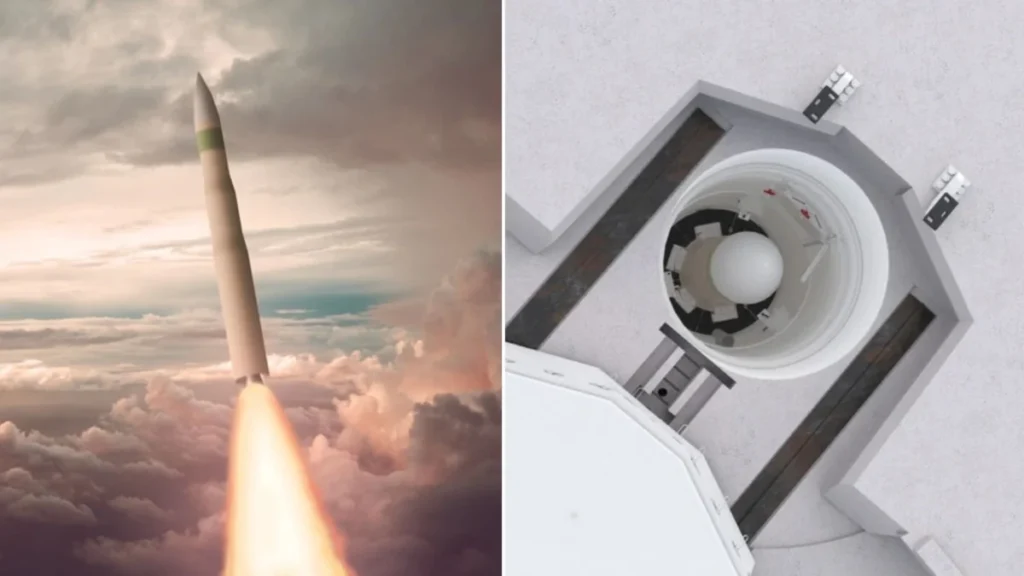
For more than five decades, the U.S. land-based nuclear deterrent has relied on the LGM-30 Minuteman III intercontinental ballistic missile (ICBM), a cornerstone of the nation’s strategic arsenal. Its replacement, the LGM-35A Sentinel, is now taking shape, representing a monumental undertaking to modernize this critical leg of the U.S. nuclear triad. This ambitious program extends far beyond merely developing a new missile; it encompasses a complete overhaul of the sprawling infrastructure that supports the ICBM force, an effort projected to cost at least $141 billion and spanning thousands of square miles across multiple states.
The Imperative for Modernization: Replacing a Cold War Legacy
The Minuteman III, first deployed in 1970, has served as a stalwart guardian of U.S. national security for over half a century. Designed and built during the height of the Cold War, it was a marvel of engineering for its time, but its operational lifespan has far exceeded original expectations. Maintaining these aging systems has become increasingly complex and costly. Components are obsolete, supply chains are strained, and the infrastructure, including launch silos and communication networks, dates back to the 1960s. These facilities, while hardened, show the wear and tear of decades of continuous operation and exposure to the elements, making them vulnerable to emerging threats and harder to secure against modern adversaries.
The U.S. nuclear triad—comprising land-based ICBMs, submarine-launched ballistic missiles (SLBMs), and strategic bombers capable of carrying nuclear weapons—is designed to ensure a robust and credible deterrent. Each leg possesses unique characteristics that contribute to overall stability. Land-based ICBMs, with their rapid response capability and dispersed deployment, are often seen as providing a crucial "prompt strike" option and complicating an adversary’s first-strike calculations due to the sheer number of targets they present. Losing confidence in the reliability or effectiveness of the Minuteman III force would introduce a dangerous vulnerability into this strategic equation, potentially inviting aggression or miscalculation from peer competitors. Therefore, the development and deployment of the Sentinel are not merely technological upgrades but a strategic necessity to maintain the credibility of U.S. deterrence into the latter half of the 21st century.
Introducing the LGM-35A Sentinel: A New Era of ICBM Technology
The LGM-35A Sentinel is envisioned as a silo-launched, three-stage, solid-fuel ICBM, designed and developed by Northrop Grumman for the U.S. Air Force. This new missile is engineered to deliver a nuclear payload across intercontinental distances with enhanced accuracy, reliability, and survivability compared to its predecessor. Air Force specifications indicate the missile is designed for a range exceeding 6,000 miles, capable of reaching speeds of approximately 15,000 mph, or about Mach 23, at burnout. While its exact weight and thrust remain classified, these figures underscore its capability to rapidly strike targets anywhere on the globe.
The Sentinel’s propulsion system is based on a proven three-stage solid-propellant architecture. The first stage provides the initial powerful thrust to launch the missile from its underground silo, propelling it skyward. The second stage continues to accelerate the missile after it exits the Earth’s atmosphere, pushing it towards its apogee. The third stage offers additional control and fine-tuning before the missile transitions into the post-boost phase. In this critical phase, a sophisticated post-boost attitude-control system precisely positions the reentry vehicle (RV) for its final trajectory towards the designated target. The RV then carries the nuclear payload through the atmosphere, designed to withstand extreme heat and pressure while maintaining its integrity and accuracy.
Deployment of the Sentinel is planned for existing ICBM bases: F.E. Warren Air Force Base in Wyoming, Malmstrom Air Force Base in Montana, and Minot Air Force Base in North Dakota. Current Air Force information projects an inventory of 400 operational missiles, with the broader modernization effort encompassing more than 450 missiles and an equivalent number of hardened silos. This extensive deployment strategy ensures the continued geographical dispersion and readiness of the land-based deterrent.
A Holistic System: Beyond Just the Missile
Crucially, the Sentinel program is not merely about replacing the missile itself. It represents a comprehensive modernization of the entire weapon system and its supporting infrastructure. The Air Force is undertaking what it describes as the largest construction project in its history, spanning across five states and involving more than 600 supporting facilities. This includes the construction of 450 new hardened silos, new launch centers, and a completely new, hardened fiber-optic communications network.
The rationale behind rebuilding the entire infrastructure is twofold. Firstly, the existing Minuteman-era facilities are simply too old and dilapidated to effectively support a new generation of missiles. Attempting to extensively modify hundreds of unique, decades-old facilities would be prohibitively complex, costly, and inefficient. Secondly, the Sentinel program aims for a standardized, modular construction approach for the new silos and associated infrastructure. This innovative strategy is designed to streamline construction, reduce long-term maintenance costs, and facilitate future upgrades. A full-scale prototype silo, which broke ground in Utah in 2026, serves as a crucial testbed for this modular approach before larger-scale construction commences.
Furthermore, the Sentinel system is being seamlessly integrated with upgraded Nuclear Command, Control, and Communications (NC3) architecture. This critical network ensures that the President and military commanders can reliably and securely communicate with and direct the nuclear forces. Two-person launch crews will continue to operate the missiles around the clock, maintaining the human element of security and decision-making that has been a hallmark of U.S. nuclear deterrence. The modernized NC3 infrastructure will enhance the resilience and responsiveness of the entire system, ensuring that Sentinel remains connected and controllable under any circumstances.
Technological Advancements and Design Philosophy
One of Sentinel’s most significant advancements over the Minuteman III is its modular, open architecture. This design philosophy is intended to future-proof the system, allowing for easier and more cost-effective upgrades as threats evolve and new technologies emerge, without requiring a complete redesign of the entire missile system. This stands in stark contrast to the Minuteman III, which often required extensive and complex modifications for even minor updates.
Northrop Grumman highlights several other technological improvements, including the use of newer composite materials in the rocket stages. These advanced materials are lighter and stronger, contributing to improved performance and efficiency. A new guidance system is also being incorporated, designed to enhance accuracy, reliability, and maintainability. While these are contractor-reported design characteristics, the promise is a more precise and dependable missile. The modernization extends to all facets of the communications and launch infrastructure, ensuring Sentinel remains robustly connected to the broader nuclear command-and-control system, capable of receiving and executing orders in real-time.
The W87-1 Warhead: A Parallel Development
Concurrent with the Sentinel missile’s development is the W87-1 nuclear warhead program. This new warhead is specifically designed to replace the aging W78 warhead currently used on the Minuteman III. The W87-1 is based on previously tested nuclear components, leveraging existing, proven designs while incorporating updated safety and security features. A critical aspect of its development is the commitment by the National Nuclear Security Administration (NNSA) that it will be certified without requiring additional underground nuclear testing, aligning with international non-proliferation efforts and treaty obligations.
The W87-1 program has already achieved significant milestones. In 2024, the NNSA successfully completed and qualified the first plutonium pit for the W87-1 at Los Alamos National Laboratory. This achievement is crucial as the plutonium pit is the core component of a nuclear weapon, and its production is a complex and sensitive process. The parallel progression of the missile and warhead programs underscores the intricate coordination required across different parts of the U.S. government, with the Air Force managing the missile and infrastructure, and the NNSA overseeing warhead development and production. This synchronized approach is vital to ensure that a fully integrated and operational system is ready for deployment.
Programmatic Hurdles and Financial Realities
Despite its strategic importance, the Sentinel program has not been without significant challenges, particularly concerning cost and schedule. In 2024, the program triggered a Nunn-McCurdy breach, a statutory threshold for major defense acquisition programs when projected costs exceed certain percentages of the original baseline. This event prompted a mandatory review by the Defense Department, which identified several critical problems. These included an unrealistic schedule that underestimated the complexity of the undertaking, an incomplete system design that led to unforeseen technical hurdles, and weaknesses within the industrial base responsible for manufacturing key components.
Following the breach, while the program was deemed essential and continued, the Air Force rescinded its previous baseline and Milestone B approval (a key decision point for entering the engineering and manufacturing development phase) and initiated a comprehensive restructuring. A Government Accountability Office (GAO) report in February 2026 highlighted the severity of the delays, noting that the program’s first flight had slipped by approximately four years from its initial estimate, now projected for March 2028. The GAO also estimated that the program’s total cost would reach at least $141 billion, although the final cost remained uncertain during the restructuring phase. These cost overruns and schedule delays have drawn scrutiny from Congress and defense watchdogs, emphasizing the immense complexity and scale of the modernization effort.
However, the program has shown signs of progress since these challenges came to light. In September 2026, the Air Force announced the successful assembly of an inert Sentinel missile, a crucial step in preparing for flight testing. They also confirmed that critical subsystems were on track for initial flight testing in 2027. The Air Force is now targeting initial operational capability (IOC) for the Sentinel in the early 2030s. This timeline indicates that the missile is still several years away from fully replacing the Minuteman III force, necessitating a careful and phased transition to ensure no gap in deterrence capabilities.
Strategic Rationale and Geopolitical Context
The fundamental objective behind building the Sentinel is to replace an aging nuclear weapons system before its infrastructure and components become increasingly difficult, costly, or even impossible to maintain. The Minuteman III will remain in active service throughout the Sentinel’s development and deployment, ensuring that the United States does not experience any lapse in its land-based ICBM capability. This strategic overlap is critical to maintaining a continuous and credible deterrent.
The Air Force explicitly describes Sentinel as a system designed to remain relevant into the 2070s and beyond. This long-term vision reflects a sober assessment of the evolving global security landscape, characterized by the rise of peer competitors like China and Russia, who are themselves investing heavily in modernizing their strategic nuclear forces. The Sentinel, therefore, represents more than a new missile; it is an attempt to entirely rebuild and re-architect the U.S. ICBM infrastructure around a weapon system specifically designed to counter future threats and maintain strategic stability in an increasingly complex geopolitical environment.
The decision to proceed with Sentinel, despite its challenges, underscores the enduring belief in the importance of the land-based ICBM leg of the triad. While some critics argue for reducing or eliminating ICBMs, proponents maintain their unique value in deterrence. Their dispersed nature means an adversary would need to expend a significant portion of their own arsenal to destroy them all, making a disarming first strike highly improbable. This "silo-busting" problem for an adversary strengthens deterrence by assuring retaliation.
Looking Ahead: Challenges and the Path Forward
The Sentinel program embodies the intricate balance between technological innovation, strategic necessity, and fiscal responsibility. As the program progresses toward its initial operational capability in the early 2030s, it will continue to face significant engineering, construction, and cost management challenges inherent in replacing a system that has operated since the Cold War.
The successful delivery of the Sentinel on its revised schedule and within its restructured budget will be a testament to the capabilities of the U.S. defense industrial base and the resolve of the Air Force. Beyond the technical and financial aspects, the program’s success will also send a clear message to allies and adversaries alike about the United States’ unwavering commitment to maintaining a robust, modern, and credible nuclear deterrent, essential for global stability and national security for decades to come. The Sentinel is not just an upgrade; it is a reinvention of a critical strategic asset, designed to navigate the complexities of a new era of global power dynamics.