October 24th, 2026
Jaguar Land Rover’s long-awaited fully electric Range Rover has finally arrived, marking a significant milestone in the brand’s transition towards electrification. The journey, however, was far from straightforward. Initially pledged at least five years prior as part of the ambitious "Reimagined Strategy" to electrify every vehicle in its lineup, the flagship electric SUV faced considerable developmental hurdles. While competitors rapidly expanded their electric SUV portfolios, Land Rover remained conspicuously absent from the burgeoning market for its most iconic model. This delay was not born of complacency, but of a fundamental commitment to preserving the Range Rover’s unparalleled off-road prowess and luxury credentials.
The Challenge of Off-Road Electrification
The core of the protracted development lay in the propulsion system. Land Rover’s initial concept involved an induction motor on the front axle. This design, while ingenious on paper, aimed to optimize efficiency by allowing the motor to disconnect during normal road driving, thereby conserving energy and extending range. The system would then seamlessly re-engage when all-wheel-drive capability was required, a crucial attribute for a luxury SUV that spends a significant portion of its life on highways.
However, real-world testing revealed critical flaws. According to Simon Fairbrother, the program chief, the induction setup consistently overheated, forcing the engineering team to de-rate its power output. This issue was particularly pronounced during high-temperature testing, where the front-axle arrangement failed to deliver the consistent, robust off-road performance that is synonymous with the Range Rover name. A vehicle that falters under demanding conditions due to thermal limitations simply could not bear the Range Rover badge. Fairbrother has openly stated that the central challenge of the entire program revolved around ensuring the propulsion system met the brand’s stringent performance demands. The inability to maintain consistent off-road capability ultimately led to the outright abandonment of the induction motor concept.
A Return to Proven Technology, Enhanced
With the induction motor concept shelved, Land Rover’s engineering team revisited their existing technological strengths. They had already developed a robust permanent-magnet motor for the rear axle. The solution was to replicate this proven design for the front axle, resulting in the Range Rover Electric featuring two identical permanent-magnet synchronous drive units. Each of these units is rated at 349 horsepower (260 kW), delivering a combined output of 542 horsepower and an astonishing 627 lb-ft of torque. This represents more torque than any previous Range Rover model, underscoring a commitment to performance even in its electric iteration.
This seemingly simple swap of motor types was far from a superficial change. It necessitated a complete re-evaluation, modeling, testing, and validation of the entire powertrain from the ground up. This extensive revalidation process is a primary reason for the vehicle’s eventual arrival as a 2027 model year rather than several years earlier.
Fairbrother’s team ultimately opted for twin permanent-magnet motors that deliver an impressive 20% more torque than comparable units of the same physical dimensions. This enhanced performance is further augmented by the integration of silicon carbide semiconductors within the drive units. The vehicle’s traction management system now operates with unprecedented speed, reacting up to 100 times faster than in an equivalent combustion-engine vehicle. The Integrated Traction Management system meticulously controls motor speed, making adjustments within a mere 50 milliseconds.
Rachel Hogg, Range Rover Product Manager, emphasized that the delay was a deliberate strategic decision rather than an unforeseen setback. "These are the things customers have told the brand they want," Hogg stated. "Delivering on that promise mattered enough that the team felt it had to get it right rather than rush something to market that was not right for the brand." This customer-centric approach underscores the brand’s commitment to its core values.
Rigorous Testing and Uncompromised Capability
The development program for the electric Range Rover was exceptionally intensive. It encompassed over 250,000 hours of virtual testing, setting a new benchmark for the brand. The physical test fleet accumulated mileage equivalent to circumnavigating the globe 38 times, according to official Jaguar Land Rover (JLR) communications. Martin Limpert, Managing Director, highlighted that the testing and development programs significantly exceeded original plans, describing the final product as "the most accomplished Range Rover ever." The extensive innovation and problem-solving during this period resulted in the filing of 300 patent applications, likely making this the most patented Range Rover in the brand’s history.
The guiding principle throughout the development was clear: the vehicle must first and foremost be a Range Rover, with its electric powertrain being a secondary consideration. This philosophy is evident in its design, which remains virtually indistinguishable from its combustion-engine counterparts, with the absence of exhaust pipes being the most discernible difference.
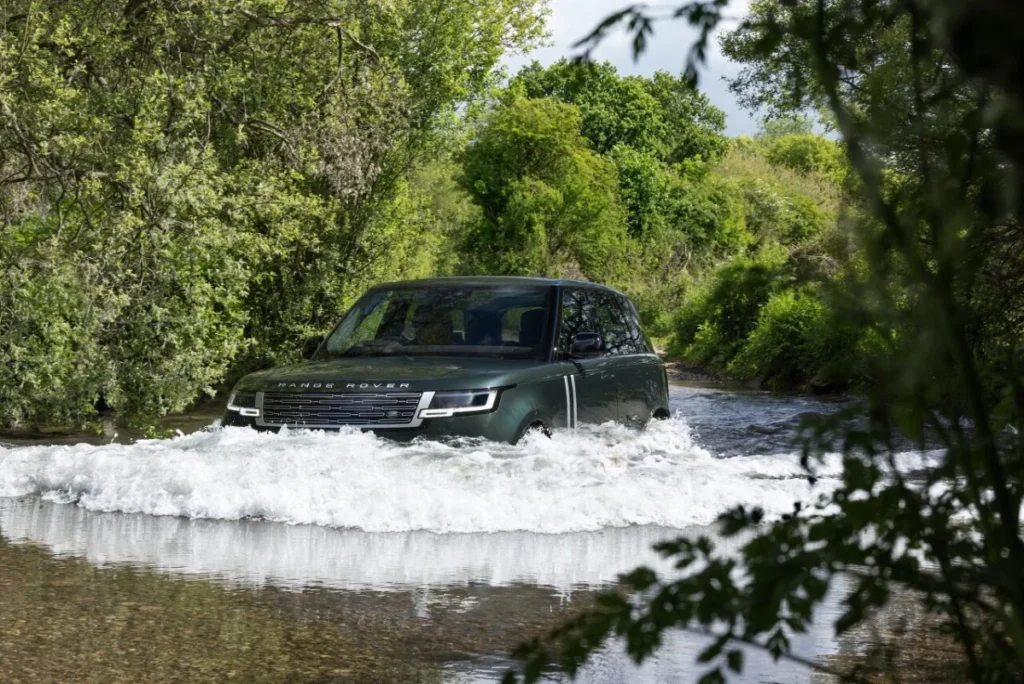
The brand’s unwavering commitment to maintaining Range Rover’s legendary off-road capabilities meant that compromises were unacceptable. A Range Rover that cannot traverse challenging terrain is fundamentally flawed. The electric version upholds the critical metrics that define its off-road prowess. Its angles of ascent and descent are identical to those of the gasoline-powered models, and its fording depth remains an impressive 900mm (approximately three feet) of water.
Minor concessions have been made to accommodate the electric architecture. The ground clearance and break-over angles are slightly reduced compared to the petrol car. Additionally, the departure angle has been marginally decreased due to the integration of a new aerodynamic rear diffuser. However, Fairbrother points out that the completely flat underfloor, a benefit of the battery pack’s structural integrity, can assist in traversing obstacles that might otherwise cause scraping.
Advantages of the Electric Architecture
Despite the need for some minor adjustments, the electric platform introduces advantages that a traditional combustion Range Rover cannot offer. The implementation of single-pedal driving facilitates climbing slopes of up to 45 degrees and allows for smooth pull-aways on gradients as steep as 33 degrees – a pitch JLR likens to navigating a black-diamond ski run. The sophisticated Intelligent Driveline Dynamics system proactively shifts rear torque from 100% to zero, anticipating and preventing traction loss before it occurs.
A significant engineering feat is the Range Rover Electric’s production on the same Solihull assembly line as its combustion and plug-in hybrid siblings. This allows Land Rover to dynamically adjust production output to meet demand within a matter of weeks. This flexibility is largely attributed to the MLA architecture, which was designed over a decade ago with powertrain versatility in mind. This platform was engineered from its inception to accommodate a range of drivetrains, including combustion, mild-hybrid, plug-in hybrid, and battery-electric systems.
The elimination of front, center, and rear differentials, along with the driveshafts, effectively offsets a substantial portion of the weight added by the battery pack and electric motors. The net result is remarkable: the electric Range Rover weighs only 75 kg (approximately 165 lbs) more than its V8 counterpart, while benefiting from a lower center of gravity.
Power is supplied by a usable 118.5 kWh double-stack battery pack, constructed from 344 prismatic cells and operating on an 800-volt architecture. This configuration enables an impressive WLTP-certified range of up to 372 miles, with a real-world estimate of up to 333 miles. When connected to a 350 kW rapid DC charger, the battery can replenish from 10% to 80% in approximately 22 minutes, adding a substantial 137 miles of range in just 10 minutes. However, the integration of the large rear motor precludes the availability of a seven-seat configuration, a feature offered on the long-wheelbase petrol model.
Strong Market Reception and Future Outlook
Despite the extended development period, the market reception for the electric Range Rover has been overwhelmingly positive. Land Rover reports over 80,000 genuine expressions of interest from potential buyers. Intriguingly, Simon Fairbrother noted that a surprising majority of these inquiries originate from the United States, with roughly half of all hand-raisers located in North America, particularly concentrated in states like New York, California, Oregon, and Washington. A significant proportion, approximately 70%, represent individuals new to the Range Rover brand, while about 20% are existing electric vehicle owners.
Rachel Hogg anticipates that fully electric models will eventually constitute between 10% and 20% of total Range Rover sales over time. For interested buyers, the next step involves placing an order. In the UK, the vehicle starts at £154,070 (on the road), with US pricing commencing at $138,000. The exclusive Curated First Edition offers buyers a choice of three exterior colors for those seeking the earliest production slots. The long and arduous development process, marked by a steadfast refusal to compromise on core brand values, has culminated in what appears to be a highly capable and desirable electric luxury SUV, poised to redefine expectations in its segment.