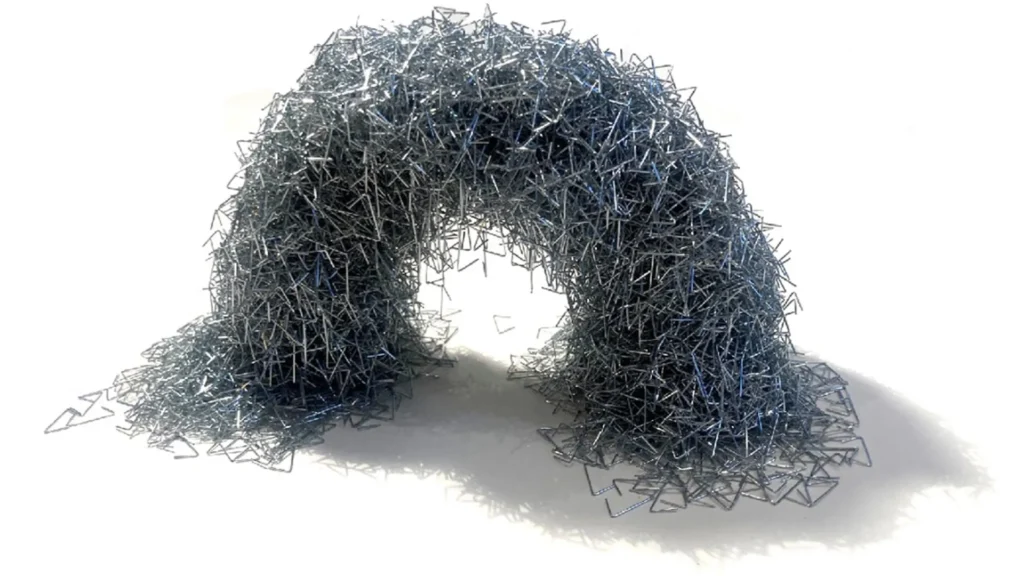
A tightly compressed bundle of office staples, despite being composed of countless individual pieces, can exhibit astonishing cohesion, resisting efforts to pull it apart and behaving almost like a unified solid. Yet, this remarkable strength is paradoxically reversible; a simple shake or specific movement can cause the intricate entanglement to unravel, returning the staples to a loose, disconnected collection. This peculiar duality of robust, temporary solidity has captured the attention of researchers at the Paul M. Rady Department of Mechanical Engineering at CU Boulder, who believe this phenomenon holds the key to a groundbreaking generation of engineered materials. By meticulously designing particles that mimic the interlocking behavior of staples, their pioneering work aims to develop materials that are not only exceptionally strong and adaptable but also inherently recyclable, aligning with the growing global imperative for sustainable innovation.
The research, recently published in the esteemed Journal of Applied Physics, marks a significant step in material science, challenging conventional wisdom about material properties. Professor Francois Barthelat, who leads the Laboratory for Advanced Materials & Bioinspiration and is a principal investigator on this project, articulated the long-term vision: "We’ve been playing around with the idea of building blocks and geometry for many years, but we started looking at interlocking, entangled particles only recently. We are excited about the combination of properties we can get out of these systems and we believe this technology has the potential to go in many directions." This statement underscores the profound potential of this discovery, suggesting applications far beyond current material capabilities.
A New Paradigm in Material Science: The Quest for Adaptability and Sustainability
The field of material science has long grappled with inherent trade-offs. Materials are typically designed to optimize for specific properties: steel for strength, rubber for elasticity, ceramics for hardness. However, achieving a combination of seemingly contradictory characteristics – such as high tensile strength, exceptional toughness, and seamless reversibility – has remained an elusive goal. Traditional engineering materials often prioritize one property at the expense of another, leading to compromises in design and application. For instance, while high-strength alloys are excellent for structural integrity, their brittleness can be a drawback, and their end-of-life disposal often presents significant environmental challenges.
In recent decades, the global shift towards a circular economy has amplified the demand for materials that are not only high-performing but also sustainable throughout their entire lifecycle. This includes materials that can be easily disassembled, reused, or recycled with minimal energy input and waste generation. Current recycling processes for complex composite materials, for example, are often energy-intensive, inefficient, or result in downcycling rather than true closed-loop recycling. The CU Boulder team’s work directly addresses these challenges by proposing a fundamentally new approach to material design that incorporates reversibility from the particle level upwards.
The Foundational Principle: Entanglement in Nature and Engineering
At the heart of this research lies the phenomenon of entanglement, a concept ubiquitous in nature but often underutilized in engineered materials. Entanglement describes a state where individual components become intertwined, forming a robust network of connections. From the macroscopic scale of a bird’s nest, where interwoven twigs and fibers create a surprisingly strong and stable structure capable of withstanding environmental forces, to the microscopic realm of biological tissues, where complex protein networks provide strength and resilience, nature frequently leverages entanglement. Even the human skeletal system, which derives its impressive strength and toughness from the intricate interaction of hard mineral components (hydroxyapatite) and softer, entangled protein matrices (collagen fibers), serves as a testament to the power of this principle.
The CU Boulder team sought to systematically understand how these natural principles could be translated into manufactured materials. Their investigations quickly converged on a critical insight: the geometry of the individual particles themselves. "Let’s take sand as an example. Sand is smooth and convex-shaped, meaning it cannot interlock from grain to grain," explained PhD student Youhan Sohn, a key contributor to the research. "However, we found that if we change the shape of a grain of sand, we can drastically affect its behavior and mechanical properties, including the particle’s ability to link with other particles." This observation highlights a fundamental departure from traditional granular materials, where particles primarily interact through friction and compaction. By introducing specific geometries that enable mechanical interlocking, the researchers unlock a new dimension of material control.
Chronology of Discovery: From Simulation to Real-World Validation
The journey to this discovery followed a rigorous, iterative scientific process. The initial phase of the research involved extensive computational modeling, a crucial step given the immense number of variables involved in particle interactions. The team employed Monte Carlo simulations, a powerful computational technique widely used in physics and engineering to model complex systems where randomness plays a significant role. These simulations allowed the researchers to explore a vast parameter space of different particle shapes and configurations, predicting how various geometries would interact, pack, and entangle under different conditions. The objective was clear: identify particle designs that would maximize entanglement and, consequently, material strength.
This computational approach allowed for rapid prototyping and testing of theoretical designs without the immediate need for physical fabrication. By simulating millions of particle interactions, the researchers could efficiently narrow down the most promising geometries. Following this intensive simulation phase, the team moved to empirical validation. They fabricated particles based on the most successful simulated designs and conducted a series of "pickup tests." These practical experiments involved physically assembling collections of the specially shaped particles and then attempting to lift or pull them apart, providing real-world data on their cohesive strength and entanglement capabilities. This two-pronged approach, combining advanced computational modeling with direct experimental observation, proved instrumental in identifying the optimal particle shape.
The Staple-Like Breakthrough: Unprecedented Strength and Reversibility
The results of both the simulations and the pickup tests consistently pointed to one particular geometry as superior: a "two-legged" particle, strikingly similar in form to a common office staple. This seemingly simple design produced the highest degree of entanglement among all tested shapes, leading to material properties that are often considered mutually exclusive in conventional engineering.
One of the most significant findings was the material’s ability to exhibit both high tensile strength and high toughness simultaneously. Tensile strength refers to a material’s resistance to breaking when pulled apart, while toughness describes its ability to absorb energy and deform plastically without fracturing. Historically, materials engineered for high strength often tend to be brittle (low toughness), while tough materials might lack peak strength. For instance, ceramics are strong but brittle, whereas many polymers are tough but less strong. The staple-like particles, however, defied this typical trade-off, demonstrating a novel combination of these crucial mechanical properties. PhD student Saeed Pezeshki emphasized this breakthrough, stating, "Our entangled granular material using the staple-like particle demonstrates both high strength and toughness at the same time." This capability opens doors for designing materials that can withstand significant stress and absorb impact energy, making them ideal for applications requiring robust performance under dynamic conditions.
Beyond this impressive mechanical performance, the staple-like particles showcased another truly unique characteristic: rapid and controlled reversibility. The researchers discovered that by applying specific vibration patterns, they could precisely control the degree of entanglement. Gentle, low-frequency vibrations encouraged the particles to interlock more tightly, increasing the material’s strength and rigidity. Conversely, stronger, higher-frequency vibrations caused the intricate network to unravel, quickly transforming the solid-like aggregate back into a loose collection of individual pieces. This dynamic control over material state—from a solid-like, load-bearing structure to a fluid-like, disassembled state—is what truly sets this research apart.
Professor Barthelat succinctly captured the unusual nature of this discovery: "It’s a strange material because it’s obviously not a liquid. However, it’s also not quite solid. This opens new and intriguing engineering possibilities. Handling a bundle of these entangled particles feels very remote and exotic." This description evokes the potential for a new class of "smart" or "adaptive" materials that can change their physical properties on demand, responding to external stimuli.
Broader Impact and Implications: Revolutionizing Construction and Robotics
The implications of this research are far-reaching, with the potential to catalyze significant advancements in multiple sectors, particularly in sustainable construction and advanced robotics.
Sustainable Construction: The construction industry is a major consumer of raw materials and a significant contributor to waste generation. Globally, construction and demolition waste accounts for approximately one-third of all waste generated. Traditional construction methods often result in structures that are difficult and costly to demolish, with much of the material ending up in landfills. The concept of "design for disassembly" (DfD) has gained traction in recent years as a strategy to promote material reuse and recycling, but its implementation has been hampered by the limitations of conventional joining and bonding techniques.
The CU Boulder technology offers a revolutionary solution. Imagine bridges, buildings, or other large infrastructures constructed from entangled materials that can be easily assembled, provide structural integrity for their service life, and then, at the end of their utility, be quickly and efficiently disassembled into their constituent particles using controlled vibrations. These particles could then be fully reused in new structures or recycled without the energy-intensive processes currently required for breaking down concrete or steel. This could dramatically reduce construction waste, lower material costs, and significantly decrease the carbon footprint of the built environment. For instance, modular housing units or temporary emergency shelters could be rapidly deployed and later reconfigured or relocated with unprecedented ease, offering flexibility and sustainability that current materials cannot match. This aligns perfectly with the principles of the circular economy, where resources are kept in use for as long as possible, extracting maximum value from them.
Robotics and Adaptive Systems: The field of robotics stands to benefit immensely from materials that can dynamically change their properties. The ability of entangled particles to transition between a rigid, load-bearing state and a fluid-like, reconfigurable state opens up exciting possibilities for swarm robotics and shape-shifting mechanisms.
In swarm robotics, where numerous small, simple robots collaborate to achieve complex tasks, the ability to physically interlock and then disentangle could allow for dynamic formation changes. For example, a swarm of small robots could entangle to form a larger, stronger structure capable of lifting heavy objects, navigating difficult terrain, or even acting as a temporary bridge. Once the task is complete, they could disentangle and disperse to perform other functions. As PhD student Saeed Pezeshki noted, "I was talking with other students who believe this technology can be used in swarm robotics – where small robots can entangle, do a task and then disentangle when they are done." This capability would enhance the versatility, resilience, and adaptability of robotic systems in environments ranging from disaster zones to space exploration.
Professor Barthelat drew a compelling, albeit aspirational, parallel to the iconic liquid metal T-1000 from the movie Terminator 2, which could change shape to slide under a door and then reform. While acknowledging the significant challenges of scaling up and cost, he stated, "It’s expensive and scaling up is a challenge, but it’s something that’s on everybody’s mind." This analogy, while futuristic, captures the essence of the dream: materials that can morph and adapt their physical form and properties in real-time. Such capabilities could lead to soft robots that can squeeze through tight spaces, adaptive tools that reconfigure to fit different tasks, or even medical devices that can navigate complex biological pathways.
Challenges and Future Directions: Refining the Design and Scaling Up
While the potential of staple-shaped particles is immense, the researchers are also realistic about the hurdles that lie ahead. One of the primary challenges, as highlighted by Barthelat, is the scalability of manufacturing these complex particles and the associated costs. Current advanced manufacturing techniques, such as micro-molding or 3D printing, can produce intricate geometries, but mass production at industrial scales for large-scale applications remains a significant engineering and economic challenge. Furthermore, the choice of material for these particles—whether polymers, metals, or ceramics—will profoundly influence their mechanical properties, durability, and ultimate recyclability, necessitating further research into material compatibility and performance.
The precision required for the vibrational control systems is another area of active development. For a large structure or a complex robotic system, generating the exact frequency, amplitude, and duration of vibrations across an entire material aggregate to achieve desired entanglement or disentanglement will require sophisticated sensor arrays and control algorithms.
Undeterred by these challenges, the CU Boulder team is already advancing into the next stage of their research, focusing on even more complex particle designs. Their latest experiments are exploring a new particle geometry that incorporates additional protruding "legs." The researchers liken this enhanced shape to the spiky burrs found in nature, which cling stubbornly to shoes and clothing with remarkable tenacity. The hypothesis is that these added features will create even stronger entanglement effects, increasing the number of interlocking points and further enhancing the material’s overall strength and toughness. This biomimetic approach, drawing inspiration from natural designs that have evolved over millennia for optimal performance, promises to unlock new possibilities for future materials.
The success of this research underscores the power of interdisciplinary collaboration, combining mechanical engineering, materials science, and computational modeling. As the world continues to seek innovative solutions for sustainability and advanced technological capabilities, materials that can adapt, strengthen, and then gracefully disassemble on command represent not just a scientific curiosity but a profound step towards a more resilient, efficient, and environmentally responsible future. The humble office staple, it turns out, holds a blueprint for engineering marvels yet to be fully realized.