The scientific community is currently witnessing a significant shift in the understanding of elemental behavior as researchers at the University of Auckland uncover previously unknown details regarding the atomic structure of gallium. Nearly a century and a half after its initial discovery and subsequent addition to the periodic table, this soft, silvery metal—long a staple of the semiconductor industry—is proving to be far more complex than previously theorized. The findings, published in the prestigious journal Materials Horizons, suggest that the fundamental assumptions governing liquid gallium for the last thirty years have been based on an incomplete understanding of its atomic bonding.
Led by Professor Nicola Gaston and Dr. Steph Lambie, the research team has identified a phenomenon described as "high-temperature covalency," a discovery that effectively overturns decades of established literature. While gallium is famous for its low melting point—famously low enough to melt in the palm of a human hand or a cup of hot tea—the mechanism behind this transition has remained a subject of intense debate. This new study provides a definitive explanation, linking the metal’s unique phase changes to the way its atoms pair and unpair under varying thermal conditions.
The Anomalous Nature of Element 31
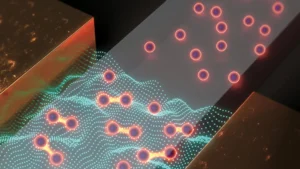
Gallium, which occupies the 31st position on the periodic table, has always been regarded as an outlier among metals. In its solid state, gallium is characterized by a crystal structure where atoms do not exist as individual units but rather as "dimers"—bonded pairs of atoms. This dimerization is more characteristic of non-metals, such as nitrogen or oxygen, than of traditional metals like iron or gold.
Furthermore, gallium is one of the few substances on Earth that expands as it freezes. Like water, its solid form is less dense than its liquid form, a property that allows solid gallium to float on its liquid counterpart. This density anomaly is a direct result of the unusual covalent bonding found in the metal. In covalent bonds, atoms share electrons, a trait typically reserved for elements on the right side of the periodic table. Gallium’s insistence on maintaining these bonds even while exhibiting metallic properties has long fascinated chemists and physicists alike.
The central mystery addressed by the Auckland team was the fate of these covalent bonds during the melting process. For decades, the consensus in the scientific community was that these bonds vanished entirely once the metal reached its melting point of 29.76 degrees Celsius (85.57 degrees Fahrenheit). The new data, however, reveals a much more counterintuitive reality: while the bonds do break at the point of melting, they unexpectedly reappear when the liquid metal is heated to significantly higher temperatures.
A Breakthrough in Atomic Chronology and Methodology
The discovery was the culmination of an exhaustive review of historical data and modern computational analysis. Dr. Steph Lambie, whose doctoral research at the University of Auckland and the MacDiarmid Institute for Advanced Materials and Nanotechnology formed the backbone of the study, meticulously compared measurements and observations from the last several decades.
By analyzing how gallium’s structure evolved across a wide range of temperatures, Lambie was able to identify patterns that had been overlooked in previous, more localized studies. The research team utilized advanced modeling to demonstrate that the breaking of covalent bonds at the melting point actually facilitates the melting process by increasing the system’s entropy. Entropy, a thermodynamic measure of disorder, increases when the rigid, paired structure of the solid dimers breaks down, allowing the atoms to move more freely as a liquid.
"Thirty years of literature on the structure of liquid gallium has had a fundamental assumption that is evidently not true," stated Professor Nicola Gaston, a leading figure at the MacDiarmid Institute. Gaston emphasized that the reappearance of covalent bonds at higher temperatures in the liquid phase suggests that the internal energy of the metal is constantly balancing between metallic and covalent states, a duality that defines gallium’s unique personality.
Historical Context: From Mendeleev’s Prediction to Modern Tech
The history of gallium is as remarkable as its chemistry. In 1871, the Russian chemist Dmitri Mendeleev, the father of the periodic table, noticed a gap beneath aluminum in his organizational scheme. He predicted the existence of an element he called "eka-aluminum," even describing its density, melting point, and chemical reactivity with startling accuracy years before it was ever seen.
In 1875, the French chemist Paul Émile Lecoq de Boisbaudran finally isolated the metal using spectroscopy while examining a sample of zinc blende. He named the element "gallium" in honor of his homeland, Gaul (the Latin name for France). Since that time, gallium has transitioned from a laboratory curiosity to a cornerstone of modern civilization.
Today, gallium is indispensable. It is the primary component in gallium arsenide (GaAs) and gallium nitride (GaN), compounds that are superior to silicon in certain high-speed and high-power applications. Without gallium, the modern world would lack efficient LEDs, laser diodes used in Blu-ray players, and the high-frequency semiconductors that power 5G telecommunications. It is also a critical material in the production of high-efficiency solar panels and specialized aerospace components.
Implications for Nanotechnology and Self-Assembling Structures
The Auckland team’s findings are not merely academic; they have profound implications for the future of material science, particularly in the burgeoning field of nanotechnology. Because gallium remains liquid over a vast temperature range (from roughly 30°C to over 2200°C) and possesses the ability to dissolve other metals, it is an ideal medium for creating "liquid metal catalysts."
In previous experiments, Gaston, Lambie, and Dr. Krista Steenbergen used liquid gallium as a solvent to grow metallic crystals. By dissolving zinc into liquid gallium, they were able to induce the zinc to crystallize into highly symmetrical, "snowflake-like" structures. Understanding the temperature-dependent bonding of gallium allows researchers to more precisely manipulate these environments, potentially leading to the creation of self-assembling nanostructures.
Self-assembly is a process where disordered components spontaneously form organized structures without external intervention. By mastering the "switch" between covalent and metallic bonding in gallium, scientists may be able to design new materials that can repair themselves or change their physical properties in response to temperature fluctuations.
Exploring the Frontiers: Gallium as a Bio-Signature on Mars
Perhaps the most exotic application of this research lies in the field of astrobiology. Researchers at the University of Auckland’s School of Environment and Te Ao Mārama—the Centre for Fundamental Inquiry—are investigating gallium’s potential to act as a chemical "fingerprint" for ancient life.
Because gallium can preserve certain chemical structures and interact with organic matter in specific ways, scientists believe it might have the capacity to trap traces of microbial life. If liquid gallium or its compounds were present in the geological history of Mars, they could have preserved biological signatures that traditional methods might miss. The discovery of how gallium behaves at the atomic level provides the necessary framework for interpreting these potential chemical fingerprints in future planetary missions.
Analysis of Scientific and Industrial Impact
The revelation that liquid gallium maintains covalent characteristics at high temperatures forces a re-evaluation of how liquid metals are modeled in computer simulations. Most current models assume a uniform metallic bonding in liquids; the Auckland study proves that for gallium, and potentially other "post-transition" metals, the reality is far more nuanced.
From an industrial perspective, this research could lead to more efficient manufacturing processes. In the production of semiconductors, temperature control is paramount. If the bonding structure of the gallium-based substrate changes unexpectedly at certain thermal thresholds, it can affect the conductivity and structural integrity of the final chip. By providing a clearer map of gallium’s atomic transitions, the Auckland team has given engineers a new tool to optimize the synthesis of electronic components.
Moreover, as the world looks for safer alternatives to toxic materials, gallium’s role as a non-toxic liquid metal becomes even more critical. It is already used as a replacement for mercury in thermometers and medical devices. A deeper understanding of its thermodynamic properties will likely accelerate its adoption in consumer electronics and green energy technologies.
Conclusion: A New Chapter for Element 31
The study, titled "Resolving Decades of Debate: The Surprising Role of High-Temperature Covalency in the Structure of Liquid Gallium," serves as a reminder that even the most well-studied elements can still harbor secrets. The collaboration between the University of Auckland, Victoria University of Wellington, and the Max Planck Institute for Solid State Research highlights the importance of international and inter-institutional cooperation in pushing the boundaries of human knowledge.
As Professor Gaston and her colleagues continue to probe the mysteries of the periodic table, their work underscores a fundamental truth in science: no assumption is too established to be questioned. By revisiting the basics of atomic bonding, they have not only solved a 150-year-old puzzle regarding a "strange" metal but have also opened new doors for the technologies of tomorrow, from the smartphones in our pockets to the search for life on distant planets. The "gallium spoon" may still melt in a cup of tea, but we now know that the atoms within that liquid are performing a complex, covalent dance that scientists are only just beginning to choreograph.