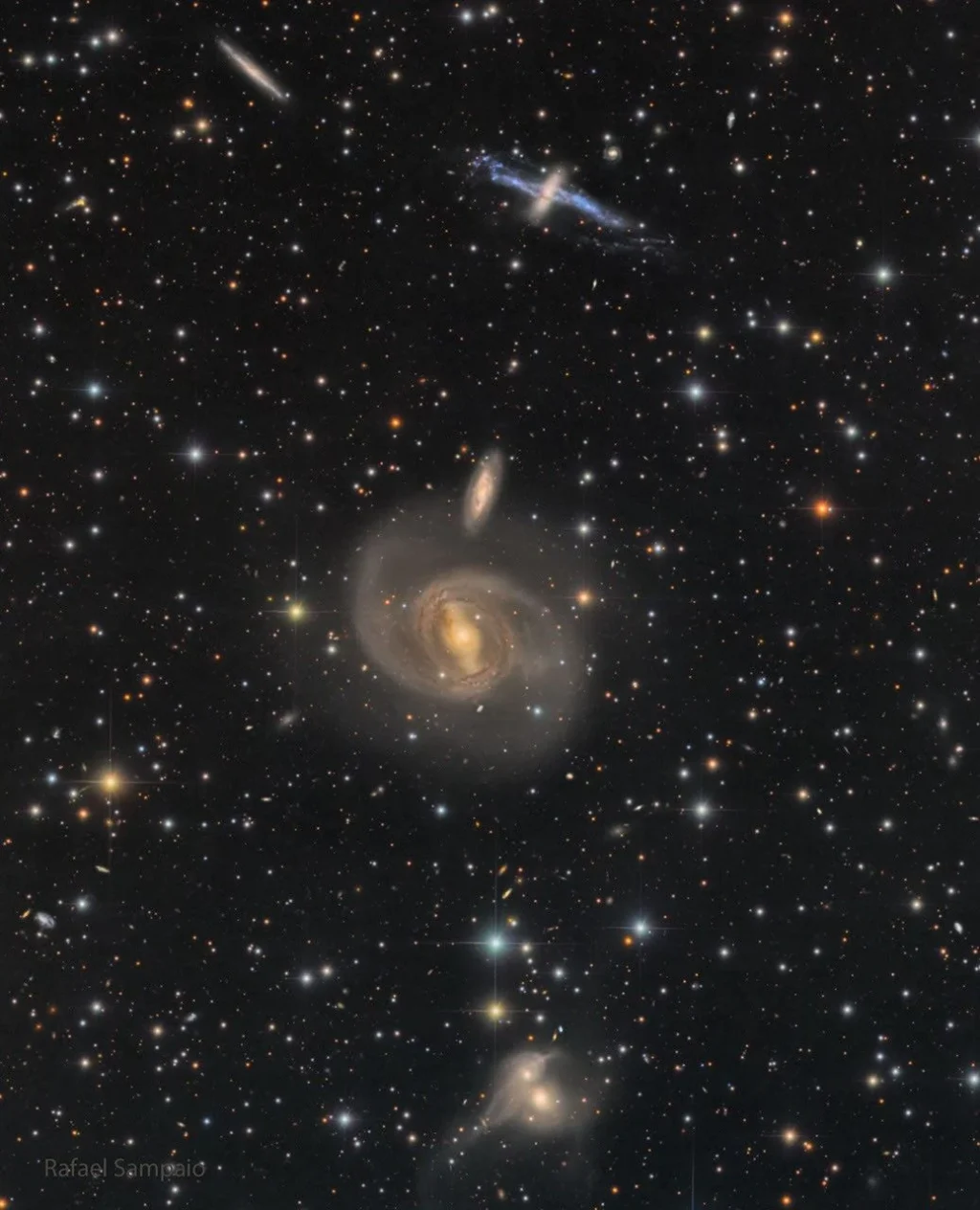
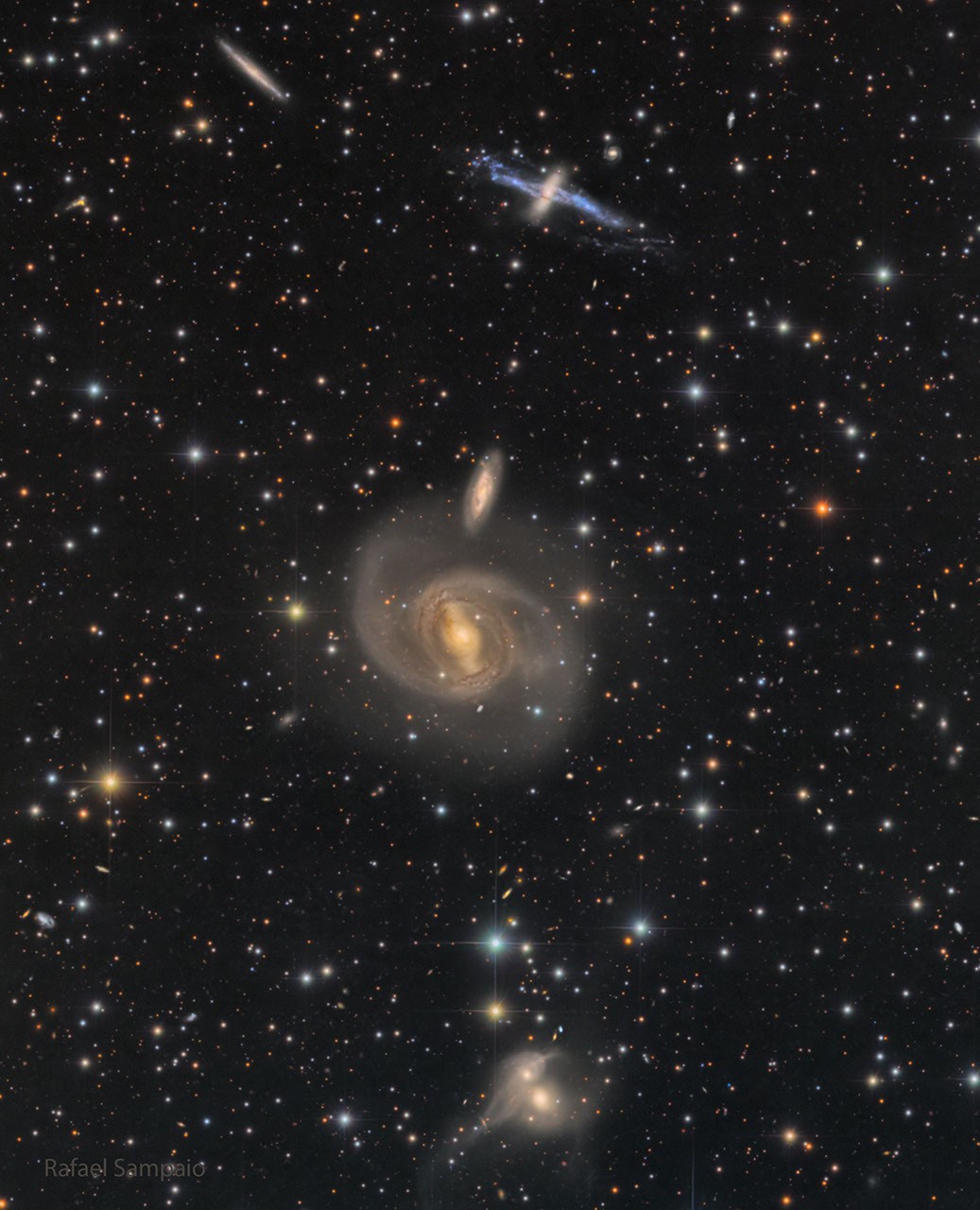
The vast expanse of the universe continues to unveil its breathtaking celestial spectacles, and for August 10, 2026, the Astronomy Picture of the Day (APOD) service presents a captivating image showcasing three distinct pairs of galaxies, each offering a unique glimpse into the dynamic processes shaping our cosmos. This featured image, captured by the keen eye of photographer Rafael Sampaio, invites viewers to ponder the intricate gravitational ballet that orchestrates the formation and evolution of these colossal stellar systems.
A Cosmic Trio of Galactic Interactions
The APOD image for August 10, 2026, is a testament to the diverse nature of galactic encounters. Arranged vertically within the same field of view, three pairs of galaxies illustrate a spectrum of gravitational relationships, from near-complete detachment to active merger. This visual narrative, meticulously explained by professional astronomers Robert Nemiroff, Jerry Bonnell, Cecilia Chirenti, and Keighley Rockcliffe, highlights the complexity and beauty of cosmic interactions, as well as the ongoing research efforts by institutions like NASA’s Goddard Space Flight Center (GSFC) and Michigan Technological University.
The uppermost pair of galaxies in the image appears to be relatively isolated, suggesting that their gravitational influence on each other is currently minimal. However, the galaxy on the right in this pair, identified as NGC 4650A, possesses a remarkable characteristic: it is a polar-ring galaxy. This distinctive morphology, where a ring of stars, gas, and dust orbits the galactic equator in a plane perpendicular to the main galactic disk, is often a telltale sign of a past, dramatic galactic event. Astronomers theorize that such structures can arise from the tidal disruption and accretion of a smaller galaxy. The blue stripe observed within NGC 4650A might be indicative of active star formation or a unique structural feature resulting from such a cosmic collision, a phenomenon that scientists are continuously studying to understand galactic evolution.
Moving down the frame, the middle pair of galaxies presents a more ambiguous scenario. While they appear close enough to potentially be interacting gravitationally, their observed relative speeds suggest that a significant merger is unlikely in the immediate cosmic timeline. The larger of these two, NGC 4650, is classified as a spiral galaxy, characterized by its prominent bar of stars stretching across its center. This bar structure is a common feature in many spiral galaxies and plays a crucial role in funneling gas towards the galactic core, potentially fueling star formation and the supermassive black hole at its center. The relative proximity of these two galaxies, despite the apparent lack of imminent merger, offers valuable data for astronomers studying the subtle nuances of gravitational influence over vast distances and timescales.
The lowermost pair of galaxies, in stark contrast to the others, is depicted in a state of active gravitational interaction. The image captures these two galaxies, NGC 4622A and NGC 4622B, in the throes of what appears to be a profound cosmic dance that will inevitably lead to their eventual merger. This process, driven by the relentless force of gravity, can take billions of years to fully unfold. When completed, these two distinct entities will coalesce into a single, larger galaxy. Such mergers are fundamental to the growth and evolution of galaxies, transforming spiral galaxies into elliptical ones and redistributing stellar populations and interstellar gas. The study of these ongoing mergers provides crucial insights into the mechanisms that shape the galactic landscape of the universe.
Context and Significance of Galactic Encounters
These three pairs of galaxies are believed to be members of the larger Centaurus Galaxy Cluster, a massive congregation of galaxies located approximately 160 million light-years away in the constellation Centaurus. Galaxy clusters are the largest gravitationally bound structures in the universe, and they serve as cosmic laboratories for studying galaxy evolution in dense environments. Within these clusters, galaxies are not isolated entities but are constantly subjected to the gravitational pull of their neighbors, leading to interactions, mergers, and tidal stripping.
The phenomenon of polar-ring galaxies, exemplified by NGC 4650A, is a particularly intriguing area of research. These galaxies challenge our traditional understanding of galactic structure and formation. While the precise mechanisms are still debated, the prevailing theory suggests that they form when a galaxy accretes material from a smaller companion galaxy, often a dwarf galaxy, in an orbit perpendicular to its main disk. This accreting material then settles into a ring, creating the distinctive polar structure. Studying these galaxies helps astronomers refine models of galaxy formation and understand the role of mergers and accretion in shaping galactic morphology.
The middle pair, with their apparent proximity but unlikely immediate merger, highlights the complexities of gravitational dynamics. The concept of "tidal force" is crucial here. While gravity pulls objects together, it also stretches them. In the case of galaxies, tidal forces can distort their shapes, create stellar streams, and trigger bursts of star formation. The relative speeds of these galaxies, as noted in the explanation, are a key factor in determining whether these tidal forces will lead to a complete merger or merely a close encounter. Data from such observations contribute to our understanding of the distribution of mass in galaxies and the subtle interplay of gravitational forces.
The active interaction of NGC 4622A and NGC 4622B offers a glimpse into the future of galactic evolution. Mergers are a fundamental process in the universe. They are responsible for the growth of massive galaxies and the redistribution of stars and gas. The process is not instantaneous; it involves a long period of tidal distortion, gas infall, and star formation before the final merger occurs. By observing galaxies in various stages of interaction, astronomers can piece together the evolutionary pathways of galaxies over cosmic timescales. This research is vital for understanding the history of our own Milky Way galaxy, which is predicted to merge with the Andromeda galaxy in billions of years.
Supporting Data and Astronomical Context
The Centaurus Cluster, the presumed home of these galaxy pairs, is a significant structure in the local universe. It is one of the nearest galaxy clusters to our own Local Group, making it an accessible target for detailed astronomical study. The cluster contains thousands of galaxies, ranging from giant elliptical galaxies to smaller spiral and irregular galaxies. The hot, diffuse gas that permeates the cluster, known as the intracluster medium, emits X-rays and can be studied to understand the cluster’s mass distribution and the processes of galaxy evolution within it.
The distance to the Centaurus Cluster, approximately 160 million light-years, means that the light we observe from these galaxies has been traveling for that duration. This temporal aspect is critical in astronomy, as it allows us to look back in time and observe the universe as it was in the past. The observed interactions and structures of these galaxies offer a snapshot of cosmic processes that have been unfolding for eons.
The classification of NGC 4650 as a polar-ring galaxy is based on its distinct visual appearance and spectral analysis, which reveal the presence of a ring of stars orbiting perpendicular to the main galactic disk. The identification of NGC 4650 as a spiral galaxy with a bright bar is based on its morphology, a common feature observed in many spiral galaxies and indicative of internal dynamics that channel gas and dust towards the galactic center.
Official Responses and Research Initiatives
The APOD program itself, a joint effort by NASA’s Goddard Space Flight Center (GSFC), NASA Science Activation, and Michigan Technological University, serves as a vital outreach tool, disseminating astronomical knowledge to a global audience. The explanations accompanying each image are crafted by professional astronomers, ensuring scientific accuracy and providing valuable context for the featured celestial object.
The credit for this particular image goes to Rafael Sampaio, an astrophotographer whose work contributes significantly to our visual understanding of the universe. The collaborative nature of this project, involving photographers, astronomers, editors, and multiple NASA divisions, underscores the broad effort involved in exploring and communicating the wonders of space.
The ongoing research into galaxy interactions, polar-ring galaxies, and the dynamics of galaxy clusters is supported by various space-based and ground-based telescopes. Data from instruments like the Hubble Space Telescope and the James Webb Space Telescope, as well as large ground-based observatories, are crucial for obtaining the detailed images and spectral information needed to study these phenomena. These observations help refine our understanding of fundamental cosmological questions, such as the formation of structure in the universe and the evolution of galaxies over billions of years.
Broader Impact and Implications
The image of these three galaxy pairs serves as a powerful reminder of the vastness and dynamism of the universe. It underscores that galaxies are not static entities but are engaged in a constant, slow-motion ballet of gravitational interaction. Understanding these interactions is fundamental to comprehending the cosmic web – the large-scale structure of the universe where galaxies are organized into filaments and clusters.
The study of galaxy mergers, in particular, has profound implications for our understanding of galactic evolution. These events are not just aesthetically dramatic; they are drivers of cosmic change. They can trigger intense bursts of star formation, feed supermassive black holes at galactic centers, and ultimately transform the structure and composition of galaxies over cosmic time. The eventual merger of our own Milky Way with the Andromeda galaxy, a process that will unfold over billions of years, is a direct consequence of these fundamental gravitational interactions.
Furthermore, the research into polar-ring galaxies like NGC 4650A pushes the boundaries of our knowledge about the diverse ways in which galaxies can form and evolve. It highlights that the universe is far more complex and varied than our initial models might suggest, prompting astronomers to continually refine their theories and explore new possibilities.
The APOD program, by showcasing such captivating images and providing expert explanations, plays a critical role in fostering public interest in astronomy and space science. It democratizes access to cutting-edge astronomical discoveries, inspiring future generations of scientists and engaging the public in the ongoing quest to understand our place in the cosmos. The featured image of three galaxy pairs is more than just a beautiful picture; it is a window into the fundamental forces and processes that have shaped, and continue to shape, the universe we inhabit. The promise of "many moons" for tomorrow’s picture hints at further celestial wonders awaiting discovery and presentation.