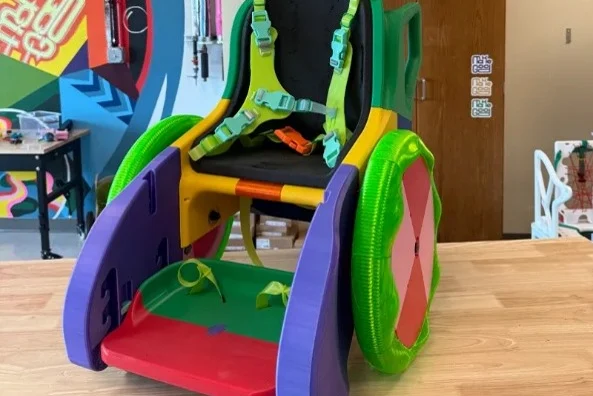
This week’s featured innovation highlights a groundbreaking assistive device designed to significantly improve a child’s ability to navigate their environment. The Toddler Mobility Device (TMT), a collaborative effort between the design firm MakeGood and manufacturer General Pattern Company, is comprised of numerous 3D-printed components, produced affordably on desktop 3D printers. This initiative represents a powerful intersection of advanced manufacturing, community engagement, and a commitment to enhancing the lives of children facing mobility challenges.
The core of MakeGood’s operation lies in its innovative distributed manufacturing model. The organization meticulously connects families requiring these specialized mobility devices with a network of "vetted makers" in their local communities. These makers are responsible for the crucial steps of printing the device components and assembling the final product, adhering to pre-approved, standardized designs. To ensure quality and consistency, makers must undergo a rigorous vetting process. This includes performing test prints and submitting photographic evidence of their work before they are officially welcomed into the MakeGood network. This network comprises a diverse group of individuals, ranging from hobbyist 3D printing enthusiasts to established manufacturing companies like General Pattern, all united by a desire to contribute to a meaningful cause.
General Pattern Company, a long-standing entity with a history of adaptation and innovation, plays a pivotal role in this ecosystem. Their involvement underscores the capacity of established manufacturers to leverage emerging technologies like 3D printing for social good. By utilizing low-cost desktop 3D printers, the TMT project dramatically reduces the production cost of these essential devices, making them accessible to a wider range of families who might otherwise face significant financial barriers. The sheer volume of 3D-printed parts required for each TMT, often numbering in the dozens, showcases the scalability and efficiency of this additive manufacturing approach.
The impact of mobility devices like the TMT is profound, particularly for children diagnosed with conditions such as cerebral palsy, spina bifida, or other developmental and physical health challenges. These devices are not merely tools for movement; they are enablers of autonomy. By providing children with the means to move independently, the TMT fosters a critical sense of self-reliance and agency. This independence is paramount for a child’s holistic development, impacting not only their physical capabilities but also their cognitive and emotional well-being. MakeGood’s initiative effectively addresses a significant gap in healthcare coverage, as these personalized mobility solutions often fall outside the purview of traditional insurance plans. The TMT offers a customized and empowering alternative.
Noam Platt, the visionary founder of MakeGood, articulated the transformative power of these devices. He shared, "We are hearing that kids are becoming much more independent, and with mobility comes brain development as well. Perhaps the most important thing is that the chairs are fun! The colors and style fit into the lives of kids, and their friends love them. So now the kids go from being the ‘other’ to being the coolest one on the playground." This sentiment highlights a crucial aspect of the TMT’s design philosophy: it integrates seamlessly into a child’s life, promoting social inclusion and positive self-perception rather than isolating them. The emphasis on aesthetics and personalization ensures that the devices are not only functional but also desirable, fostering a sense of pride and belonging among their young users.
The Genesis and Evolution of MakeGood’s Mission
The journey of MakeGood began with a clear recognition of an unmet need. Observing the limitations faced by children with mobility impairments and the prohibitive costs associated with traditional assistive devices, founder Noam Platt envisioned a solution that was both technologically advanced and community-driven. The idea of leveraging the growing accessibility of 3D printing technology to create affordable, customized mobility aids emerged as a promising avenue.
The development of the Toddler Mobility Device was not an overnight success. It involved extensive research, design iterations, and rigorous testing to ensure the safety, durability, and efficacy of the devices. MakeGood’s commitment to a distributed manufacturing model was a strategic choice. It aimed to decentralize production, reduce shipping costs, and foster local economies by empowering individuals and businesses within communities to participate in the manufacturing process.
The initial phase likely involved establishing partnerships with early adopters and makers, refining the design based on user feedback, and building a robust online platform to facilitate connections between families and makers. The decision to partner with established manufacturers like General Pattern Company represented a significant scaling-up of their operations, bringing professional manufacturing expertise and quality control to the production of the TMT. This partnership allowed MakeGood to move beyond a purely community-based model and tap into industrial-level capabilities, ensuring that even with 3D printing, the devices met stringent quality standards.

General Pattern Company: A Legacy of Manufacturing Embracing Additive Innovation
General Pattern Company boasts a rich history, with over a century of experience in the manufacturing sector. This extensive legacy has provided them with a deep understanding of evolving industrial needs and the capacity to adapt to new technological paradigms. Their embrace of additive manufacturing, specifically 3D printing, for the production of TMT components, is a testament to their forward-thinking approach.
Historically, General Pattern has been involved in various facets of manufacturing, likely including traditional methods such as machining, molding, and tooling. The integration of 3D printing into their workflow signifies a strategic diversification and a recognition of the unique advantages offered by additive technologies. These advantages can include rapid prototyping, the creation of complex geometries that are difficult or impossible with subtractive methods, and on-demand production, which can be particularly beneficial for custom or low-volume parts.
For the TMT project, General Pattern’s contribution likely involves not just the printing of components but also potentially their expertise in material selection, process optimization, and quality assurance. Their established infrastructure and manufacturing acumen ensure that the 3D-printed parts are produced to precise specifications, contributing to the overall reliability and safety of the mobility devices. This partnership exemplifies how established industries can actively participate in social impact initiatives by adapting and integrating cutting-edge technologies.
The Science and Technology Behind the TMT
The efficacy of the Toddler Mobility Device is rooted in the intelligent application of 3D printing technology. The design, developed by MakeGood, leverages the inherent advantages of additive manufacturing to create lightweight, durable, and highly customizable components.
Key technological aspects include:
- Material Selection: The choice of materials for 3D printing is critical. For a device intended for children, biocompatibility, strength, and flexibility are paramount. Common choices for such applications might include various grades of PLA (polylactic acid), PETG (polyethylene terephthalate glycol), or even more advanced engineering plastics, depending on the specific stress and wear requirements of each component. These materials offer a good balance of affordability, ease of printing, and mechanical properties.
- Design for Additive Manufacturing (DfAM): The TMT’s design likely incorporates principles of DfAM. This means the components are conceived with the 3D printing process in mind, allowing for features like internal lattices for weight reduction, interlocking parts for easier assembly, and optimized geometries for structural integrity. This approach maximizes the benefits of 3D printing, leading to more efficient and effective designs.
- Low-Cost Desktop 3D Printers: The reliance on low-cost desktop 3D printers democratizes the manufacturing process. These machines, readily available to individuals and small businesses, significantly reduce the barrier to entry for makers. This accessibility is fundamental to MakeGood’s distributed manufacturing model, enabling a broad network of individuals to contribute to the production of TMTs.
- Modularity and Customization: The device is composed of "several dozen" 3D-printed parts. This modular design facilitates customization. For instance, components related to the seat height, leg support, or armrests can be adjusted or reprinted with slight modifications to perfectly fit a child’s unique body dimensions and needs. This level of personalization is a significant advantage over mass-produced assistive devices.
- Scalability: The ability to produce numerous identical or slightly varied components using multiple desktop 3D printers simultaneously allows for the scalable production of TMTs to meet growing demand. This distributed model bypasses the limitations of single, large-scale manufacturing facilities.
Data and Supporting Evidence
While specific quantitative data on the number of TMTs produced or children assisted may not be publicly available in this initial report, the underlying principles are supported by broader industry trends and research:
- Growth of 3D Printing in Healthcare: The global 3D printing in healthcare market is experiencing substantial growth. Reports from various market research firms consistently project significant compound annual growth rates (CAGRs) in the coming years, driven by applications in prosthetics, orthotics, surgical models, and patient-specific implants. The TMT project aligns perfectly with this trend, showcasing the application of 3D printing for personalized medical devices.
- Cost Reduction through Additive Manufacturing: Studies have demonstrated that 3D printing can significantly reduce manufacturing costs for complex or customized parts, especially in low to medium volumes. This is achieved through reduced material waste, simplified assembly, and the elimination of expensive tooling. The TMT project directly benefits from this cost-effectiveness, making assistive technology more affordable.
- Impact of Early Mobility on Child Development: Research in developmental pediatrics consistently highlights the critical importance of early mobility for cognitive, social, and physical development. Children who can explore their environment independently tend to exhibit improved motor skills, enhanced problem-solving abilities, and greater social engagement. The TMT directly facilitates this crucial aspect of development.
- The "Maker Movement" and Social Impact: The rise of the maker movement, characterized by individuals and communities leveraging technology to create and innovate, has seen numerous applications in social impact initiatives. These projects often focus on addressing societal needs through accessible technology and collaborative efforts, mirroring MakeGood’s approach.
Broader Impact and Future Implications
The MakeGood and General Pattern collaboration on the Toddler Mobility Device has far-reaching implications, extending beyond the immediate beneficiaries.
- Democratization of Assistive Technology: By utilizing low-cost 3D printing and a distributed manufacturing network, this initiative significantly lowers the cost barrier to essential assistive devices. This could pave the way for similar projects addressing other needs in underserved communities, making specialized equipment more accessible globally.
- Empowerment of Makers and Communities: The model fosters a sense of purpose and economic opportunity for individuals and businesses involved in the printing and assembly process. It transforms passive consumers into active contributors, strengthening local economies and building community resilience.
- Advancement in Pediatric Rehabilitation: The success of the TMT could inspire further research and development in 3D-printed assistive devices for children with various disabilities. This could lead to a new generation of more affordable, customizable, and effective rehabilitation tools.
- Shifting Perceptions of Disability: As emphasized by Noam Platt, the TMT aims to transform how children with mobility challenges are perceived, both by themselves and their peers. By providing devices that are not only functional but also fun and stylish, MakeGood promotes inclusivity and helps children feel like active, integrated members of their social circles. This can have a profound impact on their self-esteem and overall life trajectory.
- Sustainable Manufacturing Practices: The on-demand nature of 3D printing can contribute to more sustainable manufacturing by reducing overproduction and waste associated with traditional mass-manufacturing techniques.
The initiative serves as a powerful case study in how collaborative innovation, leveraging accessible technology and a commitment to social good, can create tangible and transformative positive change. As the TMT continues to reach more children, its impact is expected to grow, fostering greater independence, inclusion, and well-being for a generation of young individuals.