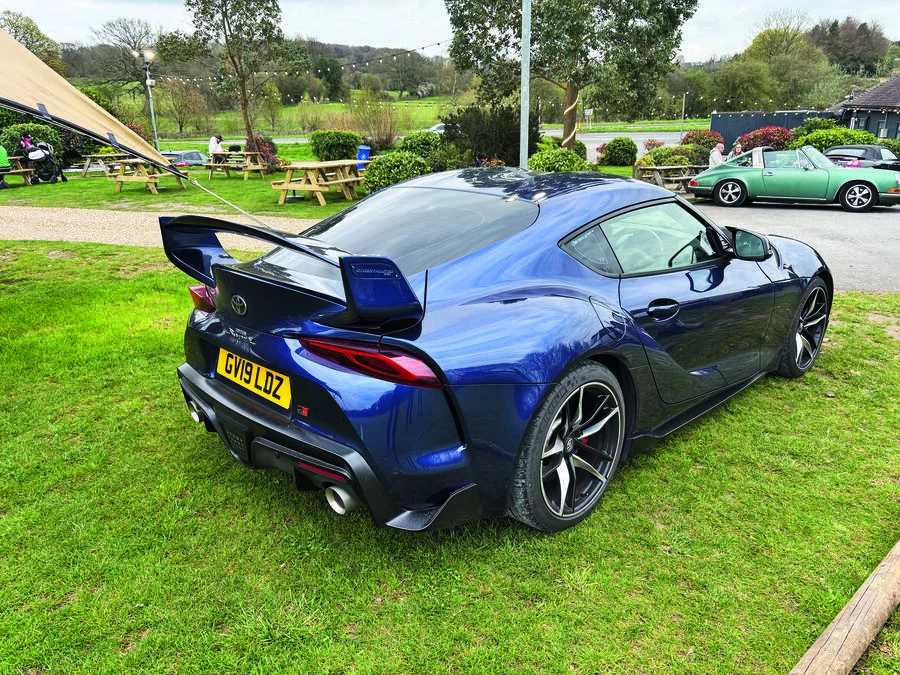
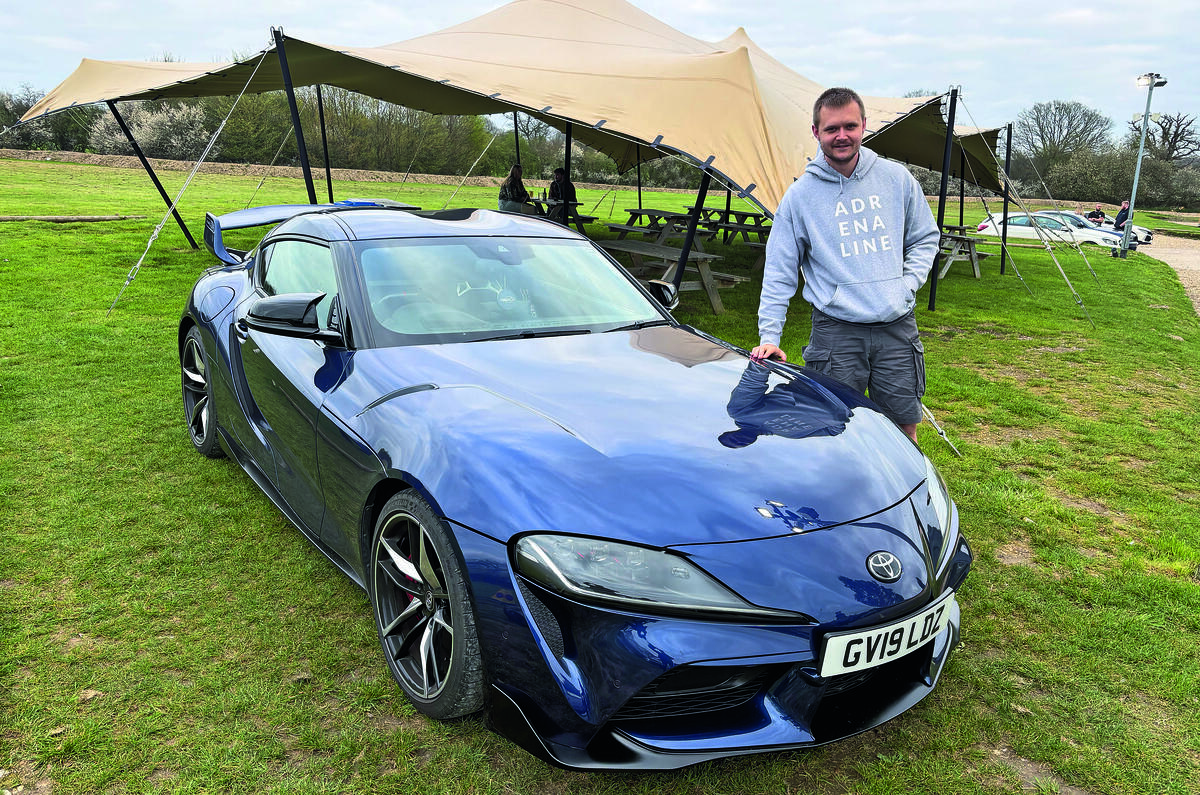
Reece Atherton, a 28-year-old enthusiast, has set his sights on transforming his Toyota GR Supra 3.0 into a hypercar-challenging machine, aiming to outpace even the legendary Bugatti Veyron. Atherton, who purchased the eight-speed automatic version of the popular sports coupe, was inspired by the ownership of two friends and a desire for a vehicle that offers both performance and a compelling driving experience. His decision to opt for the automatic transmission over the manual was driven by a preference for the paddle shifters and the perceived cost-effectiveness of used automatic models in the current market.
The GR Supra, a collaboration between Toyota and BMW, has garnered significant attention since its reintroduction to the automotive landscape. The current generation, codenamed A90, shares its platform and powertrain with the BMW Z4. The 3.0-liter turbocharged inline-six engine, a BMW B58 unit, delivers a potent 382 horsepower and 368 lb-ft of torque in its latest iteration, allowing the Supra to accelerate from 0 to 60 mph in just under 4 seconds. While impressive, Atherton’s ambition suggests a desire to push these figures significantly further, placing his modified Supra in a performance bracket typically reserved for multi-million dollar hypercars.
The Genesis of an Ambitious Project
Atherton’s journey into the world of high-performance tuning is not unprecedented. Enthusiasts worldwide frequently modify their vehicles to achieve greater power and speed. However, the specific benchmark Atherton has set – challenging a Bugatti Veyron – elevates this project beyond the ordinary. The Bugatti Veyron, a symbol of automotive excess and engineering prowess, originally produced 1,001 horsepower, with later iterations reaching up to 1,200 horsepower. Its top speed exceeded 250 mph, a figure that has remained a benchmark for hypercar performance for years.
The path to achieving such performance from a GR Supra, even a heavily modified one, presents significant engineering and financial hurdles. The Supra’s standard powertrain, while robust, is not designed to handle the extreme power outputs required to rival a Veyron. This necessitates substantial upgrades to virtually every component of the drivetrain, including the engine, transmission, turbochargers, cooling systems, and potentially even the chassis and suspension.
A Look at the GR Supra’s Performance Capabilities
The Toyota GR Supra 3.0, in its stock form, represents a formidable performance package. The 3.0-liter B58 engine is renowned for its smooth power delivery and tuning potential. When launched, the GR Supra 3.0 achieved a 0-60 mph time of 4.1 seconds, with later refinements bringing this down to 3.9 seconds. This places it firmly in the sports car category, capable of exhilarating acceleration and agile handling, thanks in part to its near-perfect 50:50 weight distribution and sophisticated chassis tuning.
However, the Veyron’s performance figures are in a different league. The original Veyron’s 8.0-liter quad-turbocharged W16 engine produced a staggering 1,001 horsepower and 922 lb-ft of torque, enabling it to reach a top speed of 253 mph. The Super Sport variant, with 1,200 horsepower, pushed this further to 267 mph. To even approach these numbers, Atherton’s Supra would require an engine output well over triple its factory rating.
The Technical Challenges and Potential Modifications
Achieving Veyron-level performance from a GR Supra involves a complex and costly series of modifications. Experts in the field suggest that such an endeavor would likely involve:
- Engine Internals: The stock B58 engine’s internal components, such as pistons, connecting rods, and crankshaft, would need to be forged and strengthened to withstand significantly higher cylinder pressures and temperatures.
- Forced Induction: Replacing the single turbocharger with a larger, more efficient twin-turbo system or a highly capable single turbocharger would be essential. This would require custom exhaust manifolds, intercoolers, and fuel delivery systems.
- Fueling System: The fuel injectors, fuel pump, and fuel pressure regulator would need to be upgraded to supply the substantially increased fuel required for such high power levels.
- Engine Management: A sophisticated standalone engine management system or heavily remapped factory ECU would be necessary to precisely control ignition timing, fuel delivery, and boost pressure.
- Transmission: While the ZF-sourced eight-speed automatic is a robust unit, it would likely require significant internal strengthening or replacement with a dedicated high-performance transmission capable of handling extreme torque. The paddle shifters, a feature Atherton appreciates, would need to be integrated with the upgraded transmission.
- Cooling System: An oversized radiator, upgraded intercoolers, and potentially an oil cooler would be crucial to manage the immense heat generated by a highly boosted engine.
- Exhaust System: A custom, high-flow exhaust system would be necessary to reduce backpressure and optimize exhaust gas flow.
- Drivetrain and Chassis: The differential, driveshafts, and potentially even the chassis itself might require reinforcement to handle the increased power and stresses.
The cost of such modifications can easily run into tens, if not hundreds, of thousands of dollars, depending on the chosen components and the expertise of the tuning shop.
A Competitive Landscape of Tuned Supras
Atherton’s ambition is not entirely unique within the broader tuning community. While directly challenging a Veyron is an extreme goal, there are numerous examples of highly modified GR Supras achieving impressive power figures. Many tuners have pushed the B58 engine to well over 700 horsepower, and some have even approached or exceeded the 1,000-horsepower mark through extensive modifications. These vehicles often compete in drag racing events or time attack challenges, showcasing the incredible potential of the Supra platform when pushed to its limits.
For instance, documented builds by reputable tuning companies have demonstrated the Supra’s ability to achieve sub-10-second quarter-mile times with power outputs in the high 700s to low 800s. Pushing beyond 1,000 horsepower typically involves extensive engine rebuilding, advanced turbocharger technology, and robust supporting modifications. The key difference in Atherton’s stated goal is the specific benchmark of a Bugatti Veyron, a car engineered from the ground up as a hypercar, with a significantly larger and more complex powertrain.
Timeline and Future Development
While Atherton has acquired his GR Supra, the journey to Veyron-baiting performance is likely to be a lengthy one. The process of sourcing parts, commissioning specialized work, and extensive testing and tuning can take months, if not years.
- Initial Acquisition (August 2026): Reece Atherton purchases his Toyota GR Supra 3.0 automatic.
- Research and Planning Phase: Atherton will likely engage with leading tuning specialists and research the most effective and reliable pathways to achieve his ambitious power goals. This phase could involve extensive consultation and the development of a detailed build plan.
- Component Sourcing and Initial Modifications: The acquisition of high-performance engine components, turbochargers, fueling systems, and transmission upgrades will commence. Initial modifications might focus on bolt-on performance parts and ECU tuning to unlock modest gains.
- Engine and Drivetrain Rebuild: A significant portion of the project will involve the complete rebuilding of the engine with forged internals and the integration of a more powerful forced induction system. The transmission will also undergo strengthening or replacement.
- Testing and Refinement: Once the core mechanical upgrades are complete, extensive testing will be required to fine-tune the engine management system, optimize power delivery, and ensure reliability. This will involve dyno testing and real-world performance evaluation.
- Chassis and Suspension Upgrades: To effectively manage the increased power and speed, chassis and suspension modifications will likely be necessary, including upgraded brakes, coilovers, and potentially aerodynamic enhancements.
- Final Performance Validation: The ultimate goal will be to achieve verified performance figures that can stand against the benchmarks set by vehicles like the Bugatti Veyron. This could involve official timed runs at specialized events.
Potential Reactions and Implications
The automotive community, particularly within the tuning and performance car circles, will undoubtedly watch Atherton’s project with keen interest. Success in such an ambitious endeavor could:
- Inspire Other Enthusiasts: Demonstrating that seemingly insurmountable performance barriers can be overcome through dedication and engineering expertise could encourage other enthusiasts to pursue their own ambitious automotive projects.
- Push the Boundaries of Tuning: Achieving unprecedented power levels from a production sports car platform could lead to new innovations in tuning technology and component development.
- Highlight the Supra’s Potential: While the Supra is already a respected performance car, a project of this magnitude would further cement its reputation as a highly capable and adaptable platform for extreme performance.
- Economic Impact: The project would likely involve significant investment in specialized parts and labor, benefiting automotive performance businesses and engineers.
However, it is crucial to acknowledge the inherent risks and challenges. Pushing any vehicle to such extreme limits can compromise reliability, safety, and longevity. The legal and practical implications of operating such a highly modified vehicle on public roads would also need careful consideration.
Reece Atherton’s aspiration to transform his Toyota GR Supra into a Veyron-challenging machine is a testament to the passion and ingenuity found within the automotive enthusiast community. While the journey will be arduous and fraught with technical challenges, the pursuit of such ambitious goals often leads to remarkable achievements and pushes the boundaries of what is considered possible in automotive engineering. The coming years will reveal whether Atherton can indeed make his Supra a true hypercar contender.