For millennia, gold has occupied a singular place in human civilization, prized not only for its rarity and color but for an extraordinary physical property that sets it apart from almost every other metal: its immunity to the passage of time. While silver turns black and copper develops a green patina, gold remains as radiant as the day it was forged. Traditionally, this phenomenon was attributed to gold’s "noble" chemical nature—a fundamental reluctance to interact with other elements. However, a groundbreaking study from researchers at Tulane University has revealed that this legendary durability is not merely a product of chemistry, but a sophisticated feat of atomic-scale self-defense. By uncovering how gold atoms rearrange themselves on a surface to create a nearly impenetrable barrier, the research team has provided a new scientific foundation for understanding why gold stays shiny and, more importantly, how it might be manipulated to revolutionize the future of clean energy and industrial manufacturing.
The study, led by Matthew Montemore, an associate professor of Chemical Engineering at Tulane’s School of Science and Engineering, and postdoctoral fellow Santu Biswas, was recently published in the prestigious journal Physical Review Letters. Their findings indicate that for the most common types of gold surfaces, the atoms naturally shift into protective patterns that make it exponentially more difficult for oxygen to react with the metal. This discovery challenges the long-held assumption that gold is simply "inert" by nature. Instead, it suggests that gold actively resists oxidation through a structural transformation that occurs at the atomic level, effectively "locking" the surface against environmental degradation.
The Mechanics of Atomic Rearrangement
To understand the significance of the Tulane discovery, one must first look at how metals typically interact with the atmosphere. Oxidation occurs when oxygen molecules from the air land on a metal surface, dissociate into individual atoms, and form chemical bonds with the metal atoms. In the case of iron, this process leads to the formation of iron oxide, or rust, which eventually flakes away and exposes more metal to the elements.
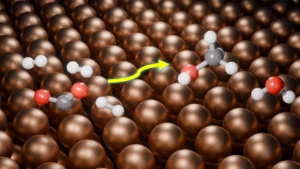
In their investigation, Montemore and Biswas focused on two of the most prevalent surface geometries found in gold. Using advanced computer simulations to model the behavior of individual atoms and their constituent electrons, the team observed a phenomenon that had previously been undervalued in the study of corrosion. They found that when gold atoms are exposed to the environment, they do not remain in a static grid. Instead, they reorganize themselves into specific geometric configurations that are significantly more stable than a standard lattice.
The simulations revealed a stark contrast between a theoretical, non-rearranged gold surface and the actual, restructured surface. If gold atoms remained in their "standard" positions, oxygen molecules would find it relatively easy to split apart and bind to the metal. However, the natural atomic restructuring creates a barrier that limits these reactions by a staggering degree. According to the researchers, these reorganized surfaces reduce oxygen reaction rates by a factor of a billion to a trillion. This creates what is essentially an atomic-scale shield, explaining why a gold coin recovered from a centuries-old shipwreck can still gleam with its original luster.
A Chronology of Gold’s Scientific Evolution
The Tulane study represents the latest chapter in a long history of scientific inquiry into the nature of gold. To appreciate the impact of this research, it is helpful to view it within the timeline of human interaction with the metal:
- 4000 BCE – 1500 BCE: Early civilizations in Mesopotamia and Egypt begin using gold for jewelry and religious artifacts, noting its unique resistance to corrosion compared to copper and bronze.
- 1700s – 1800s: Chemistry emerges as a formal science. Gold is classified as a "noble metal" due to its high electronegativity and resistance to acids, placing it alongside platinum and palladium.
- 1980s: The field of heterogeneous catalysis discovers that while bulk gold is inert, gold at the nanoscale (nanoparticles) can be surprisingly reactive. This sparks a global interest in using gold for industrial chemical reactions.
- 2000s – 2010s: Researchers begin using gold-palladium alloys to produce vinyl acetate, a key component in plastics. However, the fundamental reason for gold’s surface stability remains partially shrouded in mystery.
- 2024: The Tulane University team publishes their findings in Physical Review Letters, identifying surface rearrangement as the primary mechanism behind gold’s resistance to oxidation and proposing a new strategy for catalyst design.
Data and Quantitative Analysis: The Power of a Trillion-Fold Reduction
The quantitative data provided by the Tulane simulations offers a new perspective on the "nobility" of gold. The reduction of oxygen reactions by a factor of $10^9$ to $10^12$ (one billion to one trillion) is a monumental difference in the world of chemical kinetics. In practical terms, if an unrearranged gold surface were to tarnish in one second, the rearranged surface would take over 30,000 years to experience the same level of oxidation under the same conditions.
This extreme level of stability is what makes gold the preferred material for high-reliability electronics. In the aerospace and telecommunications industries, gold plating is used for connectors and switch contacts because even a microscopic layer of tarnish could increase electrical resistance and lead to signal failure. The Tulane research provides the mathematical and physical evidence for why this reliability is so consistent, proving that the protection is built into the very architecture of the gold surface.
Official Responses and the Scientific Community’s Reaction
While the study originated at Tulane, its implications have resonated throughout the fields of chemical engineering and materials science. Experts in the field of surface science have noted that the work of Montemore and Biswas provides a "missing link" in understanding the transition between gold’s inert bulk properties and its reactive nanoparticle properties.
"People have generally thought gold doesn’t tarnish simply because it doesn’t interact strongly with oxygen," Matthew Montemore explained in a statement accompanying the study’s release. "What we show is that for two of the most common gold surface types, the surface atoms actually rearrange themselves in a way that makes the gold much more resistant to oxidation."
This shift in perspective—from viewing gold as a passive metal to an active, self-structuring material—is expected to influence how future researchers approach the "gold paradox." The paradox lies in the fact that the same property that makes gold beautiful and durable also makes it a "lazy" catalyst. If it won’t react with oxygen, it cannot easily facilitate the chemical transformations required for industrial processes.
Broader Implications: Redefining Industrial Catalysis
The most significant impact of the Tulane discovery may not be in jewelry or history, but in the future of "green" chemistry and industrial manufacturing. Catalysts are substances that speed up chemical reactions without being consumed in the process. Gold-based catalysts are currently used in several high-stakes industries, but their efficiency is often hampered by the metal’s inherent stability.
One of the primary applications of gold catalysts is the production of vinyl acetate monomer (VAM). VAM is an essential precursor for the production of polyvinyl acetate (PVA), which is used in everything from paints and adhesives to food packaging and cable insulation. Currently, the industry uses gold-palladium catalysts, where the gold helps to isolate palladium atoms and prevent them from being "poisoned" by byproducts.
The Tulane research suggests that if scientists can find a way to "trick" gold into not rearranging its surface, they could make it significantly more reactive. "If you can trick gold into dissociating oxygen, it can actually become a very effective catalyst for certain reactions," Montemore noted. "Our work suggests a new strategy for potentially doing that by preventing or reversing these surface rearrangements."
Beyond plastics, the implications for clean energy are substantial. Researchers are currently investigating gold catalysts for:
- Carbon Monoxide Removal: Converting toxic CO from vehicle exhaust into less harmful CO2 at lower temperatures than current platinum-based converters.
- Propylene Oxide Production: A major industrial chemical used in the creation of polyurethanes. The current production methods are often energy-intensive and environmentally taxing; gold catalysts offer a potentially "greener" route.
- Fuel Cells: Improving the efficiency of oxygen reduction reactions in hydrogen fuel cells, which is a critical step in making zero-emission vehicles more viable.
A New Strategy for Material Design
For decades, the standard approach to improving gold catalysts was to either shrink the gold into tiny nanoparticles (which have more "edges" and "corners" where atoms cannot easily rearrange) or to alloy gold with more reactive metals like palladium or nickel.
The Tulane findings point toward a third path: geometric control. By manipulating the physical structure of the gold surface at the atomic level—perhaps through specialized coatings or by growing gold crystals with specific orientations—engineers might be able to suppress the natural tendency of the atoms to rearrange into their "defensive" posture. This would allow the gold to remain in a high-energy, reactive state, ready to participate in the chemical reactions necessary for fuel production or pollution control.
Conclusion: The Lasting Legacy of Gold
The work of Montemore and Biswas at Tulane University bridges the gap between the ancient appreciation of gold and the cutting-edge needs of modern technology. By identifying the billion-fold protective power of atomic rearrangement, they have solved a fundamental mystery of the natural world.
As the global community moves toward more sustainable industrial practices, the ability to fine-tune the reactivity of materials will be paramount. Gold, once valued primarily for its ability to resist change, may soon be valued for its ability to drive change. The secret to this transition lies in the very atoms that have kept the metal shiny for thousands of years. By understanding the "hidden defense" of gold, science is now one step closer to unlocking its full potential as a tool for a cleaner, more efficient future. In the end, the same atomic dance that preserves a Pharaoh’s mask may soon be the key to cleaning the air we breathe and powering the next generation of technology.