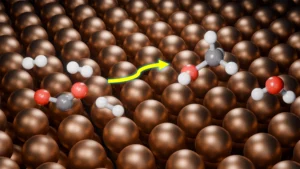
For millennia, gold has occupied a singular place in human civilization, prized not merely for its scarcity but for its immutable brilliance. Unlike silver, which blackens with tarnish, or iron, which succumbs to the slow decay of rust, gold maintains its radiant yellow hue through centuries of exposure to the elements. While the scientific community has long attributed this resilience to gold’s chemical "nobility"—its inherent reluctance to bond with other elements—new research from Tulane University suggests that the secret to gold’s endurance is far more complex than previously understood. According to a study recently published in the prestigious journal Physical Review Letters, the durability of gold is driven by a sophisticated atomic defense mechanism that physically reorganizes the metal’s surface to repel oxygen.
The research, led by Matthew Montemore, an associate professor of Chemical Engineering at Tulane’s School of Science and Engineering, and postdoctoral fellow Santu Biswas, represents a paradigm shift in materials science. By utilizing advanced computer simulations to model the behavior of atoms and electrons at the quantum level, the team discovered that gold’s surface atoms naturally shift into protective configurations. These patterns create an almost impenetrable barrier, making it exceptionally difficult for oxygen molecules to react with the metal. This finding not only solves a long-standing mystery regarding the aesthetics of precious metals but also provides a blueprint for the next generation of industrial catalysts and clean energy technologies.
The Atomic Architecture of Resistance
To understand the significance of the Tulane discovery, one must first look at the traditional view of gold’s chemistry. In most metals, surface atoms are relatively "eager" to interact with oxygen. When an oxygen molecule (O2) hits a surface like iron, the bonds holding the two oxygen atoms together break, allowing the individual atoms to bond with the metal, forming an oxide layer. In the case of gold, scientists have historically believed that the metal simply lacked the chemical affinity to facilitate this "dissociation" of oxygen.
However, Montemore and Biswas’s research suggests that the geometry of the surface is just as important as the chemistry of the element. The researchers focused their investigation on two of the most common orientations of gold surfaces, known in crystallography as the (111) and (100) facets. Using high-fidelity simulations, they observed that the atoms on these surfaces do not remain in a static, grid-like formation. Instead, they undergo a process of "surface reconstruction."
As oxygen molecules approach, the gold atoms shift their positions, tightening their bonds with one another and smoothing out the surface in a way that minimizes reactive "hotspots." The study found that if these atoms were forced to remain in their standard, un-rearranged positions, oxygen molecules would be able to split apart and react with the gold far more easily. By rearranging themselves, the surface atoms reduce the rate of oxygen dissociation by a factor of a billion to a trillion. This creates a functional "atomic shield" that preserves the metal’s luster indefinitely under normal atmospheric conditions.
A Chronology of Noble Metal Understanding
The Tulane study is the latest milestone in a scientific journey that began centuries ago. To appreciate the context of this discovery, it is helpful to examine the timeline of how humanity has perceived and analyzed gold’s unique properties:
- Antiquity to the Middle Ages: Gold is recognized for its resistance to corrosion, leading alchemists to label it the "king of metals." Its inability to be dissolved by common acids (except for aqua regia) becomes a primary test for purity.
- 18th and 19th Centuries: The development of modern chemistry identifies gold as a "noble metal" due to its full d-electron shell, which makes it chemically inert compared to transition metals like iron or copper.
- Late 20th Century: The rise of surface science allows researchers to look at metals at the nanoscale. Scientists begin to realize that "inert" gold can actually be highly reactive if it is broken down into tiny nanoparticles.
- The 2000s: Computational chemistry becomes a dominant force in materials science. Researchers begin using Density Functional Theory (DFT) to predict how molecules interact with surfaces.
- Present Day: The Tulane University study provides a definitive link between surface geometry and oxidation resistance, moving the conversation beyond simple chemical affinity to structural thermodynamics.
Supporting Data and Simulation Results
The Tulane research relied on complex numerical models to quantify exactly how much the surface rearrangement matters. The "factor of a billion to a trillion" is not merely a figure of speech; it is a calculated measurement of the kinetic barrier to oxidation.
In a typical chemical reaction, molecules must overcome an "activation energy" to react. The simulations showed that the atomic restructuring of gold significantly raises this activation energy for oxygen dissociation. On a non-reconstructed gold surface, the energy barrier is low enough that some oxidation might occur over time, particularly at higher temperatures. However, the reconstructed surface acts as a stabilizer.
The data suggests that this phenomenon is unique to gold among the noble metals in its intensity. While platinum and palladium also exhibit resistance to oxidation, their surface reconstructions do not provide the same degree of "deactivation" against oxygen as gold does. This explains why gold is the preferred material for long-term storage of value and for sensitive electronic connectors where even a microscopic layer of tarnish could disrupt a signal.
Official Responses and Scientific Analysis
The implications of this study have resonated throughout the chemical engineering community. Matthew Montemore emphasized that the discovery challenges the way researchers think about metal surfaces. "People have generally thought gold doesn’t tarnish simply because it doesn’t interact strongly with oxygen," Montemore stated. "What we show is that for two of the most common gold surface types, the surface atoms actually rearrange themselves in a way that makes the gold much more resistant to oxidation."
Independent analysts in the field of materials science suggest that this research may explain discrepancies in previous experiments where gold appeared more reactive in some laboratory settings than in others. If the surface reconstruction is disrupted—by mechanical stress, extreme heat, or the presence of other chemicals—gold’s "atomic shield" may be compromised.
"This provides a much-needed theoretical framework for understanding the ‘passive’ state of gold," says Dr. Arjan Singh, a materials scientist not involved in the study. "By quantifying the impact of surface geometry, the Tulane team has given us a tool to predict how gold will behave in environments ranging from deep-sea sensors to outer-space electronics."
Broader Impact: From Jewelry to Clean Energy
While the aesthetic preservation of jewelry is the most visible application of gold’s durability, the true impact of the Tulane discovery lies in the field of catalysis. Catalysts are substances that speed up chemical reactions without being consumed in the process. Gold-based catalysts are critical to several global industries, but they face a fundamental paradox: the same property that makes gold durable also makes it less effective as a catalyst.
For a catalyst to work in an oxidation reaction, it must be able to break oxygen molecules apart so they can react with other chemicals. Because gold is so "good" at protecting itself, it often refuses to participate in these reactions unless it is specially prepared.
Industrial Manufacturing
One of the primary uses for gold catalysts is in the production of vinyl acetate, a chemical essential for making paints, adhesives, and various plastics. Currently, industry uses gold-palladium alloys to strike a balance between durability and reactivity. The Tulane findings suggest that if engineers can find a way to prevent gold atoms from rearranging into their protective "shield" configuration, they could create a pure gold catalyst that is significantly more potent.
Environmental Technologies
The research also holds promise for air purification and emission control. Gold catalysts are uniquely effective at oxidizing carbon monoxide (CO) into carbon dioxide (CO2) at room temperature—a feat that other metals struggle to achieve. "If you can trick gold into dissociating oxygen, it can actually become a very effective catalyst for certain reactions," Montemore noted. By understanding the mechanism of the atomic shield, scientists can develop strategies to "reverse" this rearrangement in specific environments, such as inside a vehicle’s exhaust system or in industrial smokestacks, to more efficiently neutralize toxic gases.
Clean Energy and Future Innovations
In the burgeoning hydrogen economy, gold catalysts are being explored for use in fuel cells and for the production of clean-burning fuels. The Tulane study suggests a new strategy for catalyst design: rather than just mixing gold with other metals, researchers could focus on "geometrical engineering"—shaping the surface of the gold at the atomic level to ensure it stays in a reactive, non-reconstructed state.
Conclusion: A New Chapter for the King of Metals
The work of Montemore and Biswas at Tulane University marks a significant advancement in our understanding of the most storied metal in history. By proving that gold’s luster is a result of a dynamic atomic defense rather than just a passive chemical trait, the researchers have opened the door to a new era of "atomic-scale engineering."
As industries strive for more efficient and sustainable manufacturing processes, the ability to manipulate gold’s surface behavior will be invaluable. Whether it is used to create more durable electronics, more efficient plastic production, or cleaner air, the "noble" nature of gold—now understood through the lens of its atomic architecture—continues to offer solutions to some of the modern world’s most pressing technical challenges. The brilliance of gold, it seems, is not just a matter of beauty, but a masterpiece of natural engineering.