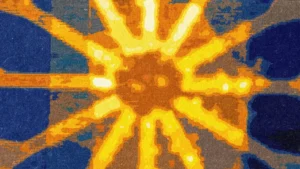
A research team at the University of Central Florida (UCF), led by Physics Professor Madhab Neupane, has achieved a significant milestone in condensed matter physics by identifying experimental evidence of altermagnetism in a layered material known as Co1/4TaSe2. This discovery, published and verified through rigorous spectroscopic analysis, marks a pivotal shift in how scientists approach the development of next-generation electronics. By harnessing "spin"—a fundamental quantum property of electrons—rather than relying solely on their electrical charge, this new class of materials promises to overcome the thermal and speed limitations currently facing the global semiconductor industry.
As conventional silicon-based computing approaches its physical limits, the demand for "Beyond Moore" technologies has intensified. The identification of altermagnetism in a transition-metal dichalcogenide (TMD) provides a versatile platform for spintronics, an emerging field where information is processed via the intrinsic angular momentum of electrons. The findings suggest that Co1/4TaSe2 could facilitate the creation of devices that are not only significantly faster but also operate with a fraction of the energy required by today’s hardware.
The Evolution of Magnetic Paradigms: From Ferromagnetism to Altermagnetism
To appreciate the significance of Professor Neupane’s discovery, it is essential to understand the historical context of magnetic materials in technology. For decades, the electronics industry has been defined by two primary magnetic states: ferromagnetism and antiferromagnetism.
Ferromagnetism is the most common form, utilized in everything from refrigerator magnets to hard drive storage. In these materials, the magnetic moments of electrons align in the same direction, creating a macroscopic magnetic field. While this alignment makes them easy to detect and manipulate, it creates a significant engineering challenge: stray magnetic fields. As devices shrink toward the nanometer scale, these stray fields cause magnetic interference (crosstalk) between closely packed components, limiting the density and efficiency of electronic circuits.
Antiferromagnetism, by contrast, features magnetic moments that align in a staggered, antiparallel fashion. This results in a net-zero magnetic field, effectively eliminating the problem of stray fields and interference. However, this cancellation comes at a cost. Antiferromagnets are notoriously difficult to manipulate and lack the robust electronic characteristics, such as spin-polarized currents, that make ferromagnets useful for active data processing.
Altermagnetism, a state only recently predicted by theorists and now experimentally confirmed by the UCF team, represents a "third branch" of magnetism. It combines the most desirable traits of both preceding categories. Like antiferromagnets, altermagnets possess a compensated magnetic structure that generates no stray fields. Yet, like ferromagnets, they exhibit a strong spin-splitting of electronic bands, allowing them to generate and control spin currents. This dual nature makes them the "holy grail" for the next generation of high-density, high-speed spintronic devices.
The Experimental Breakthrough: Mapping the Electronic Landscape
The UCF research team focused their investigation on Co1/4TaSe2, a layered material composed of cobalt atoms intercalated between sheets of tantalum and selenium. This specific structure belongs to the family of transition-metal dichalcogenides (TMDs), which have gained international attention for their unique two-dimensional properties and high tunability.
To confirm the presence of altermagnetism, the researchers utilized Angle-Resolved Photoemission Spectroscopy (ARPES). This advanced technique involves shining high-energy light onto a material to eject electrons, which are then captured and analyzed. By measuring the energy and momentum of these ejected electrons, scientists can reconstruct the "band structure" of the material—essentially a map of how electrons move and interact within the crystal lattice.
Professor Neupane’s team employed a two-step verification process. First, they used high-resolution ARPES to detect a distinct splitting in the energy levels of the material’s electronic bands. While this splitting suggested altermagnetism, it was not definitive. The team then utilized spin-resolved ARPES, a specialized variation of the technique that can specifically identify the spin orientation of the electrons.
The results were conclusive: the separated electronic states displayed opposite spin polarizations. This "spin-splitting" in a material with no net magnetic field is the definitive signature of altermagnetism. This observation confirms that the cobalt atoms within the layers are arranged in a way that allows the material to act as a source of spin-polarized electrons without the baggage of an external magnetic field.
Chronology of the Discovery and the Role of Material Quality
The path to this discovery was a multi-year effort involving international collaboration and precise material engineering. The timeline of the research highlights the meticulous nature of modern experimental physics:
- Phase 1: Theoretical Prediction (2019–2022): Theoretical physicists first proposed altermagnetism as a distinct magnetic class. This sparked a global race to find a physical material that exhibited these properties.
- Phase 2: Material Synthesis (2022–2023): Collaborating laboratories focused on growing high-purity crystals of Co1/4TaSe2. Because the altermagnetic signal is highly sensitive to the crystal’s symmetry and purity, the synthesis process required extreme precision to ensure the cobalt atoms were correctly positioned between the TaSe2 layers.
- Phase 3: Initial Spectroscopic Screening (Late 2023): Neupane’s group at UCF began the first rounds of ARPES testing. Initial data showed promising band splitting, but surface contamination—a common hurdle in photoemission studies—initially obscured the finer details of the electronic structure.
- Phase 4: Spin-Resolved Verification (2024): Using ultra-high vacuum conditions and advanced spin-detection sensors, the team achieved the resolution necessary to map the spin polarization, confirming the altermagnetic state.
The success of the project relied heavily on the cleanliness of the material surfaces. Even a single atomic layer of oxidation or contamination can ruin an ARPES measurement. The UCF team implemented rigorous surface-cleaving techniques within the vacuum chambers to ensure that the data reflected the true bulk properties of the Co1/4TaSe2.
Technical Analysis: Why Layered Materials Matter
The choice of a layered material like Co1/4TaSe2 is not incidental. In the quest for smaller electronics, "thin-film" and "two-dimensional" materials are preferred because they can be integrated into stacked architectures.
The individual layers of TMDs are held together by weak van der Waals forces. This allows researchers to "exfoliate" or peel away layers to create ultra-thin structures that are only a few atoms thick. For spintronics, this dimensionality is crucial. In a layered altermagnet, the spin-polarized currents are confined to specific planes, which could lead to the development of "spin-transistors" that are much more efficient than current charge-based transistors.
Furthermore, the "tunability" of Co1/4TaSe2 is a major advantage. By changing the concentration of cobalt or applying mechanical strain to the layers, researchers can potentially "dial in" the desired magnetic and electronic properties. This flexibility is rarely found in traditional bulk magnets, making layered altermagnets a versatile toolkit for engineers.
Statements and Reactions from the Research Community
The discovery has resonated throughout the physics and engineering communities. Professor Madhab Neupane emphasized the transformative potential of the findings for the future of infrastructure. "These materials are distinguished from more conventional antiferromagnets by their ability to generate and detect spin currents without the negative effect of producing stray fields," Neupane stated. "This new property makes them very well positioned for use in many different applications—including spintronics, ultrafast memory devices, terahertz networks, and energy-efficient electronics."
Milo Sprague, the lead graduate student researcher on the study, noted the importance of the material as a laboratory for further science. "Evidence for altermagnetism in a versatile materials platform opens a lot of new possibilities," Sprague said. "There’s currently a lot of debate in altermagnetic theory about how the spin-polarized electronic states interact with other magnetic phenomena. Now we have a material that we can easily modify to explore these new questions."
External observers in the semiconductor industry have also noted that this discovery aligns with the "International Roadmap for Devices and Systems" (IRDS), which calls for new materials that can operate at terahertz frequencies—speeds far beyond the gigahertz range of current consumer CPUs.
Broader Impact: Towards a Greener Digital Future
The implications of this research extend beyond the laboratory and into the realm of global energy consumption. As data centers and artificial intelligence (AI) processing continue to expand, the energy required to power and cool these systems has become a significant environmental concern.
Conventional electronics generate heat due to "Joule heating," which occurs when electrical charges move through a resistive material. Spintronics, particularly those utilizing altermagnets, offers a way to move information with minimal charge movement, drastically reducing heat generation.
If layered altermagnets can be successfully integrated into commercial manufacturing, the impact could be profound:
- Energy Efficiency: Data centers could reduce their power consumption by up to 30-50%, significantly lowering their carbon footprint.
- Battery Life: Portable devices, from smartphones to medical implants, could see a dramatic increase in battery longevity.
- Processing Speed: By utilizing the ultrafast dynamics of electron spin, computing speeds could reach the terahertz (THz) regime, enabling real-time processing of massive datasets and advanced AI models.
Conclusion and Future Directions
The identification of altermagnetism in Co1/4TaSe2 by Professor Neupane’s team is a landmark achievement, but it is only the beginning of a new chapter in material science. Major questions remain regarding the stability of the altermagnetic state at room temperature and the most efficient ways to interface these materials with existing silicon technology.
Current research is already shifting toward "device-level" studies, where scientists will attempt to build functional gates and memory cells using Co1/4TaSe2. The U.S. Department of Energy, which supported this work, continues to prioritize research into these quantum materials as a matter of national technological competitiveness.
As Neupane concludes, "If this approach proves viable, then layered altermagnets will be at the forefront of electronics development." The convergence of theoretical physics, advanced spectroscopy, and precision material engineering at UCF has provided the world with a new lens through which to view the future of the digital age—one where the "spin" of an electron carries the weight of the world’s data.