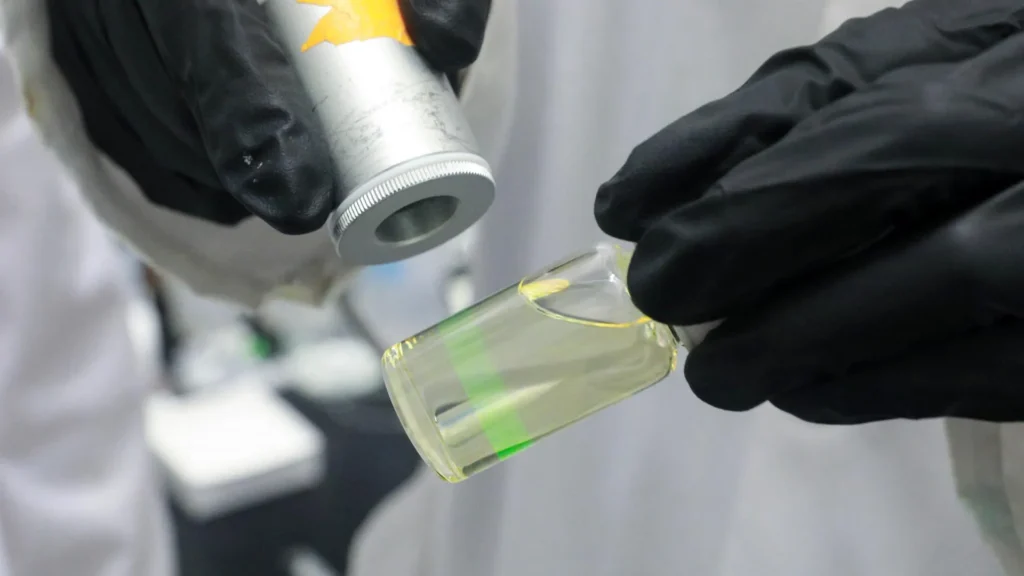
Engineers at the University of Toronto have achieved a significant breakthrough in chemical sensing technology, developing a novel dye-sensitized nanoparticle capable of detecting chemicals at exceptionally low concentrations while also precisely differentiating between molecules that are structurally almost identical. This innovation, detailed in a recent publication in the Journal of the American Chemical Society, holds profound implications for pharmaceutical manufacturing, environmental monitoring, and potentially various other fields requiring high-fidelity chemical analysis.
The core of this new technology lies in tiny particles that generate a distinctive light signal upon binding to their target chemical. What sets these nanoparticles apart is their unusual ability to absorb low-energy photons, typically in the near-infrared spectrum, and convert this energy into higher-energy photons, emitting a bright, measurable optical signal in the visible light range, specifically green light. This process, known as upconversion, offers a crucial advantage over conventional detection methods.
Revolutionizing Chemical Sensing: The Power of Upconversion
For decades, chemists and engineers have relied on organic molecules called fluorophores to detect substances by converting absorbed light into colorful emissions. However, as Professor Kai Huang, the senior author of the paper, explains, this process conventionally works in one direction: "With fluorophores, the excitation frequency has to be higher than the emission frequency, which means that they convert high-energy photons into low-energy photons." This fundamental limitation often means that the signal produced by the fluorophore can be obscured by background fluorescence, or "autofluorescence," naturally emitted by the sample itself when excited by high-energy light.
The University of Toronto team’s dye-sensitized nanoparticles overcome this hurdle through upconversion. They absorb lower-energy photons, such as those from readily available and low-cost near-infrared (NIR) lasers, and re-emit them as higher-energy photons in the visible spectrum. "What makes our dye-sensitized nanoparticles special is that they are capable of upconversion, meaning that they can absorb light in the form of low-energy photons and emit higher-energy ones," Huang elaborates. "For example, you could excite them with near-infrared light, which can easily be produced with low-cost lasers, and they would glow bright green in response."
This distinct separation between the excitation light and the emitted signal provides a "zero-autofluorescence background." Professor Huang likens this effect to stargazing: "It’s like the difference between stargazing at night versus the daytime. The stars shine the same brightness all the time, but during the day the sun is so powerful that it overwhelms them. Shifting the excitation frequency lower produces zero-autofluorescence background in the samples you are analyzing, while the luminescent nanoprobes keep shining; it is like turning off the sun, so you can see the stars better." This ability to effectively "turn off the sun" dramatically enhances the signal-to-noise ratio, making it possible to detect minuscule amounts of target chemicals with unprecedented clarity.
The Underlying Science: Lanthanides and Energy Transfer
The upconversion mechanism within these nanoparticles is facilitated by specific elements from the lanthanide family: ytterbium (Yb) and erbium (Er) ions. These rare earth elements are renowned for their unique electronic configurations, which allow for efficient light absorption and emission properties. In the earlier iterations of these sensing nanoparticles, ytterbium and erbium ions were embedded within a host material, typically composed of sodium, yttrium, and fluorine, forming flat hexagonal structures. The nanoparticles were then coated with organic dye molecules, akin to "chocolate chips embedded in a cookie" with "icing" on top, as the researchers describe.
When near-infrared light strikes the nanoparticles, the organic dyes on the surface first capture the incoming energy. This energy is then efficiently transferred to the ytterbium ions, which act as an intermediate relay. The ytterbium ions, in turn, pass this accumulated energy to the erbium ions. It is the erbium ions that perform the crucial upconversion step, releasing the stored energy as visible green light. This multi-step energy transfer process is a delicate balance, and optimizing it for brightness and efficiency has been a significant challenge in the field of upconversion nanotechnology.
Overcoming the Brightness Bottleneck: The Back-Energy Transfer Problem
Historically, a major hurdle in enhancing the brightness of these upconversion nanoparticles has been the phenomenon known as "back-energy transfer." As Jiaze Wu, a PhD student in Huang’s lab and the lead author of the new paper, explains, "if you pack the ytterbium atoms in too densely, they start to absorb not only the energy coming in, but also the energy coming out." This means that the energy destined to be emitted as green light by the erbium ions could be reabsorbed by the densely packed ytterbium ions, effectively bouncing back to the relay and preventing it from reaching the surface to be detected. This parasitic energy transfer severely limited the overall brightness and, consequently, the sensitivity of the nanoparticles.
To overcome this fundamental limitation, Wu, Huang, and their collaborators embarked on a radical redesign of both the chemical composition and the structural architecture of the nanoparticles. Instead of the conventional sodium, yttrium, and fluorine host matrix, they engineered a novel matrix using lithium, lutetium, and fluorine. More profoundly, they transformed the flat hexagonal structures into more intricate, three-dimensional, diamond-shaped particles. These new particles boast a sophisticated core-shell-shell architecture, featuring a dense core enveloped by an inner shell, which is then further surrounded by an outer shell.
A Novel Architecture: The One-Way Energy Tunnel
The ingenuity of this layered design lies in the precise gradient of ytterbium ion concentration across the different regions. "We were able to create a nice gradient: the concentration of embedded ytterbium ions gets denser as you go through each layer, with the core being the most dense," Wu explains. This meticulously engineered gradient ensures that the light energy flows almost exclusively in one direction – inward toward the erbium ions – effectively creating a "one-way energy tunnel." This innovative arrangement allows for a much higher packing density of ytterbium ions without incurring the detrimental effects of back-energy transfer, thereby maximizing the energy transfer efficiency to the erbium ions for upconversion.
Crucially, this breakthrough was not achieved through empirical trial and error alone. The research team extensively leveraged advanced computational modeling techniques to guide their design process. Undergraduate student Weixiang Ben, who spearheaded the computational work, highlights the pivotal role of these simulations: "We used Monte Carlo simulations and density functional theory to simulate how the energy would interact between different parts of the nanoparticle, right down to the atomic or even subatomic level." By simulating dozens of possible chemical formulations and particle shapes, the researchers could predict and optimize the most promising versions before embarking on their synthesis in the laboratory. "That’s how we showed that this core-shell-shell structure could actually function as a one-directional energy tunnel for incoming light," Ben adds, underscoring the power of combining theoretical prediction with experimental validation.
Unprecedented Brightness and Sensitivity: A New Benchmark
The result of this meticulous design and optimization is a dramatic improvement in performance. The newly developed nanoparticles produce a far stronger optical signal than any previous designs. According to Wu, their emitted light is approximately 150 times brighter than that of upconversion nanoparticles that have not been dye-sensitized. Furthermore, under identical excitation conditions, they are about 50 times brighter than some of the most highly optimized conventional upconversion nanoparticle structures previously reported in scientific literature.
This unprecedented brightness directly translates into significantly enhanced sensitivity. The ability of each nanoparticle to generate such a potent optical signal means that even an extremely small number of particles, when attached to their target molecules, can produce enough light to be readily detected. This leap in sensitivity is critical for applications where the target analytes are present in trace amounts, often below the detection limits of traditional methods.
Precision Detection: Distinguishing Structural Isomers
Beyond sheer sensitivity, these novel nanoparticles exhibit another remarkable capability: the ability to distinguish between structural isomers. Structural isomers are molecules that possess precisely the same types and numbers of atoms but differ in their spatial arrangement. These subtle structural variations, while seemingly minor, can have profound implications in chemistry, particularly in pharmaceutical development and manufacturing. For instance, one isomer of a drug might be therapeutically active, while another could be inert, or worse, toxic. The tragic case of thalidomide, where one enantiomer (a type of isomer) was a sedative and the other a potent teratogen, serves as a stark historical reminder of the critical importance of isomer distinction.
"Let’s say you’re making a drug molecule, and your manufacturing process works fine, except that 10% of the batch is the wrong structural isomer," illustrates Wu. "That’s a huge problem: it can make the drug less effective, or worse, lead to side effects that you definitely don’t want." Current methods for detecting such impurities, like high-performance liquid chromatography (HPLC) or mass spectrometry, often require expensive analytical tests and specialized equipment. The new nanoparticles offer a potentially revolutionary alternative, allowing for isomer detection using "low-cost lasers and a very small sample," thereby streamlining quality control processes and significantly reducing costs in drug manufacturing.
Broadening Horizons: Impact and Implications
The combination of ultra-high sensitivity and exceptional molecular selectivity positions this technology as a game-changer across various sectors. In pharmaceutical manufacturing, it could revolutionize quality control, ensuring drug purity and efficacy by rapidly identifying unwanted isomers or impurities that are difficult or expensive to detect with conventional methods. This could accelerate drug development, reduce manufacturing costs, and enhance patient safety.
In environmental monitoring, the nanoparticles could be deployed to detect extremely low concentrations of chemical pollutants, pesticides, or industrial contaminants in groundwater, soil, and air samples. The ability to detect trace amounts of pollutants in large volumes of water, for example, is crucial for early warning systems and effective environmental remediation strategies. Current methods often involve extensive sample preparation and costly laboratory analyses, which could be simplified and made more accessible by this technology.
Looking ahead, the same fundamental approach could be adapted for biomedical diagnostics. The use of near-infrared excitation light, which penetrates biological tissues more deeply and causes less autofluorescence than visible light, makes these nanoparticles ideal candidates for in vivo imaging and sensing. They could potentially be used for early disease detection, targeted drug delivery, or monitoring therapeutic responses by precisely identifying biomarkers at the cellular or molecular level. Their high sensitivity could allow for the detection of disease markers long before symptoms appear, paving the way for more effective and timely medical interventions.
The Road Ahead: From Proof-of-Concept to Commercialization
While the scientific breakthrough is undeniable, the technology is currently at the proof-of-concept stage. For these nanoparticles to be widely adopted and integrated into industrial and clinical applications, a practical and scalable method for their large-quantity manufacturing needs to be developed. This is a common challenge for many nanotechnology innovations, as scaling up laboratory-based synthesis often presents complex engineering and economic hurdles.
However, Professor Huang expresses optimism regarding the commercial viability of their discovery. "We’re working on this already, in fact. We think it’s feasible, but it requires a very long roadmap," he states, indicating that the team is already actively engaged in addressing the manufacturing challenges. "In the meantime, this model serves as proof-of-concept; with this technique, we can produce a very high-performance upconversion nanoparticle that could be customized to any molecule you might want to detect. That’s something entirely new."
This flexibility in customization is a key aspect, suggesting that the core technology can be adapted to a diverse array of target molecules, making it a versatile platform for future sensing applications. The development represents not just an incremental improvement but a fundamental advancement in the toolkit available for chemical detection, promising to unlock new possibilities in various scientific and industrial domains where precision, sensitivity, and cost-effectiveness are paramount. As research progresses, these "one-way energy tunnel" nanoparticles could soon illuminate the hidden chemical landscapes of our world, from the purity of our medicines to the cleanliness of our environment.