A groundbreaking study published in the journal Science Advances has provided a definitive answer to a question that has puzzled the scientific community for over a decade: how does water behave when it is compressed into spaces only a few molecules wide? By utilizing advanced machine learning simulations and quantum mechanical modeling, a team of researchers from the University of Cambridge and the Cavendish Laboratory has demonstrated that the perceived changes in water’s chemical reactivity under nanoconfinement are not an inherent property of the confinement itself, but rather a consequence of extreme internal pressures and specific surface interactions. This discovery reconciles years of conflicting experimental data and provides a new blueprint for engineering nanoscale chemical environments for applications in green energy, medicine, and industrial catalysis.
The Nanoscale Water Paradox
Water is perhaps the most scrutinized substance on Earth, yet its behavior at the scale of billionths of a meter—the nanoscale—has remained a subject of intense debate. In nature, water is frequently found in confined environments, such as the narrow pores of soil, the interior of biological cells, and the microscopic channels of ion-selective membranes. In technology, nanoconfined water is central to the operation of fuel cells, desalination plants, and advanced battery systems.
For years, researchers have observed that water trapped in these tiny spaces exhibits properties vastly different from "bulk" water found in a glass or a lake. Some experiments suggested that nanoconfined water becomes significantly more acidic or reactive, while others found the opposite or no change at all. These contradictions created a "nanoscale paradox" that hindered the development of technologies relying on nanofluidics.
The core of the mystery lies in the process of water dissociation, or "water splitting." In its liquid state, water molecules (H2O) occasionally split into two charged particles: the hydronium ion (H3O+) and the hydroxide ion (OH-). This fundamental reaction determines the pH of a solution and dictates the speed and efficiency of countless chemical processes. Understanding whether confinement accelerates or slows this splitting is essential for predicting how water will behave in everything from a lithium-ion battery to a human kidney.
A Decades-Long Scientific Conflict Resolved
The newly published research, led by Xavier R. Advincula, identifies the source of the decade-long confusion in the scientific literature. According to the study, previous researchers were often comparing "apples to oranges" without realizing it.
"The contradictions in the literature were largely because scientists were comparing systems at different effective pressures or densities without realizing it," Advincula explained. When the research team used machine learning to simulate water under perfectly equivalent thermodynamic conditions—specifically at the same chemical potential—they found that the "confinement effect" largely evaporated.
Chemical potential is a thermodynamic quantity that determines the direction of a chemical reaction. The team discovered that when this factor and the density of the water molecules are held constant, the act of simply being in a small space does not change how water splits. The perceived changes in reactivity reported in earlier studies were actually the result of unintended variations in pressure and density caused by the specific way the water was confined.
The Role of Machine Learning and Quantum Simulation
To reach these conclusions, the researchers had to overcome a massive computational hurdle. Traditional quantum mechanical simulations are highly accurate but require immense computing power, limiting them to studying very small numbers of atoms over extremely short timeframes. Conversely, traditional classical simulations can handle larger systems but lack the "chemical accuracy" needed to model the breaking and forming of molecular bonds.
The team bridged this gap using machine learning. By training a machine learning model on quantum mechanical data, they were able to create a simulation that maintained quantum-level accuracy while being fast enough to explore a wide range of pressures, temperatures, and confinement materials.
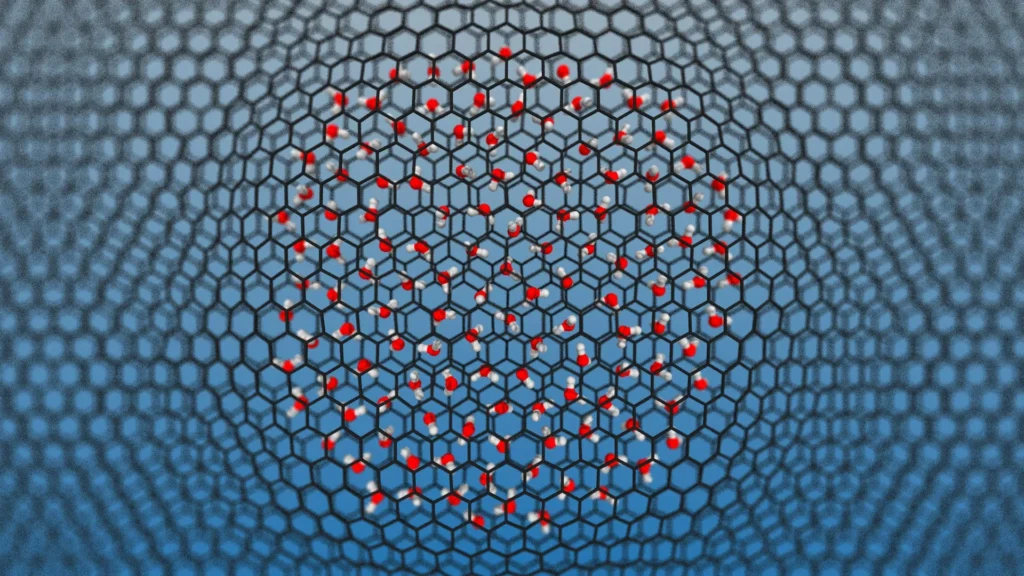
The study focused on water trapped between two-dimensional (2D) materials: graphene and hexagonal boron nitride (hBN). These materials are only one atom thick, making them the ideal "walls" for creating the world’s narrowest water channels. While graphene and hBN look identical in structure—both resemble a honeycomb lattice—their chemical properties are distinct. Graphene is composed of carbon and is chemically inert, while hBN is composed of boron and nitrogen and is polar, meaning it has a slight electrical charge across its surface.
Gigapascal Pressures: The Hidden Force
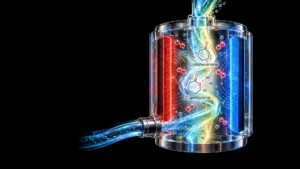
One of the most striking findings of the study is the sheer magnitude of the pressure generated within these nanoconfined spaces. The simulations revealed that water droplets trapped between sheets of graphene or hBN experience internal pressures reaching several gigapascals (GPa).
To put this in perspective, one gigapascal is roughly 10,000 times the atmospheric pressure at sea level. Such pressures are typically found only deep within the Earth’s mantle or at the bottom of the deepest ocean trenches. Remarkably, these pressures occur naturally in the lab without the application of any external force.
The phenomenon is driven by van der Waals forces—the weak attractive forces that exist between all atoms. While these forces are negligible in everyday life, they become incredibly powerful when two large, flat surfaces like graphene sheets are placed in close proximity. The sheets are pulled together with such intensity that they "squeeze" the water trapped between them.
The researchers found that it is this intense pressure, rather than the confinement itself, that drives the increased splitting of water molecules. When they compared the confined water to bulk water subjected to the same gigapascal pressures, the chemical behavior was nearly identical. This suggests that the "magic" of the nanoscale is, in many ways, the magic of high-pressure physics.
Surface Chemistry: The Active Participant
While pressure explains much of the water’s behavior, the study also highlighted the critical role of the surrounding material. Not all "walls" are created equal.
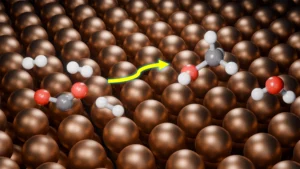
In the case of hexagonal boron nitride (hBN), the researchers observed a unique interaction. When water molecules split into hydronium and hydroxide ions, the hydroxide ions (OH-) tended to migrate to the edges of the hBN sheets and form chemical bonds with the material. This "stabilization" of the ions effectively lowered the energy barrier required for the water to split, leading to a much higher degree of dissociation than what was seen in graphene.
Graphene, being chemically inert, did not interact with the ions. Consequently, the water splitting in graphene-confined spaces was driven almost entirely by pressure, whereas in hBN, it was a combination of pressure and surface-driven chemical stabilization.
"This research provides a new framework for understanding water chemistry at the nanoscale," said Dr. Christoph Schran of the Cavendish Laboratory. "Rather than focusing solely on the size of pores or channels, we can tailor water reactivity by choosing a confining material whose surfaces interact with the products of water dissociation."
Chronology of Nanofluidic Discovery
To understand the weight of this discovery, it is necessary to look at the timeline of the field:
- 2004: The isolation of graphene opens the door to studying fluids in 2D environments.
- 2010-2015: Early experiments with "nanowater" produce wildly different results. Some labs report that water becomes more conductive (suggesting more ions), while others report no change.
- 2016-2020: Theoretical models struggle to explain why water density varies so much in small spaces. The term "nanoconfinement effect" becomes a catch-all for unexplained phenomena.
- 2021-2023: Advances in machine learning allow for more complex simulations of the water-solid interface.
- 2024: The University of Cambridge team identifies pressure and chemical potential as the "missing links" that unify the previous decade of research.
Implications for Energy and Sustainability
The ability to control the reactivity of water by manipulating pressure and surface chemistry has profound implications for the future of green technology.
1. Hydrogen Fuel Cells and Electrolyzers
Green hydrogen is produced by splitting water using electricity. If researchers can design membranes that naturally encourage water splitting through high-pressure confinement and surface interactions, the efficiency of hydrogen production could skyrocket, reducing the cost of clean fuel.
2. Next-Generation Batteries
Many batteries use aqueous (water-based) electrolytes. Understanding how water reacts when confined within the porous electrodes of a battery is vital for preventing degradation and improving energy density. This study provides the "design principles" needed to engineer better electrode-electrolyte interfaces.
3. Desalination and Water Purification
As global water scarcity increases, the demand for efficient desalination is growing. Most desalination membranes rely on nanoscopic pores to filter out salt. By understanding how the surface chemistry of these pores affects water’s ion balance, engineers can create membranes that are more durable and less prone to "scaling" (the buildup of minerals).
4. Biological Modeling
The human body is full of nanoconfined water, from the channels in cell membranes (aquaporins) to the spaces between DNA strands. This study provides a more accurate model for how biochemical reactions occur in these tight spaces, potentially leading to breakthroughs in drug delivery and synthetic biology.
Future Research Directions
The team at the University of Cambridge is already looking toward the next phase of their research. While the current study used "perfect" sheets of graphene and hBN, real-world materials are often messy, containing defects, edges, and impurities.
"Next, we plan to study more realistic environments that include defects and edges commonly found in practical materials," the researchers stated. They also intend to use their machine learning framework to screen thousands of other 2D materials to see which combinations can most effectively "tune" water’s reactivity.
By moving beyond the simple idea of "confinement" and focusing on the interplay of thermodynamics and surface science, this research has turned a mysterious anomaly into a predictable tool for molecular engineering. The "simple" question of what happens to water when it is squeezed may finally have its answer, opening a new chapter in the history of chemical science.