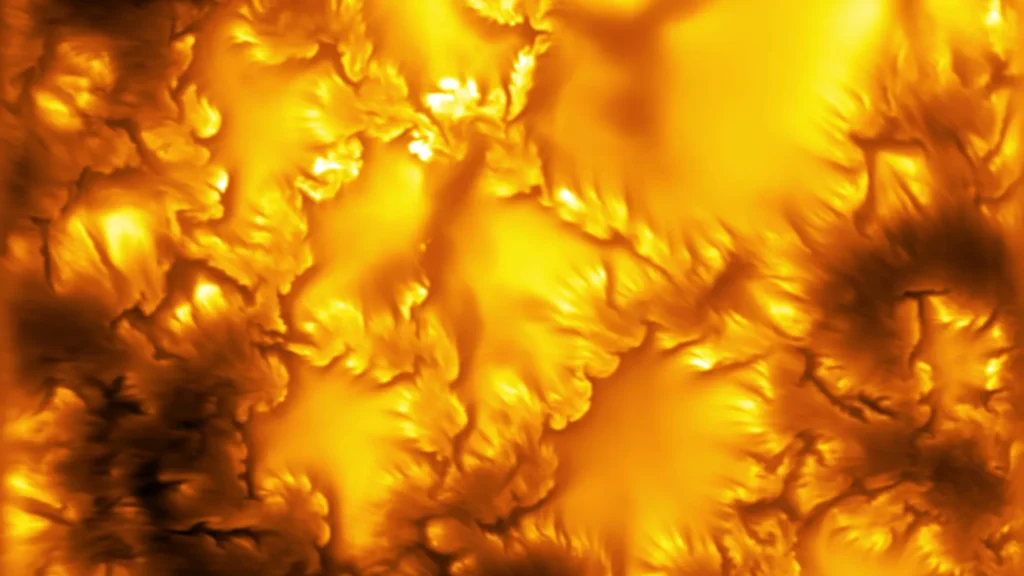
Scientists have captured previously unseen plasma vortices swirling across the surface of the Sun, revealing tiny structures that could help explain how our star stores, moves, and releases magnetic energy. This groundbreaking discovery, made possible by the world’s most powerful solar telescope and advanced computational simulations, offers a significant leap forward in our understanding of solar physics and the dynamic processes that shape our star.
The breakthrough originates from a collaborative effort involving researchers from the U.S. National Science Foundation National Solar Observatory (NSF NSO), the Max Planck Institute for Solar System Research (MPS) in Germany, and the High Altitude Observatory (HAO) in the USA. By combining unprecedented observational data from the NSF Daniel K. Inouye Solar Telescope (DKIST) with sophisticated computer models, the team has unveiled a previously hidden aspect of solar activity. The DKIST, located in Hawaii and operated by the NSO, provided imagery with extraordinary resolution, allowing for the visualization of plasma motions at scales never before achievable.
"To detect the vortices, we needed to resolve structures on the solar surface about 20 kilometers in size. That is at the limit of what even the world’s largest solar telescope and state-of-the-art simulations can achieve," stated Michiel van Noort, a scientist at MPS and co-author of the recent publication detailing these findings. His contribution extended beyond theoretical analysis, encompassing the acquisition of observational data and its meticulous reduction and restoration to reveal the elusive structures. The specialized broadband imaging camera provided by MPS was instrumental in capturing these fine details.
Tiny Whirlpools Along Solar Granules: A New Perspective on the Sun’s Surface
The newly identified vortices are observed along the boundaries of solar granules, which are the fundamental building blocks of the Sun’s visible surface. These granules, typically ranging from 500 to 2,000 kilometers in diameter, create the characteristic mottled appearance of the Sun, often likened to bubbles in a boiling liquid. This analogy is apt, as granulation is a direct consequence of the convective motion of plasma within the Sun. Hot plasma rises from deeper layers, cools as it approaches the surface, and then sinks back down, creating a continuous cycle of material exchange.
For the first time, scientists have been able to resolve exceptionally fine, fringe-like structures along the edges of these granules. These structures exhibit recurrent swirling motions, reminiscent of ocean waves just before they break. The scale of these observed "fringes" is astonishingly small, measuring only slightly more than 20 kilometers across. To put this into perspective, resolving such a feature on the Sun is akin to spotting a one-euro coin from a distance of 180 kilometers on Earth. This level of detail was previously unattainable, highlighting the immense capabilities of the DKIST.
Kelvin-Helmholtz Instabilities: The Driving Force Behind the Vortices
The research team posits that these swirling flows are a manifestation of Kelvin-Helmholtz instabilities, a well-understood phenomenon in fluid dynamics. These instabilities arise when two fluids, or layers of the same fluid, move past each other at different velocities. The resulting shear forces at the interface between these layers can amplify small disturbances, leading to the formation of waves and, ultimately, turbulent vortices.
The Kelvin-Helmholtz instability is a ubiquitous process observed across a vast range of scales and environments. It plays a role in phenomena as diverse as the formation of clouds in Earth’s atmosphere, the intricate patterns seen in the atmospheres of gas giants like Jupiter and Saturn, and the complex interactions between the solar wind and planetary magnetospheres. The presence of neighboring plasma layers within the Sun moving at different speeds along the granule boundaries creates the precise conditions necessary for these instabilities to develop.
The Magnetic Connection: How Vortices Twist the Sun’s Field
Perhaps the most significant implication of this discovery lies in its potential to shed light on how the Sun stores and releases magnetic energy. This energy conversion is responsible for a wide array of solar phenomena, including solar flares and the more subtle but still potent nanoflares – tiny bursts of radiation previously not fully understood.
Current scientific models suggest that magnetic energy accumulates within the Sun as its magnetic field lines become increasingly twisted and coiled, much like the potential energy stored in a wound-up spring. As this coiling intensifies, the magnetic configuration becomes both highly energetic and inherently unstable. Eventually, this stored energy is unleashed through a process known as magnetic reconnection, where twisted field lines snap and reconfigure into a simpler, lower-energy state.
A long-standing puzzle in solar physics has been the precise mechanism by which the Sun’s magnetic field lines become so intricately twisted in the first place. The newly observed plasma vortices offer a compelling answer. Researchers have found that these small whirlpools form continuously wherever the magnetic field is sufficiently strong at the solar surface. This suggests that these vortices could provide a persistent and ubiquitous mechanism for actively twisting and contorting the Sun’s magnetic field lines.
Implications for the Sun’s Magnetic Cycle and Beyond
The analysis of these mini-vortices also reveals their remarkable efficiency in mixing magnetized and non-magnetized plasma at the solar surface. This vigorous mixing process could play a crucial role in transporting magnetic fields from the Sun’s surface upward into its atmosphere. Such transport is vital for understanding the Sun’s approximately eleven-year magnetic activity cycle, a relatively rapid phenomenon on cosmic timescales. For the Sun’s complex magnetic "framework" to undergo such rapid transformations, magnetic flux must be efficiently transported away from the surface through the solar atmosphere.
Existing models have struggled to fully account for the speed at which this magnetic diffusion appears to occur. The newly identified vortices, with their ability to stir and transport plasma, could represent a significant missing piece of this puzzle, offering a plausible explanation for the rapid evolution of the Sun’s magnetic field.
Sami K. Solanki, Director of the MPS and another co-author of the publication, emphasized the profound significance of these microscopic processes. "The newly discovered plasma vortices impressively demonstrate how minute processes — at the limit of what we can resolve using all available techniques — significantly determine the nature of our star," Solanki remarked. This statement underscores the principle that understanding the largest and most energetic phenomena in the universe often requires a deep dive into the smallest, most subtle details.
A Timeline of Discovery and Future Research
The journey to this discovery began with the deployment of the NSF Daniel K. Inouye Solar Telescope, a project that has been years in the making. Construction and initial operational phases for DKIST were completed in the late 2010s, with full scientific operations commencing in the early 2020s. The telescope’s advanced instrumentation, including the broadband imaging camera from MPS, was specifically designed to push the boundaries of solar observation.
The period leading up to this publication involved extensive data acquisition from DKIST, followed by intensive computational analysis. Researchers meticulously processed and analyzed terabytes of observational data, comparing it with outputs from advanced magnetohydrodynamic (MHD) simulations of solar plasma. The confirmation of the vortices required a convergence of both observational evidence and theoretical modeling.
The research team, comprising experts in solar physics, plasma dynamics, and computational modeling from multiple institutions, convened to interpret the findings. The collaborative nature of the project, spanning international borders and disciplines, was crucial to its success. The publication of their findings in a peer-reviewed scientific journal marks a significant milestone, opening the door for further research and validation.
Broader Impact and Implications for Space Weather
The implications of understanding how the Sun stores and releases magnetic energy extend far beyond academic curiosity. The Sun’s activity, driven by its magnetic field, directly impacts Earth and the wider solar system. Powerful solar flares and coronal mass ejections (CMEs) can unleash vast amounts of energy and charged particles that can disrupt satellite communications, GPS systems, and power grids. Understanding the fundamental processes that lead to these events is crucial for improving space weather forecasting and mitigating their potential consequences.
The discovery of these plasma vortices offers a new avenue for studying the precursors to such energetic events. By observing the formation and behavior of these vortices, scientists may be able to identify patterns that precede more significant magnetic activity. This could lead to more accurate and timely warnings for potential space weather disruptions.
Furthermore, this research contributes to our fundamental understanding of stars in general. The Sun serves as our closest laboratory for studying stellar physics, and the processes observed on its surface are likely replicated on countless other stars throughout the galaxy. Therefore, insights gained from solar research have broad implications for astrophysics and our understanding of planetary habitability.
Future Directions and Unanswered Questions
While this discovery represents a significant leap forward, many questions remain. Scientists are eager to understand the precise relationship between the strength of the magnetic field and the formation of these vortices. They also aim to quantify the rate at which these vortices contribute to magnetic field twisting and transport. Future research will likely involve more targeted observations of these vortex-rich regions, coupled with even more sophisticated simulations that can capture the complex interplay of plasma dynamics and magnetic fields at these incredibly small scales.
The ongoing work at the Daniel K. Inouye Solar Telescope and other solar observatories worldwide will undoubtedly build upon this foundational discovery. As technology continues to advance, allowing for ever-higher resolution and more comprehensive data collection, our understanding of the Sun’s enigmatic magnetic engine will continue to deepen, revealing more about the star that sustains life on Earth and governs our solar system. The capture of these unseen plasma vortices is not an end, but a powerful new beginning in the quest to unravel the Sun’s most profound mysteries.