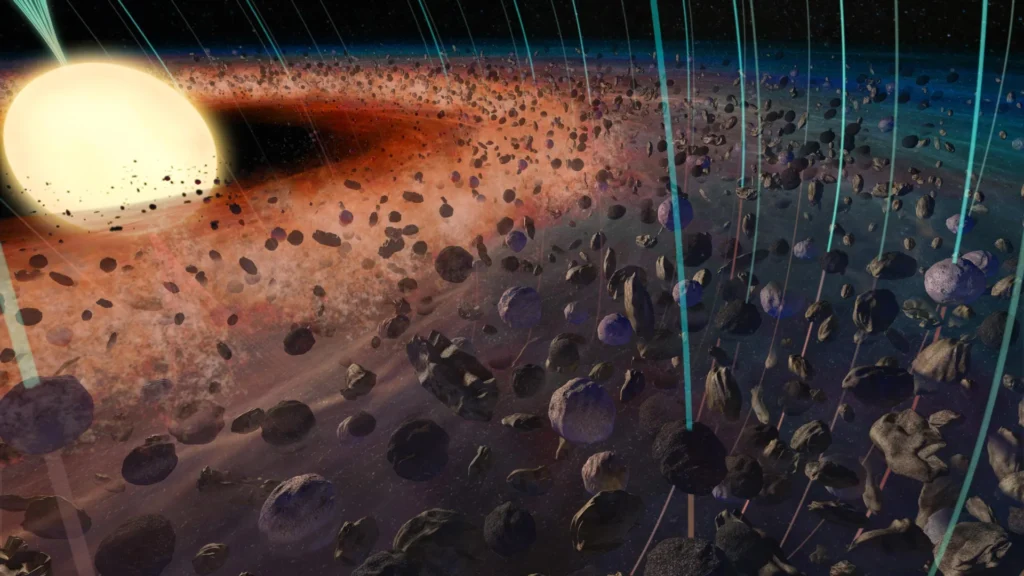
Approximately 4.6 billion years ago, the nascent solar system was an unimaginably vast expanse of gas and dust, a swirling cosmic cloud known as the solar nebula. Over the subsequent eons, this primordial entity underwent a profound metamorphosis. Driven by fundamental physical forces, the cloud began to collapse, its form transitioning from a diffuse sphere to a flattened, rotating disk. At the heart of this cosmic crucible, the sun ignited, and around it, the planets began their arduous journey of formation. While gravity has long been universally accepted as the primary sculptor of this grand transformation, groundbreaking new research from the Massachusetts Institute of Technology (MIT) is compelling scientists to reconsider the role of another powerful, yet previously underestimated, force: magnetism.
The study, published in the prestigious journal Proceedings of the National Academy of Sciences, presents compelling evidence suggesting that ancient magnetic fields were not merely passive bystanders but active participants in the very earliest stages of solar system evolution. By meticulously analyzing some of the oldest known extraterrestrial materials, researchers have unearthed signatures that point to the presence of robust magnetic fields during the crucial solar nebula phase. This discovery has the potential to reshape our understanding of how stars and planets come into being, pushing the timeline of magnetic influence further back than previously hypothesized.
The Ancient Witnesses: Meteorites as Cosmic Time Capsules
The linchpin of this transformative research lies in the examination of a remarkable meteorite, designated DOM 08006, discovered in the frigid, pristine environment of Antarctica’s Dominion Range in 2008. This meteorite is not just any space rock; it is an exceptionally well-preserved artifact from the dawn of our solar system. Within its matrix are microscopic grains known as calcium-aluminum-rich inclusions, or CAIs. These CAIs are veritable time capsules, forming within the first 200,000 years of the solar system’s existence – making them the oldest known solid materials we have access to. Their primitive composition has allowed them to retain an extraordinary fidelity to the conditions present at the very genesis of our cosmic neighborhood.
"Other meteorites went through many different processes over this 4.5 billion year history," explains Benjamin Weiss, the Robert R. Shrock Professor of Earth and Planetary Sciences at MIT and a senior author on the study. "They were formed in the solar nebula, then added to bodies with water, then got destroyed, moved to the asteroid belt, and then landed here. But somehow, DOM has experienced less alteration than any other meteorite." This exceptional state of preservation is critical, as it means the magnetic imprints within these CAIs are more likely to be a direct record of the ancient solar nebula, rather than being obscured by later geological or chemical processes.
Unlocking the Magnetic Secrets Within CAIs
The research team, led by Cauê Borlina, a former MIT graduate student who is now an assistant professor at Purdue University, focused their investigation on these ancient CAIs. The hypothesis was that if a magnetic field existed during the solar nebula stage, it would have influenced the formation of magnetic minerals within these CAIs. As these minerals condensed and solidified, they would have acted like tiny compasses, aligning themselves with the ambient magnetic field and locking in a record of its strength and direction. This "remanent magnetization" could then be detected billions of years later.
The process involved carefully separating minute mineral grains from small fragments of the DOM 08006 meteorite. The researchers then employed sophisticated techniques to identify CAIs containing naturally magnetic minerals, such as iron-bearing compounds. The subsequent analysis involved a series of delicate tests designed to determine if these minerals still held the faint whispers of an ancient magnetic field.
A Magnetic Field Stronger Than Earth’s: Quantifying the Cosmic Dynamo
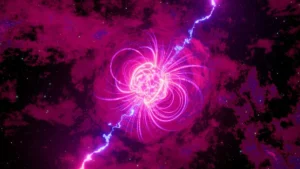
The results were nothing short of astonishing. The team detected clear traces of a magnetic field recorded within the mineral grains of the CAIs. From these measurements, they were able to estimate the strength of this primordial magnetic field. Their findings suggest a field ranging from approximately 150 to 600 microteslas. To put this into perspective, Earth’s magnetic field today measures around 50 microteslas. This means the magnetic field present during the solar nebula stage was likely three to twelve times stronger than the protective magnetic shield that envelops our planet today.
"This transition, from a spherical cloud to a protoplanetary disk, is one of the most significant events in all of solar system history," states Professor Weiss. "It has long been theorized that gravity caused this, but our measurements show magnetism likely played a role."
The Mechanics of Early Solar Magnetism
The very existence of such a potent magnetic field in the early solar system raises questions about its origin. Scientists theorize that magnetic fields are generated by the movement of electrically charged matter, a phenomenon known as a dynamo. In the context of the solar nebula, the collapsing cloud of gas and dust would have been a plasma, a state of matter containing a high density of charged particles. As these charged particles circulated and churned within the evolving disk, they could have generated and sustained a powerful magnetic field.
"Magnetic fields arise when electrically charged matter moves," explains the study. "During the earliest stage of solar system formation, the collapsing cloud of gas and dust may have generated a plasma containing charged particles. As those particles circulated through the developing disk, they could have created and maintained a magnetic field."
Beyond Gravity: Magnetism’s Role in Accretion and Disk Dynamics
The implications of this discovery are far-reaching, particularly concerning the dynamics of the protoplanetary disk. While gravity is the dominant force responsible for pulling matter together, its effectiveness can be modulated by other forces. A strong magnetic field, like the one identified by the MIT team, could have significantly influenced the movement of gas and dust within the disk.
"We think these kinds of magnetic fields were helping to move gas from the protoplanetary disk, in toward this central star, the sun," elaborates Dr. Borlina. "Gravity is also playing a role. But we are now showing that, if you want to fully understand how the sun and planets formed, you should include magnetic fields in the ingredients that make them."
Specifically, magnetic fields can create structures within the disk, such as magnetic ropes or channels, that can efficiently transport material inwards. This inward migration of gas and dust is crucial for feeding the growing protostar at the center and for providing the raw materials from which planets accrete. Without this magnetic assistance, the process of disk clearing and star formation might have been significantly slower or followed a different pathway.
A Deeper Dive into the Early Solar System Timeline
This latest research builds upon previous work that had already hinted at the importance of magnetism in planetary formation. Earlier studies, for instance, had found evidence of magnetic fields existing approximately 2 million years after the solar system’s formation. By that point, the sun was largely formed, and planets were beginning to coalesce. These earlier findings suggested that magnetic fields may have played a role in the accretion processes that built planets.
However, the current study pushes the timeline back considerably, investigating the period before planets had begun to form, when the solar nebula was still in its nascent, disk-like configuration. This is a period where the role of magnetism has been a subject of ongoing debate among planetary scientists.
"Nowadays people don’t debate whether magnetism is present when planets are forming. But the debate is around the very early solar system, before planets are forming, when there’s just a disk," notes Dr. Borlina. "That’s where the debate still resides, and that’s where we’re operating now." By providing direct evidence from the earliest stages, this research significantly strengthens the case for magnetism as a fundamental architect of the solar system from its very inception.
Broader Implications for Planetary Science and Astrobiology
The confirmation of a strong magnetic field in the early solar nebula has profound implications for our understanding of planetary evolution and the potential for life beyond Earth.
1. Planet Formation Efficiency: The enhanced inward transport of material facilitated by magnetic fields could explain the rapid formation of gas giants like Jupiter and Saturn. These massive planets are thought to have formed relatively quickly, and magnetic fields could have provided the necessary mechanism for delivering sufficient gas to their growing cores.
2. Early Planetary Atmospheres and Magnetic Fields: The presence of a strong solar nebula magnetic field could also have influenced the development of early planetary atmospheres. As planets began to form, they might have been shielded from the harsh solar wind by this larger, enveloping field, allowing their nascent atmospheres to persist and evolve. Furthermore, the dynamo mechanisms that generated the solar nebula field might have laid the groundwork for the generation of magnetic fields within the planets themselves, a crucial factor for habitability on terrestrial worlds.
3. Understanding Exoplanet Systems: The findings from our own solar system have direct relevance to the study of exoplanets. If magnetism played such a crucial role here, it is highly probable that similar processes are at play in the formation of other planetary systems. This research provides a new framework for interpreting observations of protoplanetary disks around other stars and for understanding the diversity of exoplanet architectures we observe.
4. The Search for Extraterrestrial Life: Magnetic fields play a vital role in shielding planets from harmful cosmic radiation. A strong magnetic field in the early solar system would have provided a more stable environment for the emergence and evolution of life. Understanding the conditions under which such fields arise and persist is therefore crucial for identifying potentially habitable exoplanets.
Future Directions and Ongoing Research
The MIT team’s findings open up exciting avenues for future research. Scientists will likely seek to refine the measurements of the early solar system’s magnetic field strength and its temporal evolution. Further analysis of other primitive meteorites, as well as samples from the Moon and potentially future asteroid sample return missions, could provide corroborating evidence and a more detailed picture of magnetic field behavior throughout solar system history.
The collaborative effort involved researchers from various institutions, including Tsinghua University, Cambridge University, Caltech, and the University of California at Los Angeles, highlighting the international nature of cutting-edge astronomical research. This interdisciplinary approach, combining expertise in paleomagnetism, geochemistry, and astrophysics, is essential for tackling complex questions about the origins of our universe.
The research was supported, in part, by NASA, underscoring the agency’s commitment to unraveling the mysteries of our solar system and beyond. As our understanding deepens, it becomes increasingly clear that the story of our solar system’s birth is not solely a tale of gravitational collapse, but a complex interplay of forces, where magnetism emerges as a powerful, albeit subtle, orchestrator of cosmic creation. This new evidence compels us to look at the familiar narrative of our origins with fresh eyes, recognizing the invisible threads of magnetism that may have woven the very fabric of our planetary home.