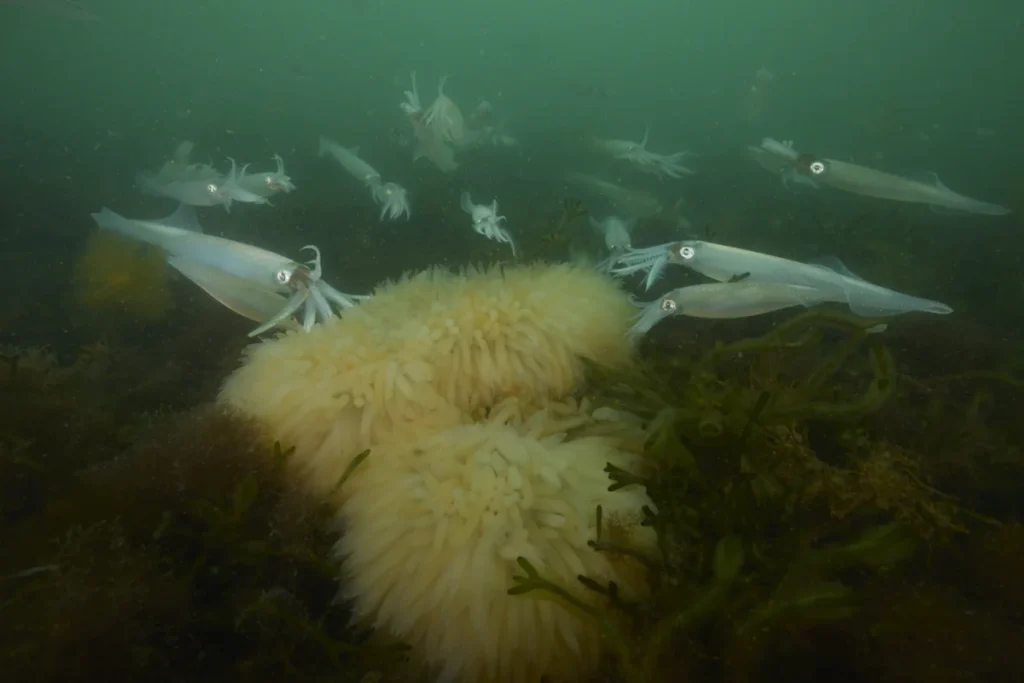
For centuries, the depths off New England’s coast have been a canvas for maritime imagination, painted with tales of mysterious tentacled creatures and sensational reports of giant squid captivating the North Atlantic in the 1800s. Today, attention turns to a more familiar, yet equally enigmatic, resident: the longfin inshore squid (Doryteuthis pealeii), affectionately known as the "Boston squid." This species has long been a cornerstone of the regional commercial fisheries, thriving in the emerald-green, turbid, and nutrient-rich waters characteristic of Massachusetts’ coastal shelf, where visibility is often limited.
A Visual Quest in Murky Waters
Capturing the essence of these swift cephalopods in their natural habitat presents a formidable challenge, even for seasoned underwater photographers. Keith Ellenbogen, an acclaimed underwater photographer and MIT Sea Grant resident artist, is intimately familiar with these waters. Despite years of diving in conditions where visibility might rarely exceed 20 feet, Ellenbogen found these elusive squid consistently evading his lens. His quest to document their life cycle, particularly the rarely witnessed spawning aggregations, underscores the inherent difficulty in observing a species that thrives in low-visibility environments and exhibits rapid, dynamic behaviors. His sustained efforts, culminating in a remarkable breakthrough in 2024, highlight the dedication required to bridge the gap between scientific understanding and public awareness of these vital marine organisms.
Commercial Significance and Volatile Populations
The economic footprint of the longfin inshore squid in Massachusetts is substantial and enduring. In 2023, the commercial landings of longfin squid in the state reached an impressive 2.85 million pounds, translating to an estimated 6 million individual squid and an economic value exceeding $2.82 million. This consistently places the species among the top 10 commercially landed species in Massachusetts, alongside iconic seafood staples such as the American lobster, Atlantic surf clam, and sea scallop. This consistent high ranking underscores its critical role in supporting the state’s vibrant seafood industry and the livelihoods of countless fishermen.
However, the year 2024 presented a stark contrast to this robust performance. Landings plummeted to under 750,000 pounds, representing roughly a quarter of the previous year’s catch. This dramatic decline was corroborated by the spring 2024 trawl survey documented in the Massachusetts Division of Marine Fisheries Annual Report, which recorded a historic low in longfin squid biomass, following the record high observed in 2023. Such pronounced fluctuations are not uncommon for Doryteuthis pealeii, whose population dynamics are inherently unpredictable. Their brief lifespan, typically six to nine months, combined with a heightened sensitivity to shifting oceanographic conditions—including temperature, currents, and food availability—makes them particularly susceptible to rapid changes in abundance. This inherent volatility poses significant challenges for fisheries management and demands sophisticated scientific approaches to ensure sustainable harvesting.
Deepening Scientific Scrutiny
Recognizing the species’ ecological importance and economic value, the scientific community, particularly the National Oceanic and Atmospheric Administration (NOAA)’s Northeast Fisheries Science Center (NEFSC), has intensified its research efforts. Kimberly Hyde, a biological oceanographer with NEFSC, emphasizes the expansion of squid research over recent years. A notable initiative includes a comprehensive two-year study specifically on longfin squid, designed to unravel more about their complex life history, track their maturity stages, and predict their readiness to spawn.
Across the Northeast region, a collaborative spirit pervades the scientific and fishing communities. Through programs like the Longfin Squid Biological Sampling Program (SQUIBS), which involves fishermen in collecting biological data; Collaborative SQUid Size Monitoring (SQUISM), focused on gathering precise size information; and the highly interdisciplinary Squid-Squad, composed of scientists, industry members, and managers, a unified goal emerges: to significantly enhance the scientific understanding of squid. These collaborative efforts are crucial, acknowledging that much of this cephalopod’s life story remains largely concealed beneath the waves, hidden from direct observation.
The Elusive Spawning Grounds: A Photographer’s Triumph
For years, Keith Ellenbogen pursued the ultimate photographic prize: a squid spawning aggregation. The notoriously murky, emerald-green, nutrient-rich coastal waters of New England posed a constant impediment. Despite knowing he was directly above potential spawning grounds, locating a dense cluster of eggs and the congregating squid 30 to 40 feet below the surface was a monumental task.
In a concerted effort, Ellenbogen chartered a vessel and leveraged his network of local fishermen, who provided invaluable insights into areas of recent squid concentrations. His persistence finally paid off. Descending into the water off Cape Cod, the initial moments were familiar: an opaque green veil. "As I descended through the emerald-green waters of Cape Cod, I couldn’t see anything at first," Ellenbogen recounts. "I knew I was in the right area, but the seafloor seemed empty. Then I noticed a few faint shadows moving in the distance."
As he cautiously swam closer, the scene gradually materialized, revealing a spectacle of life and vibrant activity. "First came the squid, then the egg masses, and then hundreds more animals appearing out of the green water," Ellenbogen vividly describes. "Suddenly I found myself surrounded by squid flashing colors, courting, competing, and spawning. It felt like being in a theater, watching a carefully choreographed performance unfold all around me."
Dozens of squid hovered with intense focus, forming a living circle, their arms and tentacles extended towards a central point: a large, pale cluster of eggs firmly anchored to a bed of slipper shells and delicate, fingerlike seaweed. Thousands of gelatinous, translucent egg capsules swayed gently in the currents. With almost ceremonial precision, male and female pairs broke from the outer circle, darting inward to deposit and fertilize eggs. Their alien-like bodies pulsed and flickered with an astonishing array of colors—flares of rust-red, golden yellow, iridescent pink, and flashes of lightning white. It was a poignant culmination of their brief lives, a synchronized effort to perpetuate the next generation.
The Biology of a Rapid Life Cycle
Longfin squid exemplify a "live fast, die young" strategy, exhibiting remarkable exponential growth throughout their lifespan of less than one year. Their journey begins as planktonic hatchlings, known as paralarvae, emerging from their egg capsules as miniature, approximately 1.5-millimeter versions of their adult forms, already possessing fully formed chromatophore organs.
Though small, these juveniles are voracious, feasting on planktonic prey in coastal, surface waters. As they mature, they descend deeper into the water column, adopting a lifestyle closer to the seafloor. Natural-born ambush and pursuit predators, they employ jet propulsion and their ten grasping arms and tentacles to hunt small crustaceans, other invertebrates, and even smaller squid.
One of the most captivating aspects of squid biology, shared with octopuses, is their chromatophore organs. These pigmented cells, controlled by an intricate network of nerves and muscles via their central nervous system, allow for mesmerizing displays of iridescence and rapid color shifts. This color-changing ability serves multiple critical purposes: sophisticated camouflage to blend into diverse backgrounds, elaborate courtship rituals, and a complex visual language for communication. Adding an intriguing layer of complexity, squid themselves are effectively colorblind. Their eyes are exquisitely adapted to detect contrast, brightness, movement, and even polarization, but they do not perceive hues in the same way humans do, relying on variations in light intensity and patterns for their visual world.
According to a comprehensive report from the NEFSC, longfin squid can achieve sexual maturity at a mantle length of just 8 centimeters. As they approach adulthood, they undertake migrations offshore to overwinter in the deeper, warmer waters along the continental shelf. At night, they form large schools, typically grouped by body size, and ascend in the water column to feed. Their growth remains exceptionally rapid and is heavily temperature-dependent, with males generally growing faster and achieving larger sizes than females.
The Intricate Dance of Spawning
Longfin squid are continuous spawners, reproducing year-round, though with distinct seasonal and geographic peaks. In the cooler waters of New England, spawning activity is most frequently reported between May and August. The egg clusters, or "mops," like the one Ellenbogen documented, serve as vital hubs for this reproductive activity. As detailed by NOAA Fisheries, female squid lay fertilized egg capsules, each containing approximately 150 to 200 eggs, attaching them securely to the ocean bottom. Females typically return repeatedly to deposit multiple clutches of eggs over several weeks, with an average female laying a total of 3,000 to 6,000 eggs during her reproductive period.
Spawning often occurs in seasonal pulses, directly influenced by water temperature and other environmental conditions. These pulses can trigger the formation of large spawning aggregations—dense gatherings where the concentration of squid increases dramatically, leading to constant interaction and intense competition.
The reproductive biology and behavior of longfin squid are remarkably complex. The NEFSC report highlights several unique aspects, including the ability of females to store sperm from various spawning events for later use. This fascinating adaptation means that eggs within the same capsule, laid by a single female, can potentially be fertilized by sperm from multiple males and multiple spawning events, enhancing genetic diversity.
Male competition during spawning is fierce and highly strategic. "Consort males," typically the larger individuals, form a close pair with a single female, often guarding her diligently with their arms and using their superior size to deter rivals. In contrast, "sneaker males," smaller, unpaired squid, employ stealth and speed, attempting to dart in and transfer spermatophores (sperm bundles) to paired females. Males deposit these spermatophores either into the female’s mantle cavity or into a specialized pouch located near her head.
This intricate competition is guided by a sophisticated array of visual and chemical signals. Pheromones indicate reproductive readiness, while rapid and dramatic color and pattern changes, strategic arm postures, and elaborate whole-body displays convey intentions and status. A seminal 1999 paper published by the Marine Biological Laboratory meticulously cataloged 34 distinct visual displays, encompassing variations in colors, brightness, spots, stripes, iridescence, and polarization signals. Furthermore, 17 specific positions and movements were identified as integral to squid communication on the spawning grounds.
For instance, squid were observed flashing white as a clear signal to repel other squid, almost always when engaged in mate guarding, egg laying, or competitive confrontations. Intriguingly, female squid can display a dark patch on one side of their mantle, a behavior colloquially likened to blushing in humans. However, in squid, this "blush" functions as a deterrent to courting males. Despite the captivating nature of these colorful displays, much of squid communication remains an encrypted secret, even to the most dedicated scientists.
Broader Implications and Future Stewardship
"Keith’s rare glimpse of squid in their natural environment beautifully bridges art and science, reminding us that we still have much to learn," remarks Kimberly Hyde, whose research at NOAA focuses on marine ecosystems and fisheries management. For the general public, squid are often perceived merely as seafood or as the stuff of shadowy legends—chameleons of the deep. Yet, each spring, beneath the cool, often turbulent waters off Cape Cod, millions of longfin squid convene in this extraordinary reproductive event, a powerful testament to the rich biodiversity and immense productivity of Massachusetts’ marine ecosystems.
The work of organizations like MIT Sea Grant is crucial in supporting sustainable fisheries and fostering environmental education and stewardship of our invaluable coastal and ocean resources. As MIT Sea Grant’s resident artist, Keith Ellenbogen is engaged in a long-term project dedicated to documenting extraordinary species and pivotal ocean events unfolding just off our coast. His images reveal hidden moments that few ever have the opportunity to witness, transforming abstract scientific concepts into tangible, breathtaking visuals. The longfin inshore squid, as one of our region’s most economically and ecologically valuable marine resources, benefits immensely from these visual narratives, which illuminate one of the most remarkable, yet largely unseen, events occurring right off our shores. Continued research, collaborative initiatives, and evocative storytelling are essential to ensure the long-term health and understanding of these fascinating cephalopods and the vibrant marine ecosystems they inhabit.