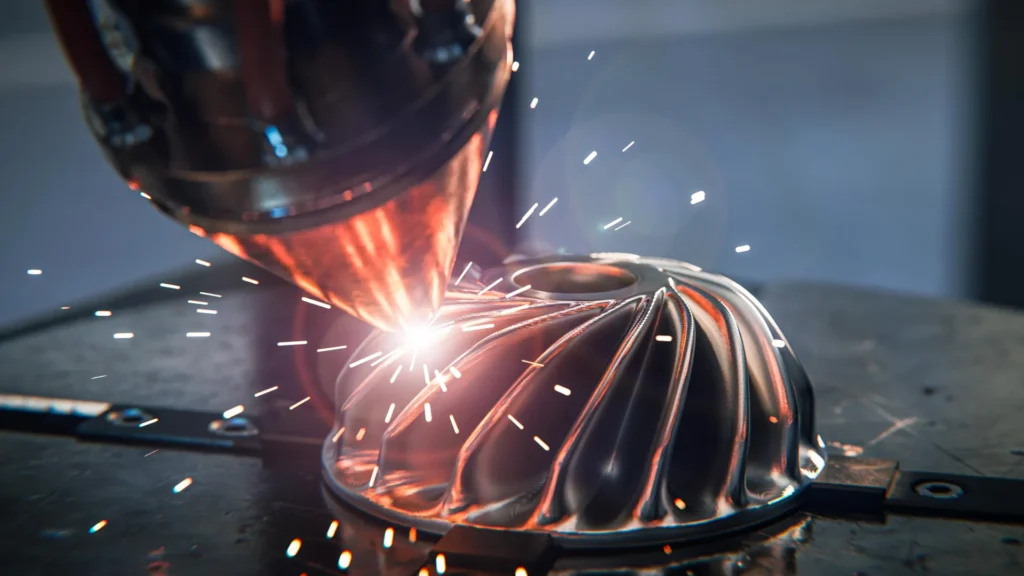
Washington State University (WSU) researchers have achieved a significant breakthrough in additive manufacturing, utilizing artificial intelligence (AI) to dramatically accelerate and reduce the cost of 3D printing a high-performance metal alloy. This innovation bypasses the need for exhaustive manual testing of over 100 million potential printing configurations, a feat that was previously considered impractical and prohibitively expensive. The developed AI strategy not only promises to democratize access to a critical alloy used in aerospace but also offers a powerful new paradigm for tackling complex scientific challenges across various industries.
This pioneering work, spearheaded by the WSU’s School of Electrical Engineering and Computer Science and the School of Mechanical and Materials Engineering, was recently published in the esteemed Proceedings of the AAAI Conference on Artificial Intelligence. The project’s impact was further recognized with the Innovative Deployed Application Award at the organization’s annual conference, highlighting its real-world applicability and transformative potential.
"Ninety percent of commercial printers cannot print this metal alloy," stated Jana Doppa, the Huie-Rogers Endowed Chair Professor of Computer Science and Berry Distinguished Professor in Engineering, who led the research. "Given that we were able to find these feasible process parameters, it allows us to use those commercial printers, and we are essentially democratizing the printing of this alloy." This statement underscores the critical barrier the research has overcome: making advanced materials accessible to a wider range of printing technologies and institutions.
The Challenge: A NASA Alloy Built for Extreme Environments
The focus of this research is GRCop-42, a specialized alloy meticulously developed by NASA. Composed of copper, chromium, and niobium, GRCop-42 is engineered for the most demanding environments where exceptional heat resistance and highly efficient heat transfer are paramount. Its unique combination of properties, including high thermal conductivity and the ability to retain strength at extreme temperatures, makes it indispensable for critical aerospace applications, such as the combustion chambers of liquid rocket engines.
However, the very properties that make GRCop-42 so valuable also render it exceptionally difficult and costly to 3D print. Traditional methods for fabricating this alloy typically necessitate substantial laser power and significant energy input, placing it beyond the capabilities of most commercially available 3D printers. Prior attempts to print GRCop-42 using lower wattage systems found on more common machines had consistently failed.
The traditional approach to optimizing 3D printing parameters involves a laborious and time-consuming process of trial and error. Each experimental run consumes valuable, expensive material, requires specialized and often high-cost equipment, and demands considerable human effort for setup, operation, and post-processing analysis. A single print can incur costs of hundreds of dollars, and a thorough analysis of the finished sample can extend over several days. Extrapolating this to the estimated 100 million possible configurations for printing GRCop-42 highlights the sheer impracticality of a manual approach.
"Sometimes they printed a certain configuration, and the product just melted," explained Azza Fadhel, the lead author of the paper and a PhD student in computer science. "It wasn’t really printable, and even with time and money, they wouldn’t be able to try all 100 million options. What we were doing in our collaboration is to apply the AI so that we efficiently choose candidates from this very large search space." This sentiment captures the frustration and limitations faced by researchers attempting to work with such advanced materials through conventional means.
The AI Solution: Navigating the Vast Possibility Landscape
The WSU research team’s breakthrough lies in their innovative application of AI to navigate this immense search space. Their strategy began by leveraging existing data from 37 previously unsuccessful printing configurations. These initial failures, rather than being discarded, became the foundational dataset for training their AI model.
By analyzing the outcomes of these early experiments, the researchers developed a sophisticated AI method capable of estimating the likelihood of a successful print for any untested combination of settings. This predictive capability allowed the AI to intelligently recommend small, targeted groups of new configurations to test. The AI’s selections were strategically balanced, prioritizing configurations that showed high promise while also exploring less certain areas of the parameter space. This exploration was crucial for gathering new information that would further refine and improve the AI model’s predictive accuracy.
The collaborative nature of the project was instrumental to its success. Nathaniel Zuckschwerdt, Susmita Bose, and Amit Bandyopadhyay from the School of Mechanical and Materials Engineering played a vital role in executing the printing of GRCop-42 using the AI-selected configurations and subsequently evaluating the quality of the finished samples. Aryan Deshwal from the University of Minnesota also contributed significantly to the project’s collaborative efforts.
"They would give me back the results, and I liked all of them – even if they failed — because every result improved our AI model," Fadhel commented, emphasizing the iterative and learning-driven nature of their AI-powered approach. Each experiment, successful or not, provided valuable data that enhanced the AI’s understanding of the complex printing process.
Timeline of Innovation
The journey from initial problem identification to successful demonstration can be broadly outlined:
- Pre-AI Era: Decades of research and development by institutions like NASA focused on understanding and optimizing materials like GRCop-42, with significant challenges remaining in their additive manufacturing.
- Early 2020s (approximate): WSU researchers, recognizing the limitations of traditional methods for printing advanced alloys, begin exploring AI-driven solutions. Initial experimental data from failed attempts at printing GRCop-42 is gathered.
- Mid-2020s: The WSU team, led by Professor Jana Doppa, initiates the development of an AI model trained on existing experimental data. The AI is designed to predict successful printing parameters.
- Development Phase: The AI model is iteratively refined through targeted experiments, with recommendations for new configurations being tested and their results fed back into the AI. This phase involves close collaboration between computer scientists and materials engineers.
- Breakthrough: The AI successfully identifies feasible printing parameters for GRCop-42 using significantly lower laser power (500 watts). This marks a critical achievement, enabling printing on more common commercial equipment.
- Publication and Recognition: The findings are published in the Proceedings of the AAAI Conference on Artificial Intelligence. The project receives the Innovative Deployed Application Award at the AAAI conference, validating its significance.
The Impact of Lower Power Printing
The ability to successfully 3D print GRCop-42 with reduced laser power opens up a cascade of advantages. Foremost among these is a significant reduction in energy consumption, contributing to more sustainable manufacturing practices. Less power also translates to decreased wear and tear on printing equipment, potentially extending the lifespan of machinery and lowering maintenance costs. Furthermore, the processing of printed samples after printing is often simplified and less energy-intensive when produced under less extreme conditions.
Crucially, this advancement democratizes access to GRCop-42. Universities, smaller research laboratories, and companies that previously lacked the financial resources or technical infrastructure to invest in specialized high-power 3D printing systems can now potentially utilize this advanced alloy. This broader accessibility is expected to spur innovation in a variety of fields that can benefit from GRCop-42’s unique properties.
The inherent difficulty in finding successful settings among the vast number of possibilities presented a substantial challenge for AI. "It’s a very challenging case for AI," Professor Doppa acknowledged. "Every time you try, you basically get a binary success or failure signal, and you are trying to minimize the number of tries that you have so that you get to those successful needles very quickly." This describes a classic "needle in a haystack" problem, where the desired outcomes are exceedingly rare.
Despite these daunting odds, the WSU team’s perseverance and the efficacy of their AI model yielded remarkable results. Over a period of three months, they successfully identified six distinct configurations that resulted in successful prints of GRCop-42 across different laser power levels. This was achieved by limiting the total number of experiments to just 40. Notably, for the first time, they demonstrated the successful printing of GRCop-42 using a laser power of 500 watts, a significant reduction from the higher power levels typically required.
A Universal Tool for Scientific Discovery
The implications of this AI-driven approach extend far beyond the realm of GRCop-42. The researchers propose that their AI-guided methodology can be readily adapted to identify workable processing conditions for a wide array of other metal alloys and additive manufacturing systems. This adaptability makes it a powerful tool for materials scientists and engineers working on the cutting edge of manufacturing.
More broadly, this method offers a transformative solution for scientific research in fields where successful outcomes are infrequent, the number of potential experimental variables is enormous, and exhaustive testing is economically or logistically prohibitive. The researchers foresee significant potential applications in areas beyond manufacturing, including other domains of scientific discovery where each experiment involves substantial material, financial, or temporal costs. Examples could include pharmaceutical research for drug discovery, materials science for developing new catalysts, or even in the optimization of complex chemical reactions.
"There’s always uncertainty when you are deploying something where real people, materials, and physical costs are involved," Professor Doppa reflected. "We didn’t know whether we would succeed or not, and there is always that risk. There are real stakes. I was very surprised that we were able to do this so well." This statement conveys the inherent risks in pioneering research and the profound satisfaction of achieving such a significant breakthrough. The success of this project not only advances the field of additive manufacturing but also provides a robust framework for accelerating scientific progress across numerous disciplines. The ability to efficiently explore vast experimental spaces with AI promises to unlock new possibilities and drive innovation at an unprecedented pace.